Organic traffic is down 15%. The C-suite wants answers. But leads are steady, branded search is up, and new customers keep mentioning they “found you through Google.” The numbers don’t add up, until you realize the measurement model is broken, not the marketing.
AI Overviews, ChatGPT, Perplexity, and Gemini now answer queries directly, often citing your business without sending a click. The user sees your brand, absorbs the recommendation, and converts later through a branded search, a direct visit, or a phone call that GA4 attributes to “direct” traffic. Your SEO and GEO investment drove that outcome. Your analytics dashboard has no idea.
This post explains why traditional click-based attribution fails in an AI search environment, which proxy metrics capture the value AI visibility creates, and how to build a blended attribution framework that reflects what’s actually happening.
The Measurement Problem AI Search Created
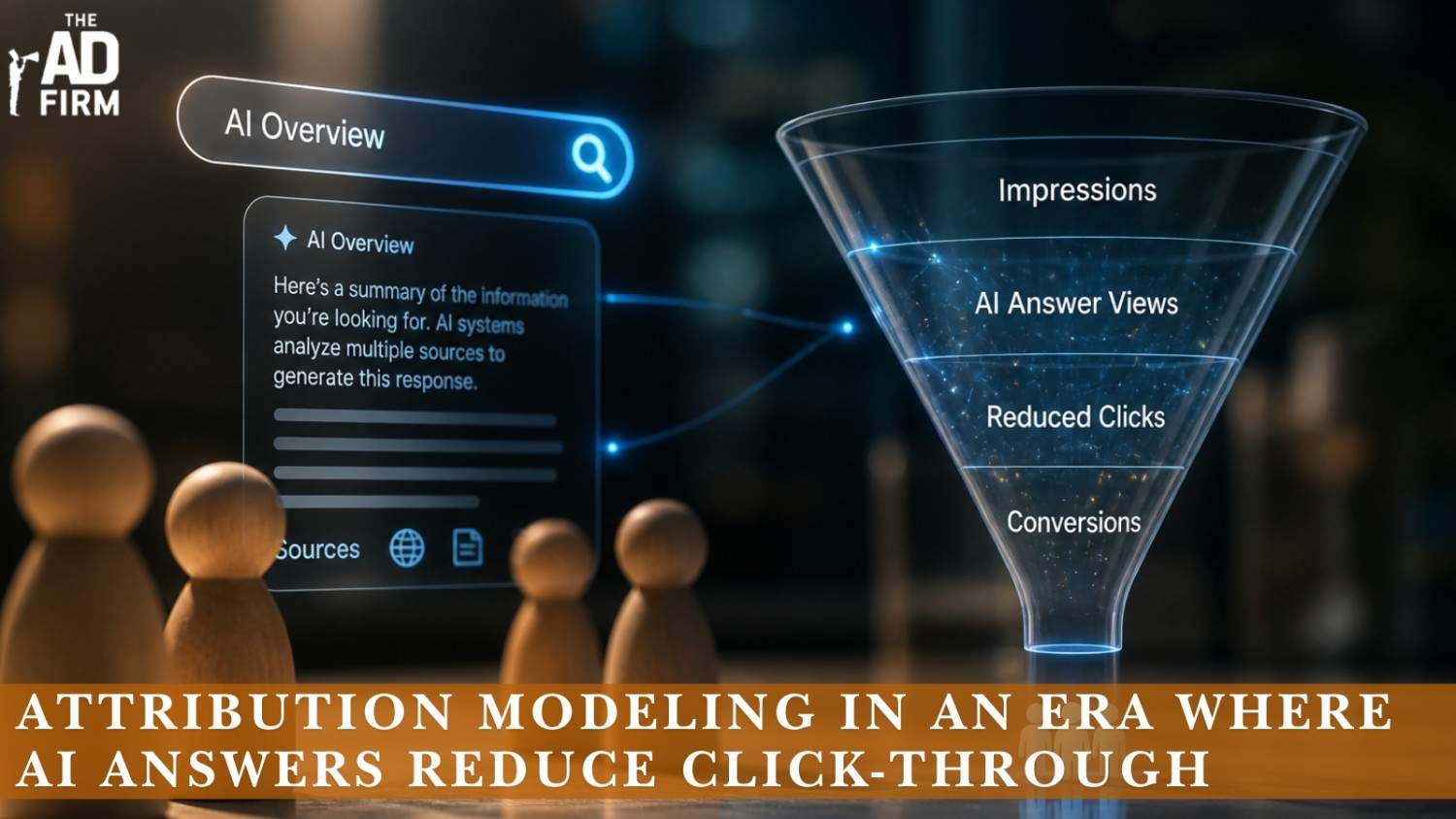
Zero-click searches now dominate. Similarweb data shows that for AI Overview-triggered results, the median zero-click rate reaches 80%. Around 93% of AI Mode searches end without a click, according to Semrush’s 2025 analysis. When AI answers satisfy user intent on the search results page itself, the traditional measurement chain of query → click → session → conversion breaks at the first link.
This creates what ALM Corp describes as “attribution blindness”: zero-click impressions significantly influence later conversions, but they rarely receive proper credit in analytics or revenue attribution models. Your most valuable visibility efforts go unrecognized.
The problem isn’t that AI SEO doesn’t work. The problem is that the tools most businesses use to measure SEO were designed for a click-based web. AI search operates on a citation-based, impression-driven model that those tools can’t fully capture.
Why Click-Based Attribution Fails in a Zero-Click Environment
Last-touch attribution, the default model in most GA4 setups, credits the final interaction before conversion. If a user arrives via a branded Google search and fills out a form, GA4 credits “organic search.” Clean and simple.
But what actually happened may look like this: the user asked ChatGPT for a recommendation, saw your brand cited, searched your name on Google two days later, visited your site, and converted. The AI interaction that created purchase intent receives zero credit because it didn’t produce a trackable click.
Maximize Your Online Impact with The Ad Firm
- Local SEO: Capture the local market with strategic SEO techniques that drive foot traffic and online sales.
- Digital PR: Boost your brand’s image with strategic digital PR that connects and resonates with your audience.
- PPC: Implement targeted PPC campaigns that effectively convert interest into action.
Search Engine Land’s 2026 analysis puts it directly: “The teams that adapted best were those who stopped asking ‘What got the click?’ and started asking ‘What shaped the decision?'”
What Happens Between the AI Answer and the Conversion
The gap between AI exposure and measurable conversion is where attribution models fail. The typical AI-influenced journey looks like this:
- Stage 1: AI exposure. A user asks ChatGPT, Perplexity, or Google AI Overviews a question like “What’s the best SEO agency in Southern California?” Your brand appears in the response as a citation or recommendation alongside two or three competitors. The user reads the answer. No click occurs.
- Stage 2: Brand imprint. The user registers your brand name and the context attached to it. The AI may have described your specialization, mentioned your review rating, or referenced a specific service. That association sticks, even if the user closes the tab and moves on to something else entirely.
- Stage 3: Delayed action. Hours, days, or even weeks later, the user is ready to take the next step. They don’t return to the AI platform. They search your brand name on Google (“The Ad Firm reviews” or “The Ad Firm SEO”) or type your URL directly into their browser. Some users skip search altogether and call the number they find on your Google Business Profile.
- Stage 4: Conversion. The user fills out a form, makes a call, or requests a consultation. GA4 records the session source as “branded organic” or “direct” and credits the last touchpoint. The AI interaction that created the initial purchase intent receives zero attribution.
This pattern plays out at scale. Multiply it across hundreds of queries per month where your brand gets cited by AI platforms, and a meaningful percentage of your branded search growth and “unexplained” direct traffic likely traces back to AI-driven discovery. The challenge is that no current analytics platform connects Stage 1 to Stage 4 automatically. The AI citation, the branded search, and the conversion exist as separate data points in separate systems with no native linkage.
That’s why proxy metrics and blended frameworks matter. You can’t track the individual journey end to end, but you can track the aggregate pattern: rising AI citations, followed by rising branded search volume, followed by rising direct traffic, followed by stable or improving conversion rates. When those four signals move together, the attribution story writes itself, even without a single click from the AI answer.
Elevate Your Market Presence with The Ad Firm
- SEO: Boost your search engine visibility and supercharge your sales figures with strategic SEO.
- PPC: Target and capture your ideal customers through highly optimized PPC campaigns.
- Social Media: Engage effectively with your audience and build brand loyalty through targeted social media strategies.
ALSO READ: Modeling Multi-Channel Leads Through GEO, Local SEO, and AI
Proxy Metrics That Capture AI-Influenced Value
Since direct measurement of AI-driven impressions isn’t fully possible in GA4 or GSC today, the most effective approach uses proxy metrics that correlate with AI visibility activity.
Branded Search Lift as an AI Visibility Indicator
When AI platforms cite your business, users search for you by name afterward. Branded search volume in Google Search Console is one of the most reliable proxy signals for AI-driven awareness.
Track branded search impressions and clicks over time. If branded queries are growing while non-branded organic traffic is flat or declining, the pattern strongly suggests that AI visibility is creating awareness that manifests as brand searches. Research cited by AI attribution specialists confirms that branded search growth, direct traffic patterns, and brand impression increases are now used as primary proxies for AI-driven discovery and influence.
Filter GSC data for queries containing your brand name. Compare month-over-month and year-over-year trends. A sustained upward trend in branded impressions, even with flat click-through rates, indicates that more people are searching for you specifically, which is exactly what AI citation exposure produces.
Direct Traffic Correlation With AI Citation Activity
AI-referred visitors frequently appear as “direct” traffic in GA4 because many AI platforms don’t pass referral data consistently. When a user sees your brand in a ChatGPT answer and later types your URL directly, GA4 logs it as a direct session with no source attribution.
The attribution workaround: correlate spikes in direct traffic with periods of known AI citation activity. If you’re tracking AI mentions using tools like Otterly.ai, Semrush’s AI tracking, or manual prompt testing, overlay that citation data with your direct traffic timeline. Correlated spikes indicate AI-influenced visits being misclassified as direct.
ZeroClick Labs describes this as “triangulated attribution,” combining deterministic data (trackable AI referrals) with probabilistic estimation (correlating unexplained direct traffic with AI visibility signals).
Impression-to-Conversion Ratios in Search Console
GSC shows impressions for queries where your site appeared, including cases where the user didn’t click. In a zero-click environment, impressions with declining CTR don’t necessarily mean poor performance. They may indicate that your content is being surfaced in AI Overviews and featured snippets where users absorb information without clicking.
Amplify Your Market Strategy with The Ad Firm
- PPC: Master the art of pay-per-click advertising to drive meaningful and measurable results.
- SEO: Elevate your visibility on search engines to attract more targeted traffic to your site.
- Content Marketing: Develop and implement a content marketing strategy that enhances brand recognition and customer engagement.
Track conversion trends alongside impression trends. If GSC impressions remain stable or grow, CTR declines, but conversions (measured in GA4) hold steady or increase, your content is generating value through on-SERP visibility rather than click-through. This is the pattern of a functioning GEO strategy.
ALSO READ: How to Get Cited in Claude, Gemini, and Other AI Assistants
Setting Up GA4 to Track AI Referral Traffic
Not all AI traffic is invisible. Some platforms pass referral data that GA4 can capture if properly configured. Setting up AI-specific channel groupings surfaces the trackable portion of AI-driven visits.
Create a custom channel in GA4 with rules that capture known AI referral sources:
- Source contains “perplexity”
- Source contains “chatgpt” or “chat.openai”
- Source contains “claude.ai”
- Source contains “copilot.microsoft”
- Medium equals “referral” AND source matches any of the above
This isolates trackable AI referral sessions from general organic and direct traffic. The volume will be small relative to total traffic, but research from Frase.io shows that AI-referred visitors convert at 4.4x the rate of standard organic visitors and spend 68% more time on site. Even a small AI referral segment can represent disproportionate conversion value.
Monitor this channel monthly. Growth in AI referral sessions, combined with the proxy metrics above, gives you a more complete picture of how AI search is contributing to business outcomes.
Building a Blended Attribution Framework for GEO
No single metric captures AI search value. The most accurate approach combines trackable data with proxy signals into a blended framework.
Layer 1: Trackable AI traffic. GA4 AI referral channel, as configured above. This is your hard data floor.
Layer 2: Branded search lift. GSC branded query trends. Growth here suggests AI-driven brand awareness that converts through search.
Layer 3: Direct traffic correlation. Overlay direct traffic patterns with AI citation monitoring. Unexplained direct traffic growth during active AI visibility periods is likely AI-influenced.
Layer 4: Impression value. GSC impressions without clicks, particularly for queries where AI Overviews are present. These represent on-SERP brand exposure.
Advance Your Digital Reach with The Ad Firm
- Local SEO: Dominate your local market and attract more customers with targeted local SEO strategies.
- PPC: Use precise PPC management to draw high-quality traffic and boost your leads effectively.
- Content Marketing: Create and distribute valuable, relevant content that captivates your audience and builds authority.
Layer 5: Conversion quality. Track lead quality metrics (sales-qualified lead rate, average deal size, close rate) alongside the layers above. If AI visibility is working, leads arriving through branded search and direct channels should show higher intent and faster close times than non-branded organic leads.
The goal isn’t perfect attribution. It’s directional accuracy that connects AI visibility investment to business outcomes with enough confidence to justify and scale the strategy.
Attribution windows matter too. Standard 7-day attribution windows miss AI influence entirely. Research from AI attribution specialists recommends extending to 30-60 days minimum, since the gap between AI citation exposure and conversion action is often measured in weeks, not hours.
ALSO READ: What 2026 Data Reveals About AI Overviews and Answer Engine Optimization
Measure Influence, Not Just Clicks
The businesses that justify and grow their SEO and GEO investment in 2026 are the ones that evolve their measurement alongside their strategy. If you’re building AI search visibility through structured content, reputation signals, and generative engine optimization, but still measuring success exclusively through organic sessions, the dashboard will always look worse than reality.
AI answers reduce clicks. They don’t reduce business value. They shift where that value shows up: in branded search growth, in higher-intent direct traffic, in conversion quality improvements, and in the steady stream of prospects who arrive pre-qualified because an AI platform already recommended you.
The measurement framework matters as much as the strategy itself. Build both, or risk cutting the investment that’s quietly driving your best leads.
The Ad Firm builds SEO and GEO strategies with measurement frameworks that capture AI-influenced value alongside traditional traffic metrics. Talk to our team about connecting your AI visibility to the business outcomes it actually drives.