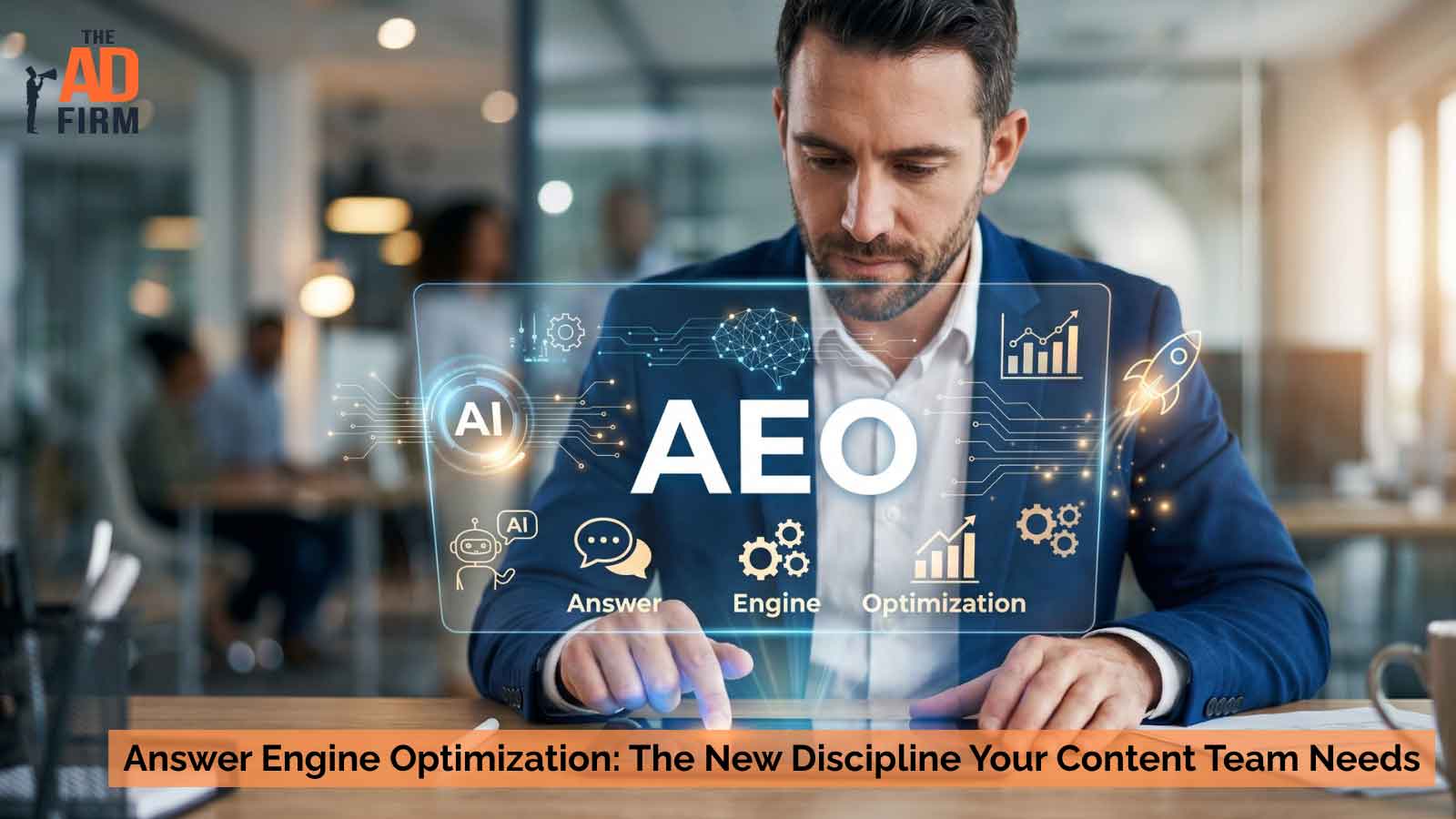
Search is no longer only about ranking pages. It is about becoming the cited answer inside ChatGPT, Gemini, Perplexity, and other AI-driven search tools. Your team may already have strong SEO performance, solid rankings, and a technically sound website, but your competitors can still appear in AI responses while your content gets overlooked.
That visibility gap is why answer engine optimization (AEO) matters. AEO helps your content become easier for AI platforms to understand, trust, and reference when users ask questions related to your business, services, or industry. As AI-driven search grows, your content needs to do more than rank. It needs to answer clearly, prove authority, and give search engines and AI platforms a reason to cite it.
Content teams that wait 12 months to adopt AEO are entering a category where 76% of AI citations already go to pages with established top-10 rankings, pages your competitors are now optimizing for AI extraction. The window to build that authority before your category gets crowded is open right now.
What Answer Engine Optimization Actually Is
Answer engine optimization is the process of formatting, supporting, and updating content so AI tools can select it as a reliable source for generated answers. It focuses on making your content eligible, credible, and useful enough to appear when users ask direct questions through AI-driven search platforms. If you are comparing answer engine optimization vs. generative engine optimization, a separate post breaks down the difference.
How AI Selects Fragments Instead of Ranking Pages
Krishna Madhavan, principal product manager on the Bing team, described the mechanic in October 2025. AI assistants break content down through parsing, evaluate each piece for authority and relevance, and then assemble fragments from multiple sources into a single response. This insight should shape how your team approaches AEO and SEO decisions.
Your page can rank No. 1 on Google and never appear in an AI answer if its content is not structured in extractable fragments. Readers who want more can start with topic-first content is replacing keyword-first pages in AI search results. According to Semrush data, AI Overviews now appear on a significant share of Google queries, with healthcare seeing notably higher rates than the overall average. For more detail, see the key differences between a featured snippet and an AI overview.
Why AEO Is Not a Replacement for SEO
AEO and AI retrieval still depend on traditional search foundations. Ahrefs analyzed 1.9 million citations across 1 million AI Overviews and found that 76% of citations come from pages already ranking in Google’s top 10. The median position of the most-cited URLs was 2. Traditional ranking is the entry ticket. Readers who want more can start with 2026 data on AI Overviews and AEO. Citation is what wins the answer. Whether AI search will replace featured snippets is a related question that gets its own post.
How Content Teams Can Turn AEO Into a Repeatable Workflow
AEO is not a small content tweak. It changes how your team plans, reviews, updates, and measures content. The goal is to build a repeatable process for creating, validating, refreshing, and measuring answer-ready content.
Updating Briefs With AEO Requirements
Update briefs so every assignment includes target questions, required sources, schema needs, internal links, entity definitions, and refresh criteria. This gives writers, editors, SMEs, and technical teams the same standard before drafting begins. For more detail, see writing for humans and AI at the same time.
Each brief should also identify the page’s role in the larger content system. A blog post, service page, comparison guide, and FAQ page may support different parts of the search journey, so your team should define the purpose before writing.
Adding SME Reviews and Source Requirements
Subject matter experts should review claims that involve technical recommendations, industry data, platform behavior, or service-specific guidance. Their input helps your content move beyond generic explanations and gives readers more useful context.
Set source requirements before content reaches editing. Require current statistics, credible references, relevant examples, and clear explanations for claims that could influence a business decision.
Creating Schema and Technical Review Steps
AEO and AI performance depend on both content quality and technical clarity. Add schema checks, visible HTML reviews, crawler permission checks, and internal linking reviews to your publishing workflow.
This step helps your team catch issues before publication, such as missing FAQPage schema, outdated Organization details, important answers hidden in accordions, or blocked crawlers that should have access.
Assigning Refresh Schedules
Assign refresh owners and review dates to high-value pages, especially pages that cite statistics, pricing, platform features, or industry benchmarks. This keeps your content current and reduces the risk of AI systems pulling fresher answers from competitors.
Refresh schedules should include more than date changes. Review the answer quality, source accuracy, schema markup, internal links, and citation opportunities each time the page is updated.
Measuring Performance Beyond Rankings
Performance reviews should track AI Overview presence, citation rates, brand mentions, ChatGPT referrals, assisted conversions, and question-led visibility alongside traditional SEO metrics. Another post explains why traditional SEO metrics don’t tell the full story in AI search.
This gives your team a clearer view of how AEO affects discovery, not just rankings. It also helps you identify which pages are citation-ready and which need stronger structure, schema, source support, or expert input. To go deeper, read what content performs best in AI search results.
RELATED ARTICLE: How to Structure Internal Links for Better AI Comprehension
The Research Behind What Gets Cited
A lot of AEO advice sounds more complicated than it needs to be. The peer-reviewed research that emerged in 2024 and 2025 tells a clearer story.
The Princeton GEO Study and the 40% Visibility Lift
The “GEO: Generative Engine Optimization” study from Princeton, IIT Delhi, and Georgia Tech, published at KDD 2024, tested nine optimization strategies and found that GEO techniques improved visibility in AI responses by up to 40%. One of the strongest findings was that citing credible sources increased visibility by 115.1% for sites that were not already ranking in top positions.
The takeaway for your content is direct: AI does not reward hype. It rewards evidence. Strong sources, factual support, and clear explanations matter more than persuasive language alone.
What this means for your content team: Audit your highest-traffic pages and ask one question of each: where are the citations? If a page makes claims without linking to credible third-party sources, that page is leaving citation potential on the table. Add a “sources required” line to every brief, and require writers to cite at least two authoritative references for any data point or recommendation. The 115.1% lift came from this single change.
Why Earned Media Dominates AI Citations
A 2025 University of Toronto study found that AI platforms cite third-party authoritative sources far more often than owned brand content. In consumer electronics, AI cited third-party sources 92.1% of the time, compared to Google’s 54.1%. Automotive showed the same pattern, with AI citing third-party sources 81.9% of the time versus Google’s 45.1%.
That matters for your content strategy. Press coverage, independent reviews, expert mentions, and trusted third-party references can strengthen your authority beyond your own website. AI platforms look for outside validation, not just what a company says about itself.
What this means for your content team: Your content team cannot win AI citations alone. Coordinate with your PR or digital PR partner to land expert commentary, data contributions, and quotes in industry publications. Track which third-party mentions get cited in AI responses for your target queries, then double down on those publications. Owned content is the floor. Earned media is the ceiling.
What 1,702 Real Citations Revealed
The GEO-16 framework analyzed 1,702 real citations from Brave, Google AI Overviews, and Perplexity. The top on-page factors tied to citation were metadata and freshness, semantic HTML, and structured data. Title tags and meta descriptions for AI-first search are covered in a separate guide. Carnegie Mellon’s 2025 AutoGEO study also found that AI engines prefer comprehensive coverage, factual accuracy, clear structure, and direct answers. A separate guide covers writing a direct answer paragraph for AI engines.
A Columbia and MIT study added an important reality check. Many common rewriting tactics produced little or no benefit. The strategies that worked focused on truthfulness, search intent, and clear differentiation. For your team, that means AEO is not about tricks. It is about building content that answers better than the alternatives.
What this means for your content team: If you have to choose where to invest first, start with the pages that already rank in Google’s top 10. Ahrefs found 76% of AI citations go to those pages, with the median citation position at No. 2. Apply structural fixes (semantic HTML, clear headings, fresh metadata, FAQPage schema) to those pages first. New content can wait. Existing top-ranking pages are the fastest path to AI citations.
Authority Signals AI Systems Look For
Authority signals help AI decide whether your answer deserves to be included over another source. The research points to a practical standard: your content should show who created it, why it can be trusted, and what evidence supports the claim.
E-E-A-T Beyond Google
Experience, Expertise, Authoritativeness, and Trustworthiness no longer apply only to Google rankings. Microsoft’s October 2025 baseline also calls for content that is fresh, authoritative, structured, and semantically clear.
Show authority with expert bylines, reviewer credentials, updated statistics, source links, original examples, case studies, and clear explanations of how you reached a recommendation. These details give AI systems stronger reasons to treat your content as a reliable source.
Freshness as a Citation Signal
Krishna Madhavan said at Pubcon Cyber Week that stale or missing content limits what AI can retrieve and may push agents toward other sources.
Your team should update content with current dates, recent statistics, revised examples, and accurate service details. Pairing those updates with IndexNow can help signal revisions faster, so AI crawlers can see changes within hours instead of weeks.
Entity Clarity and Third-Party Validation
AI systems need to understand who your company is, what services you offer, where you operate, and why your content deserves trust. Clear Organization schema, consistent company information, author details, and service descriptions help reinforce those signals.
Third-party validation strengthens that picture. Industry citations, expert mentions, and customer proof confirm that your brand is recognized beyond its own website, giving AI platforms additional context to verify your authority.
Content Structure That Earns AI Citations

Clear formatting helps AI identify complete answers, separate supporting details, and pull the right section into a generated response. Strong structure also helps your readers scan the page, find the answer they need, and understand what to do next. A separate guide covers structuring a blog post for AI Overviews.
Heading Hierarchy as a Signal to AI
Strong headings help AI understand where one idea starts and ends. Microsoft describes headings as signals that guide AI systems through your content structure.
Avoid vague headings like “Learn More” or “Overview.” Use descriptive H2 and H3 headings that focus on one clear idea. The more specific your headings are, the easier it is for AI to identify the question each section answers.
Question-and-Answer Pairs Lifted Word for Word
Microsoft notes that AI assistants can often lift question-and-answer pairs directly into AI-generated responses. Use that behavior to your advantage.
Write questions as headings, then answer them immediately below. Match how your audience actually searches by using patterns like “what,” “how,” “best,” “vs,” and “for.” This helps your content align with the way people ask questions in AI search.
Snippable Formats and Self-Contained Sections
Use formats that can stand alone, such as definitions, numbered steps, short lists, comparison blocks, and direct explanations. These formats make your content easier for AI systems to evaluate and for readers to use. GEO content formats that win in AI Overviews is the next read if you want more detail.
Place the direct answer at the top of each section, then add context. Write each section so it answers one question without relying on the previous section for context.
Building Reusable Answer Modules
Create reusable content blocks for definitions, steps, comparisons, pros and cons, FAQs, and common objections. These modules help your team move faster across blogs, service pages, landing pages, and support content.
Treat these modules as part of a larger content system, with consistent definitions, verified sources, version control, and refresh schedules instead of one-off page updates.
The Hidden Content Problem
Microsoft warns against hiding important answers in tabs, accordions, or expandable menus. AI systems may not render content that requires a click or interaction.
That means FAQ answers, product details, service information, and key explanations should appear in visible HTML. If the information matters to your audience, make it easy for both readers and AI systems to find.
Schema Markup That Helps AI Understand Your Content
Schema markup gives machines structured context about your content, classifying pages with confidence and connecting them to the right topic, entity, or intent. As Krishna Madhavan explained at Pubcon, schema removes the guesswork.
For AI citations, prioritize these schema types:
- FAQPage for question-and-answer content
- HowTo for step-by-step instructions
- Product with Offer, AggregateRating, and Review for ecommerce pages
- Article or BlogPosting for authored content
- Organization for business identity
Crawler Permissions That Affect AI Search Visibility
Crawler settings affect whether AI platforms can access your content for search, training, or both. Your team should understand these differences before blocking bots broadly.
Controlling Who Crawls Your Site
AI search engines use different crawlers for search access and training access. Knowing the difference helps your team protect content while still allowing visibility in AI search.
Common crawlers include:
- OAI-SearchBot for ChatGPT search
- GPTBot for OpenAI training
- Bingbot for Microsoft Copilot
- Googlebot for Google AI Overviews
- Google-Extended for Gemini training
- PerplexityBot for Perplexity search and indexing
- ClaudeBot for Anthropic
OpenAI offers a clearer separation between search and training. You can allow OAI-SearchBot for ChatGPT search while blocking GPTBot from training. Google’s controls are less granular. Blocking Google-Extended prevents Gemini training, but it does not affect AI Overviews.
One caveat: Cloudflare reported in August 2025 that Perplexity used undeclared crawlers with rotating IPs and spoofed user agents to bypass no-crawl directives. Perplexity disputed the claim, but your team should know the risk when setting crawler rules.
Measuring AI Visibility in 2026
Citation is becoming a new performance signal. Traditional rankings still matter, but AI Overviews and AI-generated answers can change how users click, compare, and choose businesses.
Ahrefs found that AI Overviews correlate with a 58% lower click-through rate for the No. 1 organic result. Seer Interactive reported a 61% organic CTR drop for AI Overview queries. The upside is just as important: being cited in an AI Overview can drive 35% more organic clicks than not being cited.
Conductor’s January 2026 report found that 87.4% of AI referral traffic comes from ChatGPT. That makes ChatGPT visibility a priority for content teams tracking AI search performance.
A practical measurement stack includes:
- Bing Webmaster Tools AI Performance Report for free Copilot citation data
- Profound for citations across ChatGPT, Perplexity, Copilot, and Google AI Overviews
- Peec.ai for brand mentions across ChatGPT, Gemini, Claude, and Perplexity
- utm_source=chatgpt.com in your analytics to track ChatGPT referrals
Your team should measure AI Overview presence, rankings, impressions, conversions, assisted traffic, ChatGPT referrals, brand mentions, and citation rates together. AEO performance is not just about whether your page ranks. It is about whether AI systems cite your brand when your audience asks buying-stage questions.
LEARN MORE: How to Get Cited in Claude, Gemini, and Other AI Assistants
Make Your Content Easier for AI to Cite
AEO is a new discipline because it changes what content teams produce, how they review it, and how they measure success, not just where it ranks. Briefs look different. Refresh schedules become standard. Performance reviews track citation rates alongside rankings. Teams that operationalize this shift now build clearer content systems before their categories become more competitive in AI search. The difference between content that ranks and content that gets cited by AI is covered in a separate post.
If your team is ready to turn AEO from a test into a repeatable strategy, The Ad Firm can help. As an experienced AEO agency, we help identify which pages are citation-ready and which need stronger structure, schema, source support, or citation tracking to compete in AI-generated answers.