Most businesses pour money into social ads and wonder why results stay flat. They run conversion campaigns to cold audiences, expecting strangers to buy on first contact. This approach ignores how people actually make purchasing decisions.
Full-funnel social media advertising takes a different approach. You guide potential customers through every stage of the customer journey, delivering the right message at the right time. Instead of asking for the sale immediately, you build awareness, nurture interest, and remove friction before asking anyone to convert.
This strategy works for any business model. Ecommerce brands, local service providers, B2B companies, and lead generation businesses all benefit from funnel thinking. The tactics adjust based on your sales cycle and conversion events, but the underlying framework stays consistent.
What Makes Full-Funnel Social Advertising Different
Running only bottom-funnel ads to cold audiences creates a fundamental mismatch. People scrolling through Instagram or TikTok aren’t searching for solutions the way Google users are. They’re browsing entertainment, catching up with friends, and discovering new content.
When you interrupt that experience with a hard sell, most users scroll past. The small percentage who do click often bounce quickly. Your cost per acquisition climbs, and your social advertising ROI suffers. You might generate some sales today, but you aren’t building the audience relationships that produce sales tomorrow.
A complete social media advertising strategy connects multiple campaign types into a unified system. Each stage feeds the next, creating a pipeline that compounds results over time. You benefit from lower costs at each stage since warmer audiences convert at higher rates. Your leads improve in quality because prospects who engage with multiple touchpoints understand your offering before they buy.
The Four Funnel Stages at A Glance
Platform pixels track who watches your videos, visits your website, or engages with your content. Those users are automatically included in your consideration audiences. Consideration campaigns warm these prospects until they show purchase signals, such as adding items to the cart or viewing pricing pages. After purchase, customers move into retention campaigns that encourage repeat buying. Their testimonials and user-generated content feed back into awareness campaigns, creating a self-reinforcing cycle.
Understanding how traffic moves through your funnel helps you identify gaps and optimize performance at each level.
| Stage | What Happens |
| Stage 1: Awareness | Cold audiences encounter your brand for the first time. You prioritize reach and engagement over immediate sales. Success means capturing attention and earning the right to follow up. |
| Stage 2: Consideration | Engaged users receive remarketing that builds trust. You address objections, showcase proof, and educate prospects. Success means moving users closer to purchase intent. |
| Stage 3: Conversion | High-intent prospects receive direct offers with clear calls to action. You remove friction and create urgency. Success means turning warm leads into paying customers. |
| Stage 4: Retention | Existing customers receive ongoing engagement that drives repeat purchases and referrals. Success means increasing lifetime value and generating advocacy. |
Full-Funnel Social Media Advertising: A Complete Strategy Guide
Stage 1: Awareness (Top of Funnel)
The awareness stage reaches people who don’t know your brand exists. Your goal isn’t to sell anything yet. You want to capture attention, spark curiosity, and make a memorable first impression that fills the top of your pipeline.
Creative Strategy
Your awareness needs to stop the scroll. Users aren’t looking for you, so your content must interrupt their browsing pattern with something unexpected, emotionally resonant, or immediately valuable.
Focus on identity-based messaging that helps users see themselves in your content. Ask questions that surface pain points. Show scenarios that your ideal customer recognizes. Make prospects think “that’s me” before you ever mention your product.
Effective awareness formats include:
- Behind-the-scenes footage that humanizes your brand
- Educational snippets that provide value without asking for anything in return
- Entertaining content that aligns with your brand personality
- Influencer partnerships that borrow credibility and reach new audiences
Avoid product features, pricing, or hard calls to action at this stage. You’re earning attention, not asking for commitment.
Targeting Cold Audiences
Lookalike audiences offer one of the most powerful targeting options. Facebook and Instagram analyze your existing customers and identify new users with similar characteristics. You expand reach without sacrificing relevance.
Interest-based targeting works well if you have a clearly defined customer profile. If you sell hiking gear, targeting outdoor enthusiasts, camping hobbyists, and fitness-focused users puts your message in front of receptive audiences. Demographic targeting adds another layer through age, location, income level, and life events.
Metrics and Timeline
Track reach, impressions, video completion rates, engagement rate, and cost per thousand impressions. Low CPMs with strong engagement rates indicate healthy awareness campaigns.
Awareness campaigns rarely generate direct sales, and expecting them to create misaligned optimization. If you judge awareness on ROAS, you’ll cut spending that fills your future pipeline. Evaluate awareness on stage-appropriate metrics and trust that strong performance translates to downstream conversions over time.
You’ll see reach, impressions, and engagement data within the first few days of launching campaigns. CPMs stabilize within one to two weeks as algorithms optimize delivery. Poor performance at this stage often indicates targeting problems or creativity that doesn’t resonate.
Stage 2: Consideration (Middle of Funnel)
Prospects who engage with awareness content know your brand exists. Now they need reasons to trust you and consider your offering seriously. The consideration stage builds that trust through targeted remarketing that addresses specific questions and concerns.
For lead-generation businesses, the consideration stage is especially important. Prospects can’t evaluate a physical product before committing, so they rely heavily on trust signals, case studies, and educational content to feel confident moving forward.
Creative Strategy
Your creative consideration should lead with evidence. Show results, not promises. Feature real customers, real numbers, and real transformations.
Consideration ads should build confidence through:
- Testimonial videos featuring satisfied customers who faced similar challenges
- Product demonstrations that show your offering in action
- Case studies highlighting specific results and outcomes
- Comparison content that helps prospects evaluate options
Educational content works well here because prospects actively seek information during evaluation. Teach them something useful. Help them understand their problem better. Position your brand as the knowledgeable guide who can solve it.
Remarketing and Dynamic Creative
Your social media remarketing strategy should target users based on their previous interactions. Someone who watched 75% of your awareness video clearly showed interest and deserves different messaging than a cold audience member.
Build your consideration campaigns around the objections your sales team hears most often. You’re answering the questions prospects ask themselves:
- Does this actually work?
- Can I trust this company?
- Is this worth the investment?
Dynamic creative lets you show different ad variations to users based on their behavior:
- Someone who viewed a specific product page sees ads featuring that exact product
- Someone who browses a category sees a selection of relevant options
- Someone who abandoned checkout sees reminders with the items they left behind
This personalization is handled automatically by platform algorithms. You provide the creative assets, and the system assembles the most relevant combination for each user.
Metrics and Timeline
Monitor website traffic, time on site, pages per session, add-to-cart rate, lead form completions, and content engagement. When these metrics trend upward, your consideration campaigns are working, and prospects are moving closer to purchase.
Consideration campaigns need time to build remarketing audiences. Your results here depend directly on awareness campaign performance. Expect two to four weeks before consideration metrics stabilize. If these metrics remain flat after four weeks, review your creative and audience definitions.
Read More: Analyzing Social Media Metrics for Campaign Improvement
Stage 3: Conversion (Bottom of Funnel)
Bottom-funnel campaigns target high-intent users who have demonstrated clear purchase interest. These prospects have engaged with your awareness content, consumed your consideration messaging, and shown behavioral signals that indicate readiness to buy. Your job now is to remove every possible barrier between interest and purchase.
Lead generation funnels replace purchase events with form submissions, calls, or appointment bookings. The conversion tactics remain similar: clear offers, urgency where appropriate, and friction-free paths to action.
Creative Strategy
Your conversion creative should make action obvious and immediate. Strip away complexity. Show the product, state the offer, and tell users exactly what to do next.
Effective conversion tactics include:
- Limited-time offers with clear deadlines
- Exclusive discounts for engaged audiences
- Free shipping thresholds that reduce friction
- Bundle deals that increase average order value
Urgency elements like countdown timers, limited inventory notices, and expiring discounts push fence-sitters to decide. Social proof elements like review counts and bestseller badges provide final reassurance.
Abandoned cart recovery campaigns target users who added products but didn’t complete checkout. These ads remind users what they left behind and often include an incentive to finish the purchase. Recovery campaigns frequently deliver the highest ROAS of any campaign type.
Landing Page Optimization
Your ad is only half the equation. The landing page experience determines whether clicks become customers. Social traffic requires mobile-optimized landing pages since most users arrive on smartphones.
Key elements for high-converting landing pages:
- Trust badges and security indicators that reduce purchase anxiety
- Streamlined checkout with minimal form fields
- Multiple payment options, including digital wallets for one-click purchase
- Clear return policies that eliminate risk concerns
Every extra step in your checkout process loses a percentage of buyers, so audit your conversion path and eliminate anything that doesn’t directly support purchase completion.
Metrics and Timeline
Conversion results require warmed audiences to reach critical mass. New accounts or campaigns typically need 30 to 60 days before conversion metrics become reliable. Full optimization often takes 90 days.
Early conversion campaigns may show volatile ROAS as algorithms learn and audiences build. Resist the urge to judge performance too quickly or to make dramatic changes before sufficient data has accumulated.
Stage 4: Retention (Post-Purchase)
The purchase isn’t the end of the funnel. Existing customers cost far less to reach than new prospects, and their lifetime value multiplies when you maintain the relationship.
Creative Strategy
Post-purchase advertising brings customers back for additional purchases. Email retargeting combined with social ads keeps your brand present without being intrusive.
Focus your retention efforts on:
- Personalized product recommendations based on purchase history
- Loyalty program promotions that reward repeat purchases
- Cross-sell campaigns featuring complementary products
- Replenishment reminders for consumable products
Leveraging User-Generated Content
Satisfied customers become your most credible marketing asset. When they share their experiences, that content carries authenticity that polished brand messaging cannot match.
Encourage user-generated content through hashtag campaigns, review incentives, social contests, and customer spotlight features. Real customer photos, videos, and testimonials perform exceptionally well when recycled into awareness campaigns for new audiences.
Metrics and Timeline
Track repeat purchase rate, customer lifetime value, and referral activity. Initial retention campaigns may yield modest results, which improve as more customers enter your post-purchase sequences. These metrics become increasingly significant as your business matures.
How Full-Funnel Social Ads Differ by Platform
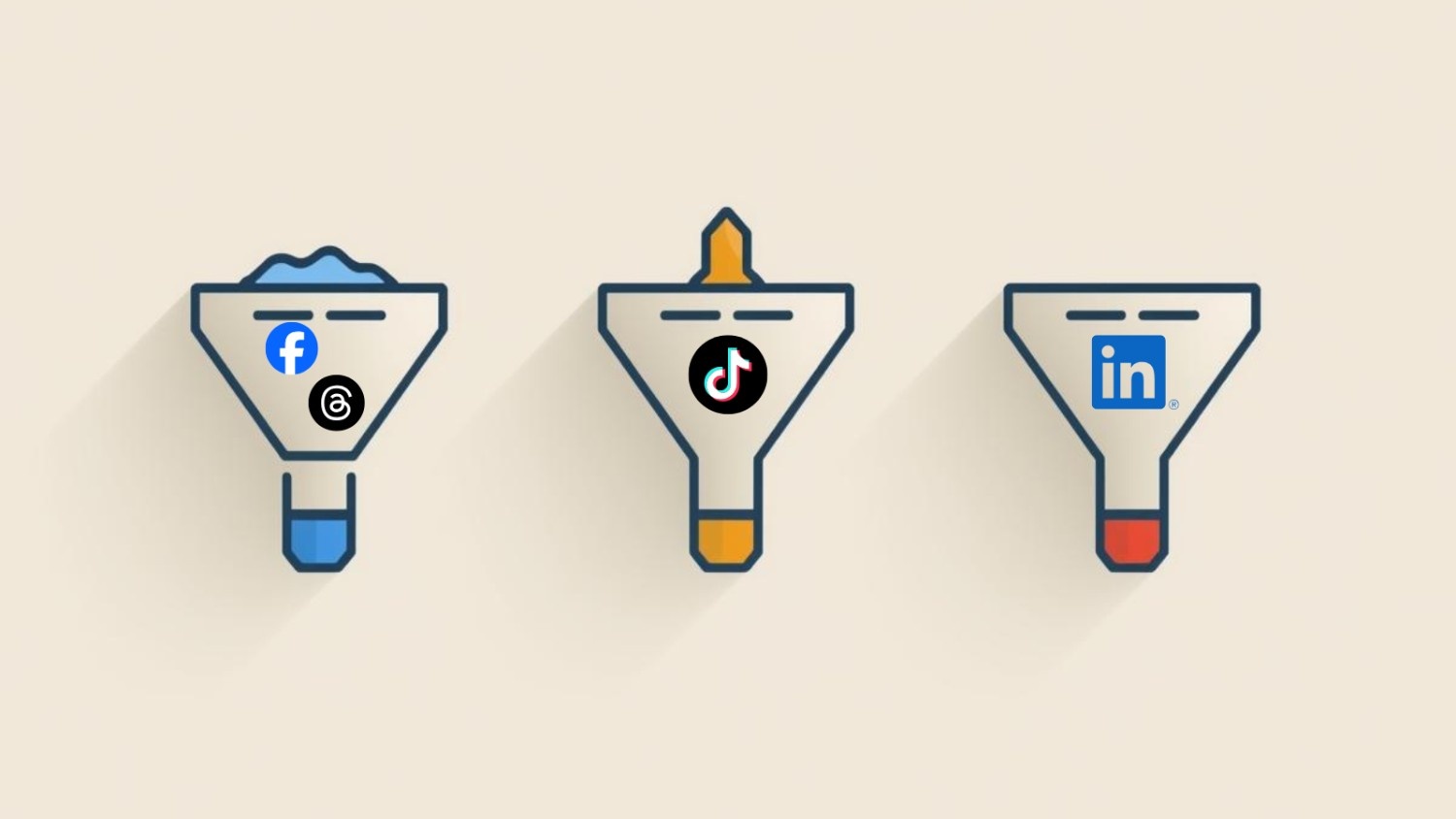
Each platform has unique strengths at different funnel stages. Understanding these differences helps you allocate budget and creative resources effectively.
Facebook and Instagram
Meta’s platforms offer the most mature full-funnel infrastructure. Robust pixel tracking, extensive custom audience options, and sophisticated optimization algorithms make Facebook and Instagram ideal for complete funnel execution.
Facebook excels at consideration and conversion stages due to its detailed targeting options and strong intent signals. Instagram performs well for awareness and consideration, particularly with visual products and younger demographics. Both platforms support dynamic creatives and advanced retargeting.
TikTok
TikTok dominates awareness for audiences under 35. Its algorithm surfaces content to users who haven’t followed you, making organic and paid reach highly efficient. The platform rewards authentic, entertaining content over polished advertising.
TikTok’s conversion capabilities are improving, but still lag behind Meta. Use TikTok primarily for top-of-funnel visibility and brand building, then retarget engaged users on Facebook and Instagram to drive conversions.
LinkedIn serves B2B funnels better than any other platform. Its professional targeting options let you reach decision-makers by job title, company size, industry, and seniority level.
LinkedIn costs more per impression than other platforms, so awareness campaigns require larger budgets. The platform performs best at the consideration and conversion stages, where precise targeting justifies higher costs. Use LinkedIn for account-based marketing and high-ticket B2B offers.
Technical Requirements for Full-Funnel Advertising
Effective full-funnel advertising requires a technical infrastructure that tracks users across stages and enables precise targeting. Set up these components before launching campaigns.
Pixel Installation and Conversions API
Install platform pixels on every page of your website. The Meta pixel, TikTok pixel, and LinkedIn Insight Tag track user behavior and enable retargeting. Configure standard events like page views, add to cart, initiate checkout, and purchase.
Server-side tracking via the Conversions API improves data accuracy, as browser privacy restrictions limit the effectiveness of pixels. This setup sends conversion data directly from your server to ad platforms, capturing events that cookies miss.
Custom Audience Structure
Build custom audiences for each funnel stage. Create lookalike audiences based on customers, website visitors, and email lists for awareness. Build consideration audiences from users who engaged with awareness content, visited your website, or watched videos. Define conversion audiences from users who added to cart, viewed pricing, or completed lead forms. Segment past purchasers by recency and purchase value for retention.
Event Prioritization and CRM Integration
Platform algorithms need clear signals about which events matter most. Prioritize your conversion events by business value. For ecommerce, this typically means purchase, initiate checkout, add to cart, and view content. For lead generation, prioritize form submissions, then page views of high-intent pages.
Connect your CRM to ad platforms to track offline conversions. If your sales process involves phone calls, in-person meetings, or delayed purchasing decisions, offline conversion imports show ad platforms to which users eventually became customers.
Budget Allocations by Business Model
Budget distribution varies based on your sales cycle, average order value, and customer acquisition goals. These examples provide starting frameworks you can adjust based on performance data.
Full-funnel strategies work at various budget levels. Smaller budgets can still implement funnel principles by focusing on fewer platforms and simpler audience structures. The key is maintaining adequate investment at each stage rather than starving one level to overfund another.
Ecommerce Brand
Ecommerce businesses typically need significant investment in awareness to maintain pipeline volume. Shorter sales cycles allow faster budget movement between stages.
- Awareness: 35 to 40 percent
- Consideration: 25 to 30 percent
- Conversion: 25 to 30 percent
- Retention: 10 percent
Focus awareness spending on new customer acquisition. Shift budget toward conversion during peak selling seasons and promotional periods.
Local Service Business
Local businesses benefit from targeted, geographically focused marketing that reduces wasted awareness spend. Consideration stages often include phone calls and consultations rather than website actions.
- Awareness: 25 to 30 percent
- Consideration: 35 to 40 percent
- Conversion: 25 to 30 percent
- Retention: 10 percent
Invest heavily in content that builds trust and demonstrates expertise. Reviews, before-and-after content, and local testimonials perform well.
B2B Lead Generation
B2B sales cycles tend to run longer when multiple decision-makers are involved. Awareness budgets must sustain extended consideration periods.
- Awareness: 30 to 35 percent
- Consideration: 40 to 45 percent
- Conversion: 15 to 20 percent
- Retention: 5 to 10 percent
Prioritize consideration of content that educates and nurtures. Gated resources, webinars, and case studies move prospects through lengthy evaluation processes.
High-Ticket Direct-to-Consumer
High-ticket items require significant trust-building before purchase. Customers research extensively and need multiple touchpoints.
- Awareness: 30 percent
- Consideration: 40 percent
- Conversion: 20 percent
- Retention: 10 percent
Invest in detailed product demonstrations, customer testimonials, and comparison content during the consideration phase. Conversion campaigns should address final objections and offer reassurance through guarantees and return policies.
Common Mistakes to Avoid
Even well-intentioned full-funnel strategies fail when execution goes wrong. These mistakes undermine performance and waste the budget.
Skipping the Consideration Stage
Many advertisers jump directly from awareness to conversion, expecting cold audiences to buy after minimal exposure. This approach overwhelms prospects and produces weak results. The consideration stage builds the trust necessary for conversion success.
Retargeting Too Aggressively
Bombarding prospects with constant remarketing ads creates annoyance rather than conversions. Set reasonable frequency limits for each stage. Exclude recent converters from conversion campaigns. Rotate creative regularly to maintain freshness and prevent ad fatigue.
Insufficient Audience Separation
Overlapping audiences create internal competition and unclear attribution. If the same user appears in multiple campaigns simultaneously, you waste budget and confuse optimization algorithms. Define clear audience boundaries and use exclusions to keep each stage distinct.
Letting Creative Go Stale
Performance declines when audiences see the same ads repeatedly. Monthly refreshes represent the minimum for most accounts. High-spend accounts or competitive industries may need weekly updates. Watch frequency metrics and engagement rates as indicators.
Read More: Social Media Ad Fatigue: How to Combat It With Smarter Creative
What Successful Full-Funnel Campaigns Have in Common
Patterns emerge that separate high-performing full-funnel campaigns from those that struggle.
Consistent Performance Monitoring
High performers regularly compare stage-to-stage progression rates to find where prospects drop off. If awareness generates strong engagement but consideration metrics stay flat, they investigate remarketing gaps. If consideration shows activity but conversions remain low, they examine offers and landing pages. Clean data and proper audience separation make these patterns visible and actionable.
Patience With Optimization
Successful advertisers allow campaigns sufficient time to learn before making changes. They resist reactive adjustments based on daily fluctuations and focus on weekly and monthly trends. Platform algorithms need data to optimize effectively, and frequent changes reset learning phases.
Stage-Appropriate KPIs
High performers measure each stage against relevant metrics rather than forcing universal standards. They celebrate strong awareness engagement even without immediate sales. They value consideration progress even when conversions haven’t materialized yet.
Continuous Testing Culture
Top performers treat every campaign as an experiment. They systematically test audiences, creative, offers, landing pages, and bidding strategies. They document results and build institutional knowledge over time. Small improvements at each stage multiply into significant performance gains across the full funnel.
Getting Started With Full-Funnel Social Ads
Building a complete social media ad funnel requires strategic planning, creative development, audience building, and ongoing optimization. Each stage needs dedicated attention and resources.
The Ad Firm is a digital marketing agency that provides customized full-funnel strategies for businesses ready to move beyond single-stage advertising. Our transparent tracking shows you exactly how your investment generates returns at every stage. We operate on month-to-month agreements with no long-term contracts. You stay because results keep you growing, not because you’re locked in.
Contact our team for a strategy consultation and see how a full-funnel approach could change your marketing performance.