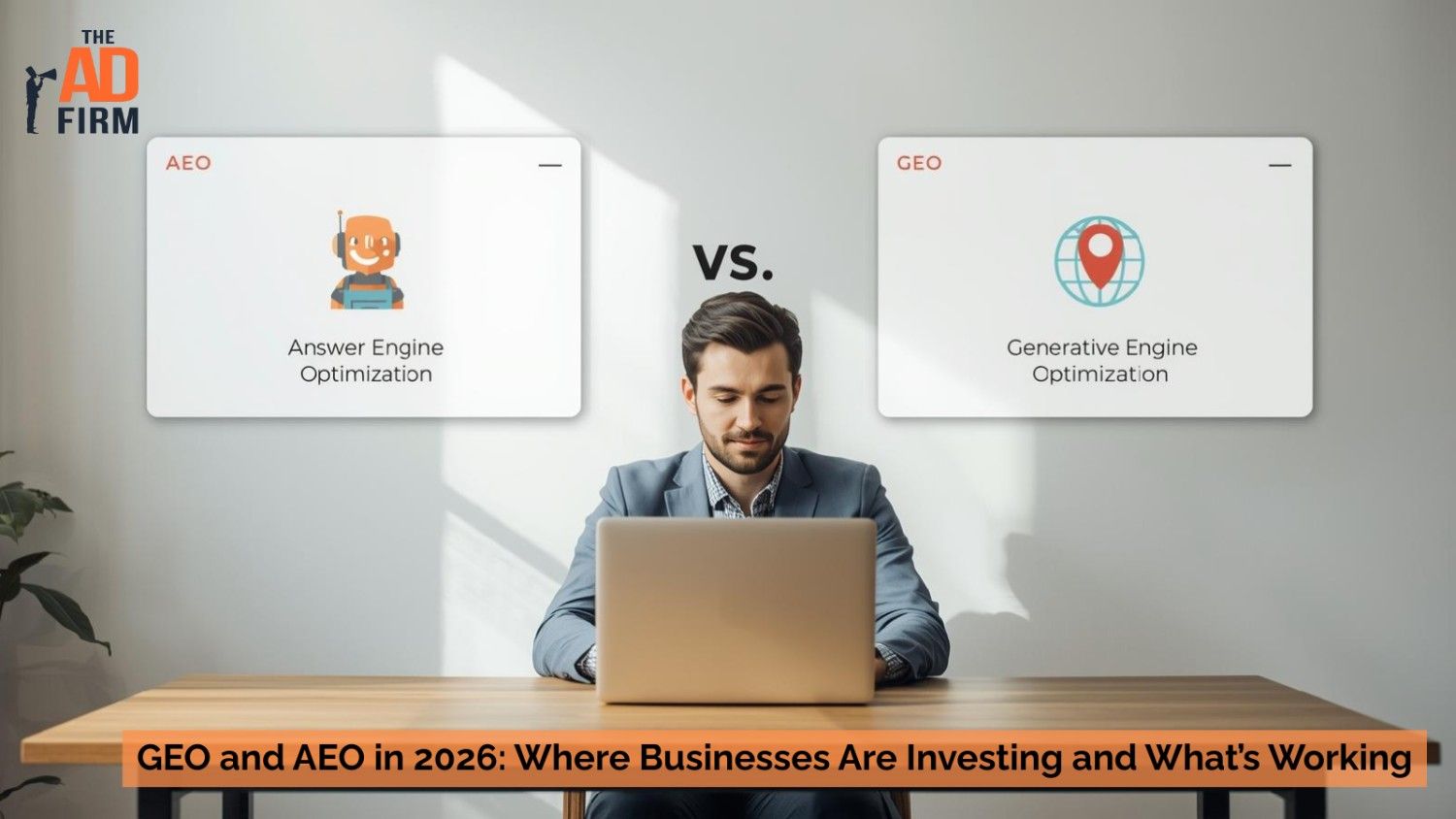
In 2026, many businesses are increasing investment in generative engine optimization (GEO) and answer engine optimization (AEO) as AI-driven search systems play a larger role in influencing purchase decisions. Budgets increasingly prioritize content clarity, entity alignment, and citation-ready formats across platforms like ChatGPT, Perplexity, and Google AI Overviews, where exposure increasingly matters more than traditional rankings.
AI search now determines which brands surface as trusted answers at scale. Companies that align content and technical strategy with how these systems select sources gain an advantage, while others experience early-stage displacement in the buyer journey. This blog breaks down where enterprises are investing, what delivers results, and how to build sustainable visibility in an AI-first search environment.
What GEO and AEO Mean for Brands Today
Traditional SEO prioritized blue-link rankings. GEO and AEO require a different operating model. AI answer engines synthesize information, evaluate source credibility, and generate responses that may cite your content or omit it entirely. Your pages no longer compete just for clicks; they compete for inclusion in AI-generated answers that shape buyer perception before a visit ever occurs.
AEO focuses on structuring individual pieces of content so AI systems can extract, interpret, and confidently reference specific answers. In most organizations, this work sits closest to content, SEO, and editorial teams, where page-level clarity, formatting, and accuracy are owned.
Generative engine optimization extends beyond individual pages. GEO governs how a brand is represented across AI-generated responses at scale, which typically requires cross-functional ownership spanning SEO, content, data, and engineering. It addresses entity consistency, source reinforcement, and how systems synthesize information about your brand across multiple inputs.
When someone asks an AI assistant about your industry, your brand needs to appear as a reliable source within the response itself.
How AI Answer Engines Select Sources
Based on observed patterns and industry analysis, AI systems appear to evaluate content using signals tied to trust, clarity, and authority rather than relying primarily on keyword density. These systems consistently surface sources that demonstrate:
- Factual accuracy and verifiability: Claims supported by reliable, cross-referenced sources.
- Structure and clarity: Information formatted for direct extraction.
- Topical depth and expertise: Demonstrated command of a subject area.
- Freshness and relevance: Content aligned with current conditions.
- Structured data and schema: Clear identification of entities and relationships.
Brands that align content structure and machine-readable signals with these criteria increase their likelihood of being referenced within AI-generated answers.
Why Enterprises Are Prioritizing These Approaches Now
Enterprises continue shifting marketing budgets toward AI visibility, answer-driven content, and machine-readable signals that support AI discovery. A growing share of queries that once flowed through traditional search engines now move through AI assistants. When your strategy fails to reflect this shift, performance gaps emerge that traditional SEO metrics no longer explain.
Early adoption produces compounding advantages. AI systems tend to reuse sources they already recognize, reinforcing citation patterns that become difficult to displace. This shift also changes how organic performance works.
Google’s AI Overviews frequently draw from organic results while concentrating attention within summaries, compressing traffic distribution, and reducing the marginal value of rank alone. Brands now compete within a narrower set of surfaced sources rather than across an entire results page.
Measurement and Success Metrics
Evaluating GEO and AEO performance requires metrics that account for redistribution, attribution loss, and competitive displacement, not rankings alone:
- AI-assisted traffic: Sessions originating from AI platform referrals, indicating downstream impact rather than direct clicks.
- Citation frequency: How often AI systems reference your content across relevant queries.
- Schema-driven impressions: Visibility generated by machine-readable signals, with partial insight available through tools like Google Search Console.
- Featured and overview placement rates: Presence within AI Overviews, featured snippets, or knowledge panels.
- Brand mention sentiment in AI responses: How AI systems characterize your brand relative to competitors when answering industry questions.
These indicators surface whether your content competes effectively within compressed AI-driven environments.
Channel Mix Beyond Traditional SEO
Generative engine optimization extends beyond Google rankings. Effective strategies account for multiple AI-driven discovery channels where buyers now find and validate information.
Voice search and conversational AI assistants rely on natural language patterns, making question-aligned content critical. AI-powered shopping assistants synthesize product data, pricing, and reviews, requiring ecommerce teams to maintain clean, structured product information.
Industry-specific AI tools, from legal research platforms to financial planning systems, represent high-value opportunities for brands with verifiable domain expertise.
If your visibility strategy stops at traditional search, you miss how prospects research, compare, and validate options through AI systems before making decisions.
Technology and Workflow Requirements
Effective generative SEO programs rely on operational discipline and clear accountability:
- Content brief automation owned by the content and SEO teams.
- Quality assurance workflows with explicit editorial and legal sign-off for factual accuracy.
- Schema validation tools typically owned by SEO or engineering.
- Citation tracking systems monitored by SEO and analytics teams.
- Cross-channel publishing processes governed centrally to maintain consistency.
Ownership clarity matters. When AI surfaces incorrect or outdated information, teams need a defined responsibility for correction, not shared ambiguity.
ALSO READ: Ranking in Google’s AI Overviews: Structured Data and Content Layout Tips
Practical Tactics That Deliver Results

Strategy without execution produces no return. For generative AI search engine optimization to affect visibility and pipeline, your content and technical foundation must support extraction, evaluation, and citation.
Content Architecture for Answer Engine Visibility
AEO performance depends on structure. AI systems extract answers most reliably from content that presents information clearly and predictably, including:
- Question-and-answer formats with concise, authoritative responses
- Step-by-step instructions using clearly numbered, self-contained steps
- Definition blocks that introduce concepts before expanding
- Comparison tables with consistent data points
- Lists with contextual explanation
Clear structure reduces interpretation and increases extraction confidence.
GEO Content Strategies That Earn Citations
Generative engine optimization depends on credibility at scale. AI systems cite sources that demonstrate depth, verification, and authority:
- Original data and research: Proprietary studies, surveys, and first-party analysis outperform recycled summaries.
- Multi-perspective coverage: Addressing different viewpoints signals completeness and credibility.
- Expert attribution: Named experts, credentials, and clear authorship strengthen authority signals that AI systems can validate.
- Clear sourcing: Proper attribution and links to authoritative references reinforce factual reliability.
Content that simply summarizes existing material rarely earns sustained citation.
Structured Data and Schema Governance
Schema markup acts as a translation layer between your site and AI systems. Strong implementations cover:
- Organization schema: Company details, brand relationships, and contact information
- Product schema: Specifications, pricing, availability, and reviews
- Service schema: Offerings, service areas, and provider credentials
- FAQ schema: Extractable question-and-answer pairs
- HowTo schema: Procedural content with defined steps and materials
- Article schema: Authors, publication dates, and content categories
- LocalBusiness schema: Location data for geographically relevant queries
Governance matters. When machine-readable signals remain consistent across pages and platforms, AI systems maintain confidence. A conflicting or incomplete schema reduces citation potential.
RELATED ARTICLE: How to Implement Generative Engine Optimization (GEO) Strategies
Industry-Leading Patterns and Examples
Brands achieving measurable AI visibility follow consistent organizational practices:
- Topical authority concentration: You achieve stronger results by building deep content clusters around your core expertise instead of spreading thin coverage across unrelated topics. AI systems reward this depth with higher trust and more frequent citations.
- Strategic publication partnerships: Guest contributions, co-authored research, and content syndication with authoritative industry publications expand where your insights appear. These placements increase citation opportunities within sources AI systems already trust.
- Structured content libraries: Comprehensive glossaries, how-to resources, and comparison guides give AI systems reliable reference material to pull from when answering user questions.
- Cross-platform consistency: When your website, Google Business Profile, social profiles, and industry directories present the same information, AI systems gain confidence in your data accuracy and brand legitimacy.
These behaviors reinforce trust across every surface that AI systems evaluate.
Common Pitfalls to Avoid
Certain missteps limit generative engine optimization gains:
- Optimizing for AI without user value: Content built only for extraction lacks depth. AI systems factor engagement and usefulness into source selection.
- Brittle schema implementations: Manually maintained schema breaks as content evolves. Automation tied to your CMS supports long-term stability.
- Chasing platform-specific behavior: AI platforms change quickly. Accuracy, structure, and authority remain constant signals.
- Neglecting content maintenance: Stale information loses citation value. Regular updates protect relevance and trust.
- Ignoring negative AI mentions: AI responses can surface unfavorable narratives. Monitoring and correcting the underlying sources protects your brand.
Avoiding these issues preserves trust and long-term credibility.
Best Practices for Implementation
Successful programs follow disciplined execution with clear expectations:
- First 30 days: Audit AI visibility, establish baselines, identify high-risk inaccuracies
- Within 90 days: Deploy structured content improvements, schema governance, and monitoring
- Over 6–12 months: Build citation momentum, reinforce authority clusters, and refine attribution models
Execution quality, not speed alone, determines sustained results.
READ MORE: Top GEO Content Formats That Win Visibility in AI Overviews
Prepare Your Brand for AI-Driven Search Visibility
Generative engine optimization and answer engine optimization now shape how buyers discover, evaluate, and trust brands through AI-driven search. As answer engines expand, visibility depends on structured data, authoritative content, and architecture built for AI interpretation. Brands that commit to these fundamentals secure durable exposure across both traditional search and emerging AI channels.
The Ad Firm specializes in helping businesses build comprehensive AI visibility strategies. Our team combines technical SEO expertise with generative SEO knowledge to create programs that deliver measurable results across traditional and AI-powered search channels.
Ready to evaluate your AI search visibility? Contact The Ad Firm for a complete audit of your current position and a strategic roadmap for 2026 and beyond.