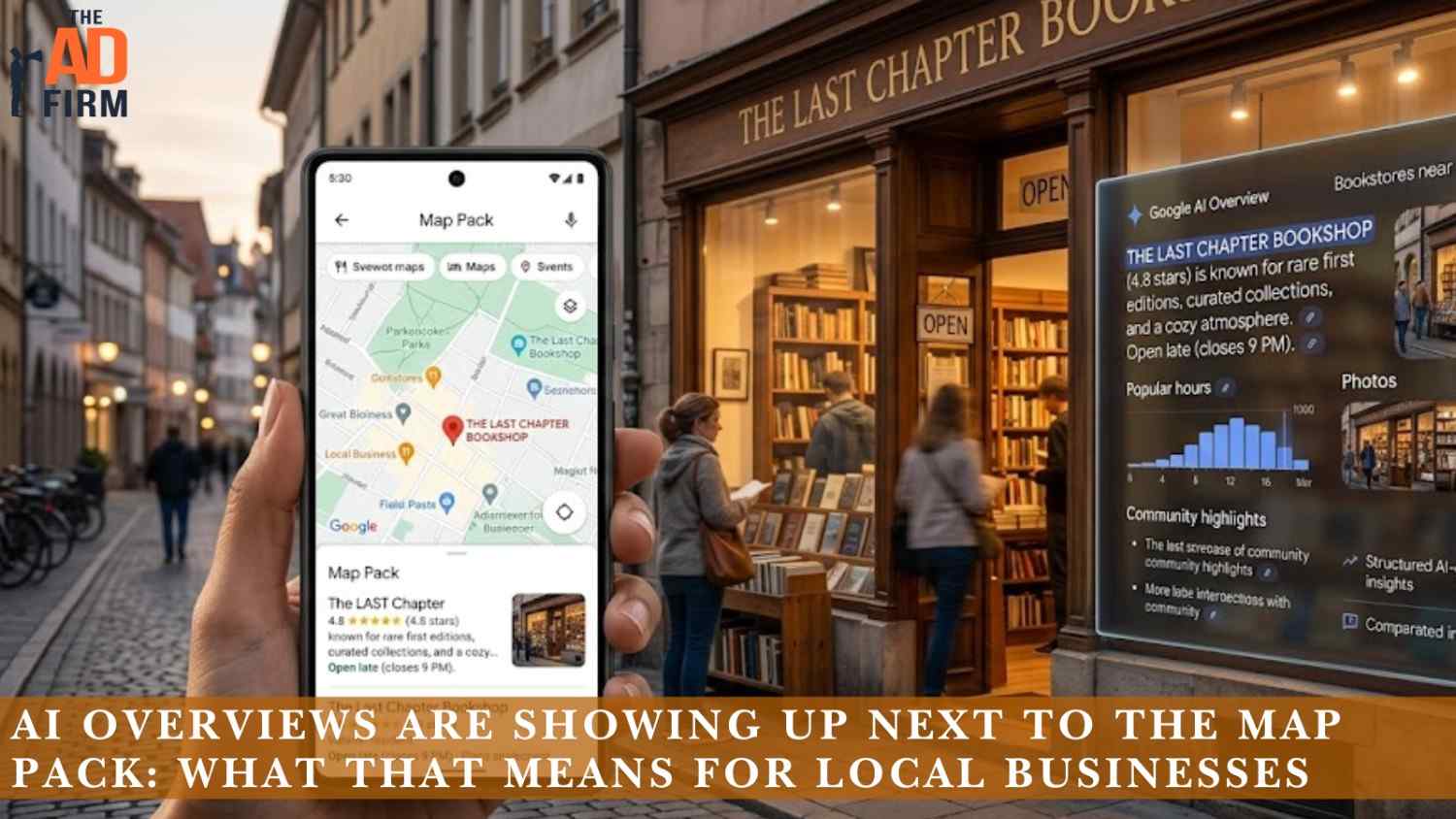
Search a service business and you’ll increasingly see an AI Overview sitting above or beside the local map pack, sometimes answering the question before any business listing even loads. The move from map pack to AI overview is covered in a separate post on expanding your local SEO footprint. For years, ranking in the map pack meant winning on proximity and review volume. That’s no longer the whole story. The Ad Firm’s generative engine optimization services help local businesses get recommended in those AI answers.
Local visibility is shifting from a guaranteed three-pack of nearby options to one or two businesses an AI system chooses to recommend, based on what it can find about them across the web. The businesses showing up in that summary aren’t necessarily the closest. They’re the ones with the strongest documented authority on the question being asked.
How AI Overviews Are Reshaping Local Search Results
Google’s AI Overviews now appear alongside, and in some cases above, the traditional map pack for many local queries. Where the map pack reliably surfaces three nearby businesses ranked largely by proximity and review count, the AI Overview works differently. It synthesizes an answer that names one or two businesses it considers the strongest match, drawing on reviews, website content, and how that business is referenced elsewhere online.
This is a meaningful structural change. The map pack has long been a near-guarantee of visibility for businesses with decent local SEO and enough reviews. AI Overviews add a layer of selection on top of that. Even if your business shows up in the map pack, the AI summary above might recommend a competitor instead, based on factors the map pack doesn’t directly measure. GEO for local businesses to get recommended by AI is covered in its own post.
For local businesses, this means visibility now depends on two systems running in parallel. One rewards proximity and review volume. The other rewards documented expertise and consistency across the web. Local SEO work that used to stop at the map pack now needs to account for both.
What This Shift Means for Local Businesses
AI Overviews change more than where a business appears in results. The practical impact breaks down into three areas: the kind of traffic you get, what now influences a recommendation, and which searches are affected at all.
Maximize Your Online Impact with The Ad Firm
- Local SEO: Capture the local market with strategic SEO techniques that drive foot traffic and online sales.
- Digital PR: Boost your brand’s image with strategic digital PR that connects and resonates with your audience.
- PPC: Implement targeted PPC campaigns that effectively convert interest into action.
Less Traffic, but Better-Qualified Leads
AI Overviews answer a portion of queries directly inside the search results, which means fewer total clicks reach business websites for those queries. That sounds like a loss, and for raw traffic numbers, it is. But the users who do click through after reading an AI summary tend to arrive with more context. They’ve already seen a recommendation and some basic information about your business before landing on your site.
The practical effect is a smaller but more qualified stream of visitors. A user who clicks through from an AI Overview that named your business as the recommended option for a specific question is closer to a decision than someone scanning three map pack listings with little to differentiate them.
Ranking Factors Move Beyond Proximity and Review Count
Traditional map pack ranking has relied heavily on proximity to the searcher and the number and recency of reviews. Those factors still matter, but AI Overviews introduce a different weighting. What seems to drive AI visibility is the quality and consistency of information about your business across the web. Does your site answer the questions customers actually ask? Do your reviews mention specific services or details? Do other sources online describe your business in consistent, accurate terms? These are the signals that appear to matter most.
A business with fewer reviews but a website that thoroughly answers the questions customers are actually asking can outperform a competitor with more reviews but a thin web presence, at least for the queries where AI Overviews appear.
Which Searches Are Affected Depends on Intent
Not every local search triggers an AI Overview. Highly transactional searches, the kind where someone is ready to call or visit immediately, like “plumber near me,” still tend to pull the traditional map pack as the primary result. Informational searches are where AI Overviews show up most often. Questions like “how much does AC repair cost” or “what causes a water heater to leak” increasingly surface an AI-generated answer that cites specific local businesses as sources.
This distinction matters for where to focus. Your map pack presence still needs to be strong for the transactional searches that drive immediate calls. But the informational searches, the ones happening earlier in a customer’s research, are where AI Overviews are creating a new visibility layer that didn’t exist before.
Streamline Your Digital Assets with The Ad Firm
- Web Development: Build and manage high-performing digital platforms that enhance your business operations.
- SEO: Leverage advanced SEO strategies to significantly improve your search engine rankings.
- PPC: Craft and execute PPC campaigns that ensure high engagement and superior ROI.
ALSO READ: Why Your Brand Should Care About Gemini (Not Just Google Search)
How to Adapt Your Local SEO Strategy
None of this requires abandoning what’s worked for local SEO. It means adding a few specific practices that directly feed the signals AI Overviews draw from, and building those practices into a routine rather than treating them as a one-time fix.
Publish Content That Answers Local Questions Directly
AI Overviews favor sources that answer a specific question clearly, in language that mirrors how the question was asked. For local businesses, that means content built around the questions customers actually ask before they call, not generic service pages. A page or blog post titled “What Are the Most Common Foundation Problems in [Your City]” or “How Much Does AC Repair Typically Cost in [Your Region]” gives an AI system a specific, locally relevant answer to cite.
Finding these questions doesn’t require guesswork. The Google Business Profile “Questions & Answers” section is a direct record of what people ask before contacting a business. Customer service calls, intake forms, and even text message threads are full of the same recurring questions, phrased the way real customers phrase them. A roofing company might field “how long does a roof replacement take in [city]” or “do I need a permit to replace my roof in [state].” A dentist might see “how much does a root canal cost without insurance” come up again and again. Those exact phrasings, not the keyword-research version, are what should shape the content.
Structure matters as much as topic. Lead with a direct, two-to-three sentence answer at the top of the section, then expand with the specifics that make the answer locally relevant: typical price ranges, permitting requirements, seasonal factors, or local building codes. This gives an AI system a clean, citable answer while still giving human readers the depth they came for.
This kind of content also has to be genuinely useful, not just keyword-targeted. Content built around real customer questions and structured to answer them directly is far more likely to be referenced than a generic page that mentions your city a few times.
Keep Your Google Business Profile Active and Specific
Your Google Business Profile remains foundational, and AI Overviews appear to weigh it heavily. Beyond keeping hours, services, and photos current, actively asking customers for reviews and responding to them matters more than it used to. Reviews that mention specific details, a particular service, a specific product, or a notable detail about the experience, give AI systems concrete information to draw from when describing your business.
Transform Your Online Strategy with The Ad Firm
- SEO: Achieve top search rankings and outpace your competitors with our expert SEO techniques.
- Paid Ads: Leverage cutting-edge ad strategies to maximize return on investment and increase conversions.
- Digital PR: Manage your brand’s reputation and enhance public perception with our tailored digital PR services.
A review that says “fixed our AC the same day and explained the issue clearly” gives an AI system something specific to work with. A review that just says “great service” doesn’t. The difference comes down to what you ask for. A follow-up text or email that prompts customers with a specific question, “what was the main issue we fixed for you today?”, produces noticeably more detailed reviews than a generic request to leave a review.
Photos play a role too. Geotagged photos of completed work, captioned with what was done (“new water heater installation, [neighborhood]”), give both Google and AI systems additional context tied to a specific location and service. The Q&A section of your profile is also worth using proactively. Seed it with the questions customers ask most, and answer them yourself before someone else does with incomplete information.
Review management is also where reputation management and local SEO start to overlap directly. A steady stream of detailed, recent reviews across your profile and other review platforms builds the kind of consistent signal AI systems look for when deciding which business to recommend.
Build Entity Trust Across the Web
AI systems cross-reference information about your business from multiple sources, not just your website and Google Business Profile. Consistent business information, your name, address, and phone number, across directories like Yelp, industry-specific platforms, and local citation sites builds what’s often called entity trust: a consistent, verifiable picture of who you are and what you do.
This goes beyond the major directories. Industry-specific platforms carry real weight too. Houzz matters for contractors and home services, Healthgrades or Zocdoc for medical practices, Avvo for legal services. A business listed and consistent across the directories relevant to its industry, not just the generic ones, gives AI systems more corroborating sources to draw from.
Inconsistent NAP details across these platforms create exactly the kind of ambiguity AI systems are designed to avoid when selecting which business to recommend. The same applies to business descriptions and category selections. If your website describes you as a full-service plumbing company but a directory lists you only under drain cleaning, that mismatch is a small but real source of confusion for systems trying to determine what you actually do.
Advance Your Digital Reach with The Ad Firm
- Local SEO: Dominate your local market and attract more customers with targeted local SEO strategies.
- PPC: Use precise PPC management to draw high-quality traffic and boost your leads effectively.
- Content Marketing: Create and distribute valuable, relevant content that captivates your audience and builds authority.
An audit of your listings across major and industry-specific directories is a straightforward place to start, and it’s often part of a broader local SEO audit. Tools built for citation tracking can flag inconsistencies automatically, but even a manual review of your top ten to fifteen listings is enough to catch the most damaging gaps.
Add LocalBusiness Schema Markup
Structured data in the form of LocalBusiness schema gives both traditional crawlers and AI systems a direct, machine-readable summary of your operating hours, location, services, and other key details. Without it, that information has to be inferred from page content, which introduces room for error or omission. For more detail, see GEO for local SEO content.
The most useful properties go beyond the basics of name, address, and phone number. Opening hours specifications, service area, price range, and accepted payment methods all give AI systems specific data points to pull from when answering a question. The “sameAs” property, which links your schema to your social profiles and directory listings, reinforces the entity trust signals described above by tying everything back to the same verified business.
Using the most specific schema type available helps too. A general “LocalBusiness” type works, but types like “Plumber,” “Dentist,” or “HomeAndConstructionBusiness” give search engines and AI systems a more precise category to work with, which can influence which questions your business gets cited for.
This is a technical SEO fix that’s often overlooked on local business websites, particularly for businesses with multiple locations or service areas. Each location needs its own accurate markup, and Google’s Rich Results Test will confirm your schema is implemented correctly and free of errors.
ALSO READ: Building Geo-Relevant Link Profiles for Stronger AI and Local Rankings
Build a Local Visibility Strategy for the AI Search Era
The shift from map pack exclusivity to AI Overview recommendations doesn’t replace local SEO. It adds a layer on top of it, one that rewards businesses able to answer customer questions clearly, maintain consistent information across the web, and structure their site so that information is easy to find and verify.
Strengthen Your Online Authority with The Ad Firm
- SEO: Build a formidable online presence with SEO strategies designed for maximum impact.
- Web Design: Create a website that not only looks great but also performs well across all devices.
- Digital PR: Manage your online reputation and enhance visibility with strategic digital public relations.
At The Ad Firm, our local SEO team builds strategies that account for both systems: the proximity and review signals that drive map pack rankings, and the content, consistency, and structured data that influence whether AI Overviews recommend your business. Contact our team to find out where your local visibility stands today.
Frequently Asked Questions
What is the difference between the map pack and AI Overviews in local search?
The map pack is Google’s traditional set of three local business listings, ranked primarily by proximity, relevance, and review signals. AI Overviews are AI-generated summaries that can appear alongside or above the map pack, recommending one or two businesses based on a broader set of signals, including website content, review detail, and consistency of information across the web.
Do AI Overviews replace the local map pack?
Not currently. The map pack still appears for most local searches, particularly transactional ones like “[service] near me.” AI Overviews appear alongside the map pack for many queries, especially informational ones, and can recommend businesses that don’t necessarily appear in the map pack itself. Local businesses now need to account for both. A separate post covers GEO for local AI Overviews and best near me searches.
How can local businesses appear in Google AI Overviews?
Appearing in AI Overviews depends on the quality and consistency of information available about a business across the web. This includes a Google Business Profile with detailed, specific reviews, website content that directly answers common customer questions, consistent business information across directories, and structured data like LocalBusiness schema that makes key details easy for AI systems to verify.
What is entity trust in local SEO?
Entity trust refers to how consistently and accurately a business’s information, name, address, phone number, services, and description, appears across the web. When this information matches across a business’s website, Google Business Profile, and third-party directories, it gives search engines and AI systems a clear, verifiable picture of the business, supporting both traditional rankings and AI-driven recommendations.