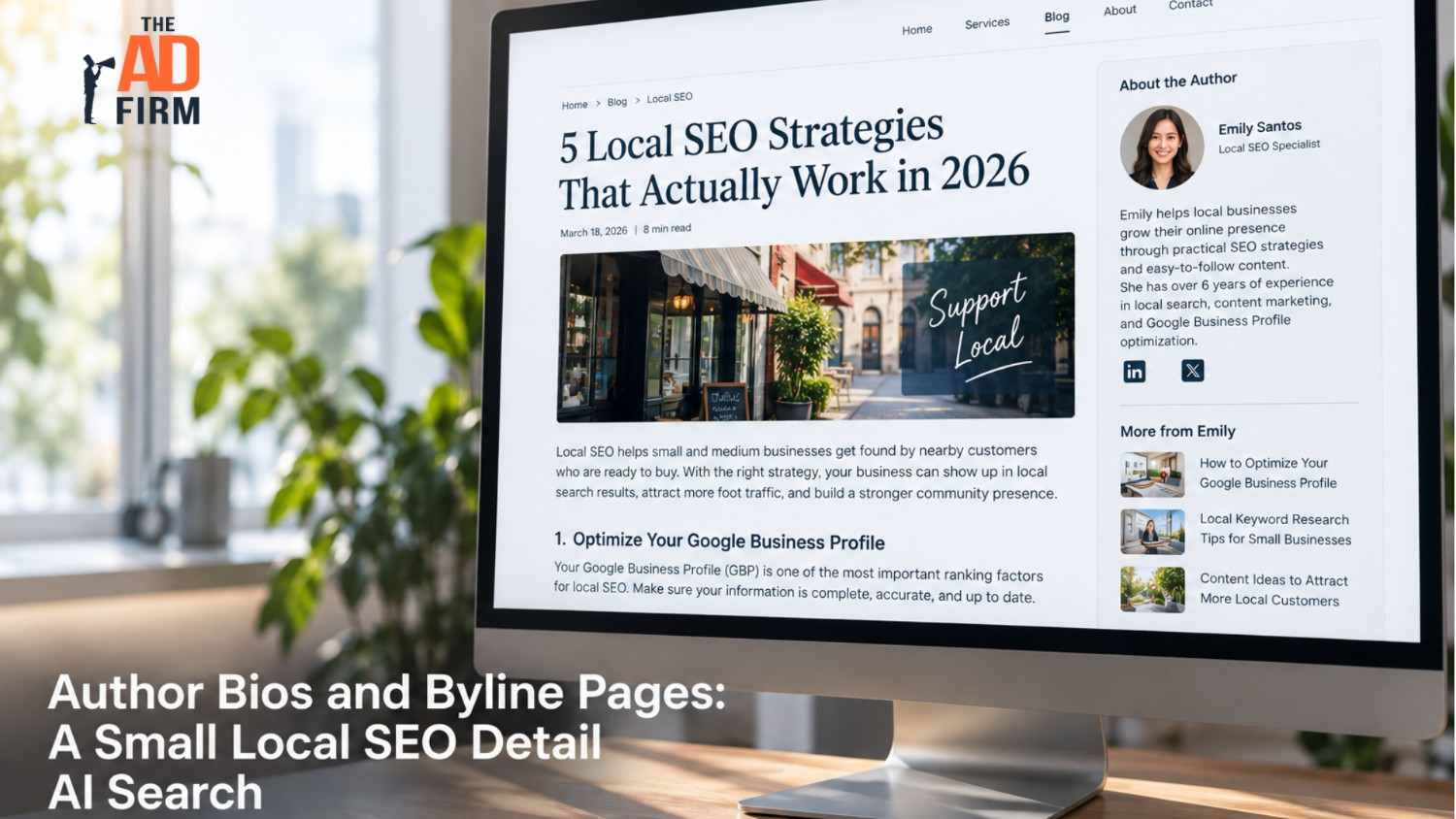
Author bios and byline pages can support local SEO and AI search by clearly identifying who created content and providing useful information about that person’s role, experience, and connection to the business.
A byline may seem like a small website detail, but it gives readers context about who is behind an article. A dedicated author page can provide more information about the person’s expertise, qualifications, professional background, and other content they have created.
For local businesses, this can be useful when publishing service guides, local resources, educational articles, and content that relies on professional knowledge.
Author information is not a shortcut to higher rankings or AI citations. It is one part of a well-structured website that helps connect content with real people and the business publishing it.
Why Do Author Bios Matter?
Author bios help readers understand who created the content and why that person is relevant to the topic.
They Identify the Author
A simple byline such as “By Maria Santos” tells readers who wrote the article.
The author’s name can link to a dedicated profile page that provides more information about the person. This gives readers a clear path to learn about the person behind the content instead of leaving the byline as an isolated name.
Google recommends providing an author name and a URL that uniquely identifies the author, such as an author bio or profile page, in Article structured data.
They Add Relevant Context
A short bio can explain the author’s role, experience, qualifications, or area of expertise.
For example, a local dental practice could identify the dentist who reviewed an article about a dental procedure. An electrical company could identify a technician who contributed to a guide about electrical services.
The information should relate to the content rather than simply list generic accomplishments.
They Give Readers More Information
Readers may want to know who is providing information before they contact a business or act on advice.
An author profile gives them another place to understand the person’s role and professional background.
This can support the broader trust a business builds through its website, content, reviews, and online reputation management.
Strengthen Your Online Authority with The Ad Firm
- SEO: Build a formidable online presence with SEO strategies designed for maximum impact.
- Web Design: Create a website that not only looks great but also performs well across all devices.
- Digital PR: Manage your online reputation and enhance visibility with strategic digital public relations.
Are Author Bios a Local SEO Ranking Factor?
Author bios are not a standalone local ranking factor that guarantees better search positions.
Their value comes from supporting the overall quality, transparency, and structure of a website.
Local SEO Still Needs Core Signals
An author bio cannot replace the fundamentals of Local SEO.
A local business still needs accurate business information, relevant service pages, useful local content, consistent listings, and a website that clearly communicates what it offers and where it operates.
Author information simply adds another layer of context.
The Author Should Match the Topic
The person listed as the author should have a genuine connection to the content.
A plumber writing about plumbing services is clearly connected to the subject. A dentist contributing to dental content has relevant professional experience.
This is more useful than assigning every article to the same generic author regardless of subject.
Local Expertise Can Add Context
Some professionals understand a specific local market because they work with customers in that area every day.
If that local experience is relevant to the article, the author’s profile can explain it.
For example, a real estate professional could have a profile describing the markets they serve and the types of properties they handle.
How Can Author Pages Help AI Search?
Author pages can provide clearer information about the people associated with a website’s content.
They are not a special method for getting cited by AI search. Instead, they can create clearer connections between an author, their articles, their expertise, and the business they represent.
AI Search Needs Context
An article provides information about a subject. The surrounding website provides additional context.
An author profile can help establish:
- Who created the content
- What the person does
- What subjects they cover
- What organization they work with
- What relevant experience they have
- What other content they have published
This creates a clearer relationship between the person and the information they provide.
Author Pages Connect Content
Suppose a local HVAC company publishes 20 articles about heating and cooling.
If those articles identify the same qualified professional and link to that person’s profile, the website creates a clear connection between the author and the content.
Advance Your Digital Reach with The Ad Firm
- Local SEO: Dominate your local market and attract more customers with targeted local SEO strategies.
- PPC: Use precise PPC management to draw high-quality traffic and boost your leads effectively.
- Content Marketing: Create and distribute valuable, relevant content that captivates your audience and builds authority.
The author page can then link back to relevant articles.
This creates useful internal connections without forcing keywords into the content.
Consistency Matters
The author’s name should be consistent across the article, author page, and structured data.
Google recommends using the author’s name in Article structured data and providing a URL or sameAs reference that helps identify the author.
Consistent information makes those relationships easier to understand.
What Should an Author Bio Include?
An effective author bio should be short, factual, and relevant.
It does not need to become a full résumé.
Use the Real Name
Use the actual public name of the person who created or substantially contributed to the content.
Avoid creating fictional authors to make content appear more authoritative.
Explain the Role
Tell readers what the person does.
For example:
“Maria Santos is a licensed electrician with more than 10 years of experience working on residential electrical systems in Melbourne.”
That provides useful context without unnecessary marketing language.
Include Relevant Experience
Focus on experience connected to the content.
A contractor’s experience with residential renovations is relevant to a renovation guide. A financial professional’s qualifications are relevant to financial content.
Do not fill the bio with unrelated achievements.
Link to the Profile
The author’s name can link directly to the author’s profile page.
That gives readers a clear path to additional information about the person and gives the website another useful internal connection.
What Is a Byline Page?
A byline page, also called an author page or profile page, is a dedicated page that provides information about an individual contributor.
The article identifies the author. The profile page provides more detail.
It Can List Published Content
An author page can display articles written or reviewed by that person.
This gives readers a simple way to see the author’s work.
It also creates additional internal connections between related pages.
It Can Explain Expertise
The profile can provide more information than a short article bio allows.
It could include the person’s:
- Job title
- Professional qualifications
- Industry experience
- Areas of expertise
- Relevant memberships
- Published content
- Professional profiles
The information should be specific to the person rather than copied from a generic company description.
Transform Your Online Strategy with The Ad Firm
- SEO: Achieve top search rankings and outpace your competitors with our expert SEO techniques.
- Paid Ads: Leverage cutting-edge ad strategies to maximize return on investment and increase conversions.
- Digital PR: Manage your brand’s reputation and enhance public perception with our tailored digital PR services.
It Can Use ProfilePage Structured Data
Google supports ProfilePage structured data for pages focused on a single person or organization. Its examples include author pages, About Me pages, and employee pages on company websites.
The structured data should accurately represent what is visible on the page.
How Should Author Pages and Articles Connect?
The relationship should be simple.
The article identifies the author. The byline links to the profile. The profile provides information about the person and links to their relevant content.
Article to Author Page
A byline can appear near the article title or introduction.
For example:
By Maria Santos
The author’s name can link to the corresponding profile.
Author Page to Articles
The author profile can list relevant articles written or reviewed by that person.
This creates a two-way connection between the content and its creator.
Author Page to Professional Profiles
Where appropriate, an author profile can link to a relevant professional profile.
Google’s ProfilePage documentation supports sameAs for external profiles that help identify the person.
Only use genuine profiles that belong to the author.
Do All Local Businesses Need Author Pages?
Not every local business needs a large collection of author profiles.
The right setup depends on how much content the business publishes and who creates it.
One Main Contributor
A small business with one primary writer may only need a short author bio and one profile page.
There is no need to create multiple profiles just to make the website appear more sophisticated.
Multiple Contributors
Businesses with several writers, professionals, or subject matter experts can benefit from individual profiles.
Each profile can explain the person’s role and connect them with their work.
Expert-Reviewed Content
Some businesses use a writer to create an article and a professional to review it.
In this situation, distinguish the writer from the reviewer.
Do not list the reviewer as the author if they only reviewed the content.
What Author Bio Mistakes Should You Avoid?
Once the basics are in place, author information can do real work within the broader content structure.
Don’t Create Fake Authors
A fictional author should not be used to make content appear more trustworthy.
Amplify Your Market Strategy with The Ad Firm
- PPC: Master the art of pay-per-click advertising to drive meaningful and measurable results.
- SEO: Elevate your visibility on search engines to attract more targeted traffic to your site.
- Content Marketing: Develop and implement a content marketing strategy that enhances brand recognition and customer engagement.
The person listed should have a genuine relationship with the content.
Don’t Overstate Credentials
Only include qualifications, awards, certifications, and experience that are accurate.
An impressive bio does not create trust if the information cannot be supported.
Don’t Copy the Same Bio
If different employees have different roles, their profiles should reflect those differences.
Copying the same paragraph onto every author page makes the profiles less useful.
Don’t Stuff Local Keywords
An author bio does not need to repeat a city or service keyword several times.
Mention location when it is genuinely relevant to the person’s role or experience.
How Can Author Information Support SEO?
Author information works best when it fits into the site’s broader content and SEO structure.
Connect Authors to Relevant Pages
If an author specializes in a specific service, their profile can link to related articles.
Those articles can then link to the appropriate service page.
This creates a stronger relationship between educational content and commercial pages.
A broader SEO strategy can use these connections alongside technical SEO, keyword research, internal linking, and content development.
Build Stronger Content Connections
A website can connect:
Author → Article → Service → Contact
For example, a professional’s profile could link to a guide about a service. That guide can link to the related service page, which can then lead visitors toward a contact or conversion page.
This gives users a clearer path through the website.
Support Content Marketing
Author profiles can also support a broader content marketing strategy.
When businesses consistently publish useful content from identifiable contributors, those contributors can become part of the site’s overall content structure.
How Should You Handle Author Markup?
Author markup should accurately reflect the author shown on the page.
Google recommends using Person for individual authors, providing the author’s name, and using a valid URL or sameAs property to help identify them.
Match the Visible Byline
If the article says “By Maria Santos,” the structured data should identify Maria Santos as the author.
Do not use a different name in the markup.
Use an Author URL
If the website has an author profile, use that profile URL to identify the author.
Boost Your Business Growth with The Ad Firm
- PPC: Optimize your ad spends with our tailored PPC campaigns that promise higher conversions.
- Web Development: Develop a robust, scalable website optimized for user experience and conversions.
- Email Marketing: Engage your audience with personalized email marketing strategies designed for maximum impact.
This creates a direct connection between the article and the person.
Consider ProfilePage Markup
If the author has a dedicated profile page, ProfilePage structured data can help Google understand that the page focuses on that person.
The markup should describe the actual content of the page.
How Do Author Bios Fit Into AI SEO?
AI SEO involves more than adding author information.
The goal is to make the website’s information easier for search engines and AI-powered systems to interpret.
Make Relationships Clear
A website should make it easy to understand the relationships between:
- The business
- Its employees
- Its authors
- Its services
- Its content
- Its locations
Author pages are one small part of that structure.
Connect Expertise With Content
If a person has relevant experience, connect that person with the content they actually contributed to.
This provides more useful context than simply placing a generic “expert” label beside an article.
The Ad Firm’s AI SEO services can support a broader strategy for improving how a business’s information is structured and represented online.
Support Generative Search
Generative Engine Optimization focuses on improving how a brand’s information can be understood across AI-powered search experiences.
Author information can support that broader structure by making the people connected to the content easier to identify.
It should be one component of the strategy, not the entire strategy.
Can Digital PR Support Author Visibility?
Digital PR can provide another way to connect a business and its professionals with external sources.
When qualified professionals contribute expert commentary to relevant publications, those references can create additional context around their expertise and the business they represent.
The Ad Firm’s Digital PR services can support broader visibility and authority-building efforts.
This is different from simply adding an author bio to your own website. The two can work together as part of a broader visibility strategy.
Can Website Design Affect Author Pages?
Author pages should be easy to find, read, and use.
A profile that is difficult to access, poorly organized, or disconnected from the site’s navigation provides less value to visitors.
A clear web design structure can make author profiles easier to access from articles while keeping the main navigation focused on important customer pages.
Maximize Your Online Impact with The Ad Firm
- Local SEO: Capture the local market with strategic SEO techniques that drive foot traffic and online sales.
- Digital PR: Boost your brand’s image with strategic digital PR that connects and resonates with your audience.
- PPC: Implement targeted PPC campaigns that effectively convert interest into action.
The page should also work well on mobile devices and provide clear links to the author’s relevant content.
What Is the Real Value of Author Bios?
Author bios are a small website detail, but they can improve how clearly a business presents the people behind its content.
They can identify authors, provide relevant professional context, connect articles with author profiles, and create clearer relationships between people and the content they produce.
For local businesses, this can be useful when articles rely on industry expertise, professional experience, or local knowledge.
The goal is not to treat author bios as a ranking shortcut. They are one part of creating a useful, transparent, and well-structured website.
How Can The Ad Firm Help?
The Ad Firm can help make your website’s authorship clearer and more useful by reviewing how your content identifies its writers, connects to author pages, and presents expertise. We can also look at how these elements fit into the overall structure of your website so they support both readers and search systems.
- Review your existing bylines: We can check whether articles clearly identify their authors and whether the names, roles, and author information are presented consistently.
- Improve author profile pages: We can help structure author pages so they provide useful information about each contributor, including their role, relevant experience, qualifications, and published content.
- Strengthen internal connections: We can connect articles with their corresponding author pages and related content so the relationships between authors, topics, and pages are clearer.
- Clarify expertise: We can help businesses present relevant professional experience in a factual way, giving readers more context about why an author is qualified to discuss a particular subject.
- Review authorship signals: We can identify gaps or inconsistencies between visible bylines, author pages, and structured data and recommend changes that make the information more consistent.
- Align content with the broader website: We can review how author information fits with your service pages, local content, and other important sections of the website instead of treating author bios as an isolated element.
Frequently Asked Questions
Do author bios directly improve Google rankings?
There is no guarantee that adding an author bio will improve rankings. Its value comes from providing clearer information about the person behind the content and supporting the overall structure of the website.
Streamline Your Digital Assets with The Ad Firm
- Web Development: Build and manage high-performing digital platforms that enhance your business operations.
- SEO: Leverage advanced SEO strategies to significantly improve your search engine rankings.
- PPC: Craft and execute PPC campaigns that ensure high engagement and superior ROI.
Should every blog post have a byline?
A byline can help readers understand who created the content. The appropriate approach depends on how the website produces and manages its content.
Should the author name link to an author page?
It can be useful to link the byline to an author profile because the profile gives readers and search systems another page that identifies the person.
Can an author be an organization?
Yes. Google supports both Person and Organization as author types for Article structured data. The type should accurately represent the actual author.
Should an author bio include social media profiles?
Relevant professional profiles can help identify an author, but only include accounts that genuinely belong to that person and are useful to readers.
Can an AI-generated article have a human author bio?
The author’s information should accurately represent who created or substantially contributed to the content. A person should not be listed as the author simply because they work for the company.
Should an author bio mention a location?
It can if the location is relevant to the person’s role or expertise. It should not be added simply to repeat local keywords.
Do author pages need to be long?
No. A useful author page can be short if it clearly identifies the person, explains relevant experience, and connects them with their work.