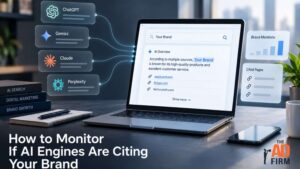
AI engines can mention your brand without linking to your website, so monitoring AI citations requires more than checking if your company name appears in an answer. You can track AI visibility through dedicated monitoring tools, consistent prompt testing, and automated systems that record when and where your brand is cited.
For businesses investing in generative engine optimization, this tracking helps show how often AI engines use your website as a source and which pages are earning citations. It also gives you a clearer view of how your brand appears alongside competitors across AI search platforms.
1. Use Dedicated AI Visibility Tracking Tools
Dedicated AI visibility platforms can make it easier to monitor how often your brand appears across different AI engines. Tools such as Otterly AI, Profound, and HubSpot AEO can track AI search visibility across platforms such as ChatGPT, Perplexity, Gemini, Claude, and Copilot.
Depending on the tool, you can monitor metrics such as your brand visibility score, competitor rankings, citation frequency, and the specific URLs being cited. This provides more useful information than simply knowing your brand appeared in an AI-generated response.
For example, a report may show that your brand was mentioned for a particular search but that a competitor’s website was used as the source. Another result may show both a brand mention and a direct citation to a specific page on your website.
Tracking these details can help identify which searches produce citations and which areas need more attention.
2. Test Your Brand With a Consistent Prompt Bank
Manual prompt testing gives you another way to check how AI engines present your brand. Start with a consistent bank of 10–20 prompts based on the questions your potential customers are likely to ask.
Include different types of searches, such as:
- Buyer-intent questions
- Category-related questions
- Product or service questions
- Comparison searches
- Questions that mention specific problems your business solves
Run the same prompts across ChatGPT, Perplexity, Claude, and Gemini several times a week. Keeping the prompts consistent makes it easier to compare results instead of testing random questions each time.
Record what happens with each prompt. Note if your brand appears, how it is described, which competitors are mentioned, and if the AI engine provides a direct link to your website.
Boost Your Business Growth with The Ad Firm
- PPC: Optimize your ad spends with our tailored PPC campaigns that promise higher conversions.
- Web Development: Develop a robust, scalable website optimized for user experience and conversions.
- Email Marketing: Engage your audience with personalized email marketing strategies designed for maximum impact.
A mention and a citation should be recorded separately. An AI engine can name your company without using your website as a source. A citation means the response identifies or links to a specific source, such as one of your website pages.
In practice, one pattern worth watching is the difference between being mentioned and being cited. A business may appear in answers for relevant searches while AI engines consistently rely on competitor pages or third-party sources instead. Tracking both results separately makes it easier to identify where the gap exists and which sources may need attention.
Read More: Connecting Local Rankings to Revenue with GEO and AI Search
3. Automate AI Citation Tracking With APIs and Scripts
Businesses that need more frequent tracking can use official developer APIs from platforms such as OpenAI, Perplexity, Google Gemini, and Anthropic to build lightweight monitoring scripts. This can allow businesses to track results from multiple AI engines, including ChatGPT, Perplexity, Gemini, and Claude, using a more consistent monitoring process.
An automated system can submit the same prompt bank on a schedule and record the results. Instead of manually checking every response, you can create a dataset showing how your brand’s AI visibility changes over time.
Useful fields to record include:
- Date and time
- AI engine
- Prompt
- Brand mentioned
- Brand cited
- Citation URL
- Competitors mentioned
- Competitor citation URLs
- Changes from previous results
This type of tracking can make patterns easier to spot. You may find that your brand is consistently mentioned for certain topics but rarely cited, or that particular website pages receive citations more often than others.
Related Article: Trust Factors That Influence GEO Performance in AI Search
What Can You Do If AI Engines Are Not Citing Your Brand?
Start by looking at the sources AI engines are citing instead. These pages can give you useful clues about the type of information AI engines are using to answer the same questions where your brand is missing.
Review the results and compare the cited sources with your own website. Look for gaps in the information, content depth, page structure, and supporting resources.
Here are some areas to check:
- Review the pages being cited: Look at the websites and specific pages appearing as sources for your target prompts. Identify what information they provide that your website does not.
- Compare the content: Check if competing pages answer the question more directly, provide more supporting details, or cover related questions that your content does not address.
- Look for content gaps: Identify important topics, questions, definitions, comparisons, or supporting information that are missing from your existing pages.
- Review page structure: Clear headings, organized sections, descriptive page titles, and easy-to-find information can make important content easier to access.
- Strengthen supporting content: Build useful resources around the topics connected to your main services instead of relying on a single page to answer every question.
- Check your website information: Review important business facts, service details, and other information across your website to make sure they are accurate and consistent.
- Compare your AI visibility over time: After making changes, continue testing the same prompts to see if your brand begins appearing more often or earning citations.
Your SEO strategy supports this process by addressing website structure, content organization, and the pages that need stronger search visibility. Content marketing can also help fill information gaps with useful resources built around the questions your audience is asking.
Streamline Your Digital Assets with The Ad Firm
- Web Development: Build and manage high-performing digital platforms that enhance your business operations.
- SEO: Leverage advanced SEO strategies to significantly improve your search engine rankings.
- PPC: Craft and execute PPC campaigns that ensure high engagement and superior ROI.
The Ad Firm can use AI SEO to assess your current AI visibility, identify citation opportunities, review competing sources, and determine which parts of your website may need improvement.
How Often Should You Monitor AI Citations?
AI citation monitoring works best as an ongoing process rather than a one-time check. Run the same prompt set regularly so you can compare results under consistent conditions.
Checking several times a week can help you identify changes in brand mentions, citations, cited URLs, and competitor visibility. The frequency can also depend on how important AI search is to your overall marketing strategy.
The key is consistency. Using different prompts every time makes it difficult to determine if your AI visibility has actually changed.
A digital marketing agency can also incorporate AI visibility monitoring into a broader search strategy, giving businesses a way to track AI search alongside traditional search performance.
Improve Your Brand’s Visibility in AI Search
Getting your brand cited in AI-generated answers requires more than monitoring mentions. The Ad Firm can use the information from your citation tracking to identify what may be limiting your visibility and strengthen the areas AI engines rely on when selecting and interpreting sources.
Here’s how the work can support your brand:
- Assess your current brand and content presence: Review your website, existing content, and overall online presence to identify areas that may be limiting your AI visibility.
- Strengthen topics, keywords, and entities: Build clearer connections between your brand, services, expertise, and the topics you want AI engines to associate with your business.
- Optimize content for generative engines: Improve important pages so the information is clear, well-structured, and easier for AI systems to understand and use when generating answers.
- Improve technical signals: Review your website structure and relevant technical elements, including structured data, to make important information easier for search and AI systems to interpret.
- Build stronger brand authority: Strengthen the signals surrounding your brand through relevant third-party mentions and other sources that can help reinforce your expertise and credibility.
- Improve supporting content and engagement: Develop and refine useful content and supporting media that give AI engines more reliable information about your brand, services, and areas of expertise.
The Ad Firm can combine these efforts with ongoing AI citation monitoring to see which changes are improving your visibility and which areas still need work. The goal is to create a stronger, more consistent digital presence that gives AI engines more useful information to reference when answering relevant searches.
Advance Your Digital Reach with The Ad Firm
- Local SEO: Dominate your local market and attract more customers with targeted local SEO strategies.
- PPC: Use precise PPC management to draw high-quality traffic and boost your leads effectively.
- Content Marketing: Create and distribute valuable, relevant content that captivates your audience and builds authority.
If you want to understand how AI engines are currently citing your brand and where your website can improve, contact The Ad Firm to discuss your AI search strategy.
Frequently Asked Questions About AI Citation Monitoring
Does AI citation visibility affect traditional SEO rankings?
AI citations and traditional search rankings are related but are not the same measurement. A page being cited in an AI response does not automatically mean its Google rankings will improve. Businesses should continue working on their traditional SEO while monitoring how their content appears in AI-generated answers.
How long does it take for a website to start appearing in AI citations?
There is no fixed timeframe. Citation visibility can depend on the AI engine, the query being tested, the sources available to the system, and how clearly your website addresses the topic. Consistent monitoring is more useful than expecting citations to appear after a specific number of days.
Is AI citation monitoring useful for small businesses?
Yes. Small businesses do not need enterprise-level monitoring systems to start. A business can begin with a focused list of important customer questions, check how different AI engines respond, and record which sources and competitors appear in the results.
What should I do if competitors are cited but my business is not?
Review the sources that AI engines use when answering the relevant queries. Look at the pages, third-party references, business information, and other sources associated with the competitors being cited. This can help identify gaps in your own online presence and content that may be worth addressing.