Local search changed in 2026. Businesses that set up their Google Business Profile years ago and never touched it again are quietly losing map pack rankings to competitors who treat their profile like a living channel.
The data behind this shift is now clear. Whitespark’s 2026 Local Search Ranking Factors report confirms that behavioral and engagement signals have climbed sharply in importance, and Google itself has been pulling GBP further into its AI Mode and live search surfaces. Static profiles that performed fine three years ago are bleeding visibility every week.
This post breaks down what “dynamic profile” means in practice, which signals carry the most ranking weight, and exactly how to build management into your operation before more of your map pack territory gets taken.
What Makes a Google Business Profile “Dynamic”
A dynamic Google Business Profile sends Google fresh, authentic engagement signals on a regular cadence. A static profile sits untouched between major updates.
The distinction is not about having more features turned on. Two businesses can both have GBP Posts, photos, and reviews configured, but only one is getting rankings out of them. The difference is activity: new posts, new photos, new reviews, active Q&A responses, accurate hours, and real-time product data all flowing through the profile week after week.
Google reads that activity as proof your business is operating. Absence of activity gets read as the opposite, even if your profile is technically complete.
This applies across every local business category: law firms, dental practices, restaurants, HVAC contractors, retailers, gyms, salons, auto shops, and B2B service providers. The mechanism varies by business type. The outcome does not.
ALSO READ: Community Partnerships That Improve Local SEO Trust Signals
Why Static Profiles Don’t Win Local Pack Spots Anymore
The old ranking fundamentals are still real. Primary category, proximity to the searcher, and keywords in the business title remain the top three local pack factors per Whitespark’s 2026 report. Businesses that neglect these still lose. Businesses that only optimize these plateau.
The problem: every serious competitor in your market has those fundamentals dialed in already. Primary category, accurate NAP, and keyword-optimized business titles used to be a moat. In 2026, they are table stakes. Once every player in a local pack has them, the ranking tiebreakers move to behavioral signals.
One finding from the Whitespark report deserves special attention: being open when users search is now the #5 local pack ranking factor. Joy Hawkins of Sterling Sky flagged this first, and a BrightLocal study of 50 businesses across 10 categories confirmed that rankings tend to drop when a business shows as closed during search windows. Your hours are no longer just informational. They are a ranking input.
That shift mirrors the broader pattern: Google is using every data point it can collect to answer a simpler question than “who is the most optimized?” It is now answering “who is actually open, active, and earning real engagement right now?”
The Dynamic Signals That Actually Move Rankings
Five engagement signals carry the most ranking weight in 2026. Business owners who build a cadence around these hold local pack positions through algorithm updates. Those who don’t drift down.
Review Velocity, Not Just Review Count
Total review count matters less than the rate of fresh reviews. A business with 150 total reviews earned steadily over 24 months ranks stronger than one with the same total earned three years ago and nothing since. Google treats review velocity as a health signal for the business itself.
Build the ask into your workflow. Send review requests within 24 hours of service completion, not monthly in a batch. Respond to every review, positive or negative, within 48 hours. Owner responses are an engagement signal the algorithm tracks directly, and generic copy-paste replies get discounted. Teams managing online reputation across search results should tie review acquisition KPIs to weekly targets, not quarterly.
GBP Posts as a Weekly Freshness Signal
Most businesses never post to GBP, or they publish one post at the start of the year and forget the feature exists. That inactivity is a missed ranking lever.
Post at minimum once per week. Tie content to things actually happening: a seasonal promotion, a recently completed project, a staff milestone, a local event. Use the Offer post type for time-sensitive campaigns since expiry dates signal recency. Events and Updates get secondary placement but still add activity. Stale “Welcome to our business!” posts recycled every few months signal the opposite of what you want.
Format each post for scanability. Keep content under 1,500 characters with the most important information in the first two lines before the truncation cutoff. Include one high-quality image per post, sized at least 720 x 540 pixels for clean display across devices. Pair the text with a CTA button (Learn More, Book, Order, Sign Up, or Call Now) when the post links to a specific action. Update posts rotate through the prominent profile position as newer content replaces them, which is why weekly cadence matters: a gap in your posting schedule leaves empty space where a competitor’s fresh content could surface first.
Photo Recency and Authenticity
Birdeye’s 2025 State of Google Business Profile report showed that profiles with recent photos and video outperform those with stale imagery on website visits, direction requests, and calls. The key word is “recent.” A profile with 80 photos all uploaded three years ago sends a weaker signal than one with steady uploads over the last six months.
Upload new photos twice a month minimum. Focus on authentic content: current work, your actual team, your current space, seasonal inventory. Service businesses win with job-site photos and before/after shots. Retail wins with fresh merchandise and in-store activity. Avoid stock photos as primary images, and monitor customer-uploaded photos rather than letting them sit unattended.
Booking, Messaging, and Q&A Engagement
Google keeps pushing GBP features that keep searchers inside its ecosystem. Booking links, appointment URLs, messaging, and Q&A are no longer just convenience add-ons. Each one is an engagement signal when used, and a missed opportunity when left dormant.
Connect a booking link if your business supports appointments. Google supports direct integrations with platforms like Booksy, Vagaro, and OpenTable, with additional options available for specific industries (Fresha and Schedulicity for salons, Tock and Resy for restaurants, practice management tools for healthcare). Seed the Q&A section with three to five questions customers actually ask, then answer them yourself before random users post inaccurate guesses. Enable messaging if your team can respond within Google’s expected window (usually 24 hours). Unmonitored Q&A sections and ignored messages erode trust signals both ways: for users and for the algorithm.
Real-Time Inventory for Retailers
Retailers have one additional lever that service businesses don’t: Merchant Center integration with GBP. Real-time product inventory now surfaces directly in search results, Maps, and the profile itself.
Prioritize your top 50 highest-intent products before syncing your full catalog. Add product schema to your website’s product pages so your feed and site tell Google the same story. Don’t skip Merchant Center diagnostics, a feed with errors underperforms silently. And don’t assume inventory feeds only matter for paid campaigns. Enabling free local listings through Merchant Center unlocks organic product visibility at no additional cost.
ALSO READ: Local Signaling for GEO Using Reviews, Links, and Citations
Why Dynamic Profiles Matter Even More in AI Search
The signals above feed more than just the traditional local pack. Google’s AI Mode pulls from the same inputs: review recency, sentiment, photo freshness, post activity, accurate hours, and service completeness.
Whitespark’s 2026 report introduced an AI Search Visibility category for the first time, and three of the top five AI visibility factors are citation and entity-based signals. Translation: when a searcher asks an AI assistant for a local recommendation, the businesses getting surfaced are the ones with current, consistent, trustworthy profile data. Stale profiles don’t just lose map pack spots. They become invisible to AI-driven discovery.
This reframes what “optimizing for AI search” actually means for local businesses. It is not a separate workstream. Dynamic GBP management IS the AI search strategy for local businesses. Every fresh review, accurate update, and recent photo is input data for the models deciding which businesses get recommended in AI-generated answers.
The Metrics That Tell You If It’s Working
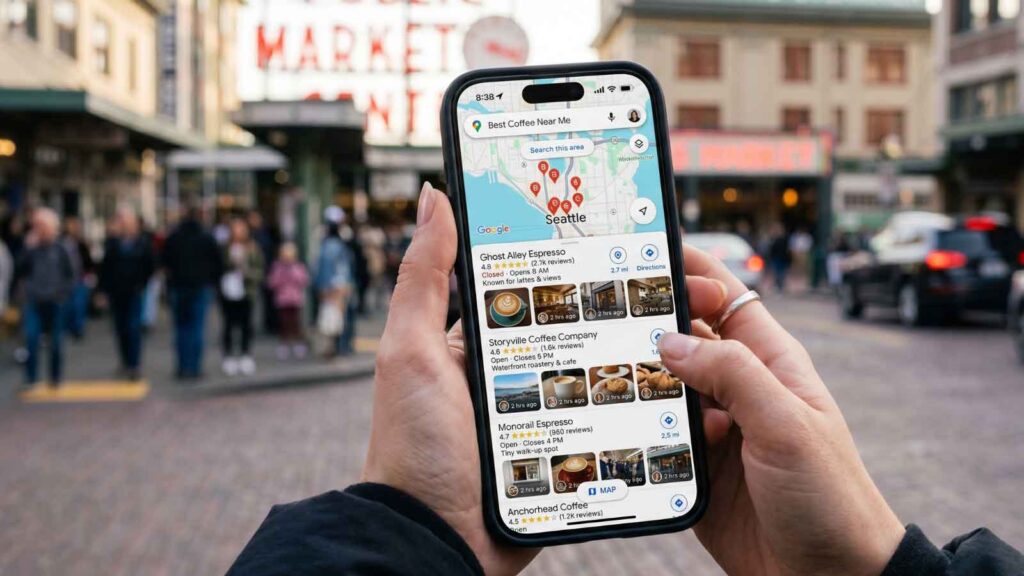
Dynamic management without measurement turns into busy work. Track four metrics weekly:
- Profile interactions. Calls, direction requests, website clicks, and booking clicks. These show which profile features are actually driving action.
- Review velocity. New reviews per month and response time to each. Both numbers should trend up or hold steady.
- Post engagement. Views and clicks on GBP posts show which content types your local audience actually responds to.
- Local pack position. Track your ranking on your top 10 priority keywords across the map pack and organic local results. For retailers, add product impressions and store visit conversions.
Watch for the compounding effect. Consistent posting builds freshness. Steady review velocity builds trust. Fresh photos drive engagement. Higher engagement improves rankings. Better rankings bring more profile views, more reviews, and more interactions. Measurable ranking shifts usually appear within the first quarter of consistent management, with faster lift in less competitive markets and longer ramp-up in dense metros where every competitor is running the same playbook.
Building Dynamic GBP Management Into Your Operations
Most businesses fail at dynamic GBP not from lack of awareness but from lack of operational rhythm. One-off optimization sprints don’t work. A repeatable weekly cadence does.
- Daily (5 minutes): Check Q&A for new questions, respond to messages, respond to new reviews.
- Weekly (30 minutes): Publish one GBP post tied to current business activity. Upload two to four new photos. Audit that hours reflect any schedule shifts.
- Monthly (60 minutes): Review the four metrics above. Benchmark against the prior month. Identify the one signal showing the weakest trend and add a specific action for the next 30 days.
- Quarterly (2 hours): Full profile audit. Verify the primary category is still optimal, business description reflects current services, attributes are accurate, and products/services are current. Compare against your top three local competitors and flag gaps.
For businesses with multiple locations or heavy competitive markets, a professional local SEO team manages this cadence at scale and tracks the signal-level data that DIY approaches miss. Agencies with local SEO depth handle the reputation layer through structured review acquisition and response programs, which tend to be the hardest lever for internal teams to sustain.
ALSO READ: Local Trust Signals That Drive Recommendations in GEO and AI
Stop Losing Local Pack Spots You Used to Own
The businesses treating GBP like a compliance checkbox are the ones watching competitors steal map pack spots they used to own. The ones posting weekly, earning fresh reviews, updating photos, keeping information current, and (for retailers) feeding Google live inventory are building durable local visibility that is hard to disrupt.
That reality is not going to reverse. User experience signals, engagement data, and AI search integration are all moving in the same direction. Dynamic profiles compound visibility. Static ones bleed it.
If your local rankings have slipped in the last 12 months or your map pack impressions are declining, the profile is almost always the first place to look. The Ad Firm’s local SEO team runs dynamic GBP audits that identify exactly which signals are weak, what your top competitors are doing that you are not, and what a realistic 90-day improvement plan looks like. Get in touch before another quarter of rankings gets taken by a competitor who figured this out first.