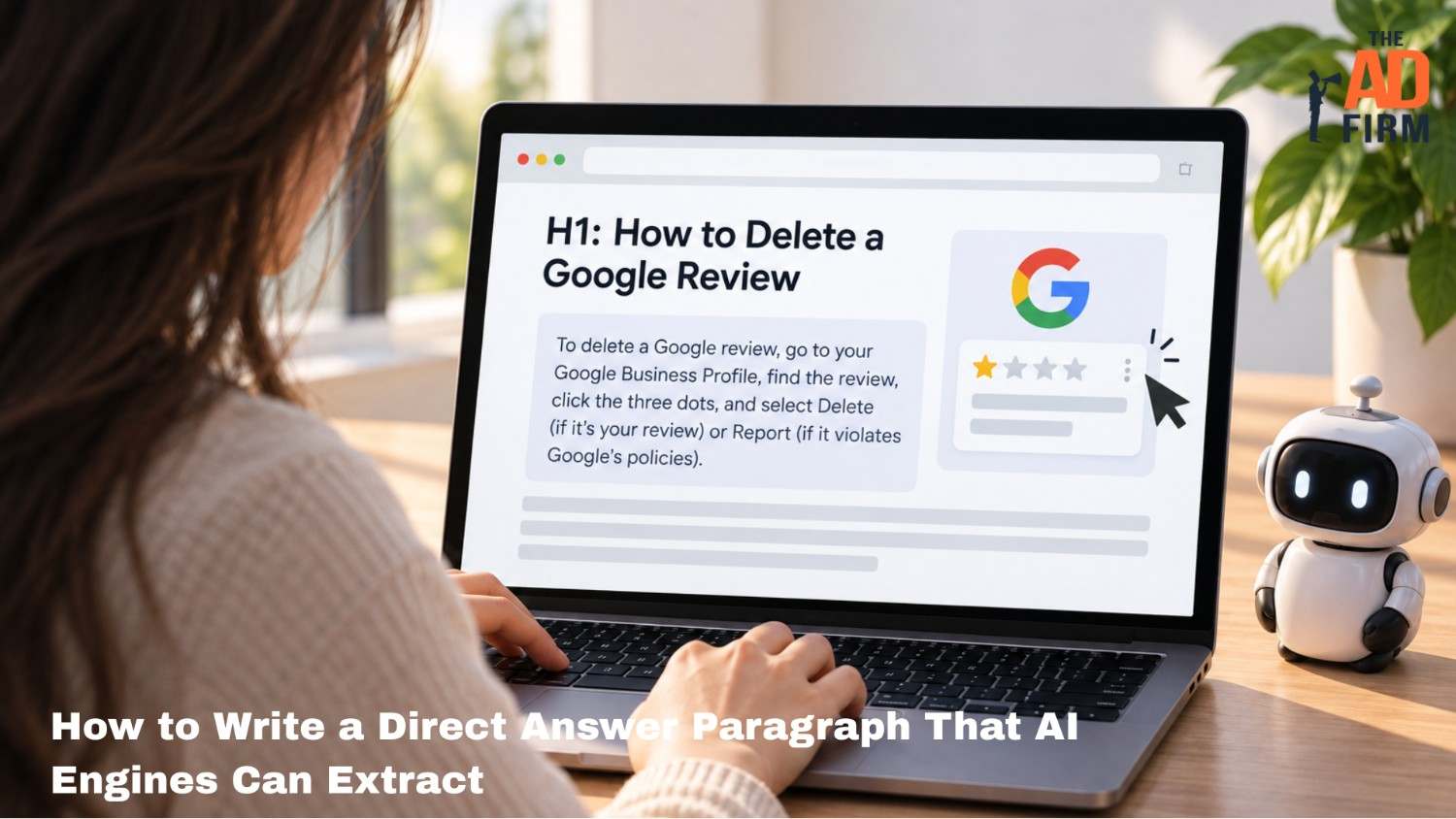
A direct answer paragraph gives the answer to a specific question immediately, using clear language that can stand on its own without surrounding context. This format helps readers find information quickly and gives AI search systems a concise passage they can evaluate when matching content to a question.
Writing answer-first content does not mean making every paragraph short or removing useful detail. The goal is to make the main answer easy to identify before expanding on it with explanations, examples, evidence, and supporting information.
Key Rules for AI Extraction
A strong direct answer paragraph should give the core answer first, remain concise, make sense on its own, use clear definitions, and match the question in the heading. These rules make the content easier for both people and AI systems to understand.
Lead With the Answer
Put the core conclusion or definition in the first sentence instead of starting with background information.
Avoid introductions such as “In today’s digital landscape” or “As businesses continue to…” when the reader is looking for a specific answer. Start with the information the reader actually came for.
Keep It Short
The paragraph should make sense if someone reads it without the paragraphs before or after it. This matters because an extracted passage may be presented separately from the rest of the page.
Avoid dependent pronouns such as “this,” “that,” or “they” when the reader needs previous context to understand what they mean. Instead, name the subject directly so the passage carries its own meaning.
Instead of writing:
This makes content easier for AI to understand.
Write:
Direct answer paragraphs make content easier for AI systems to identify and understand.
The second version does not require the reader or an automated system to determine what “this” refers to. The subject and the relationship between the subject and the result are explicit.
Make It Standalone
The paragraph should make sense if someone reads it without the paragraphs before or after it.
Avoid dependent pronouns such as “this,” “that,” or “they” when the reader needs previous context to understand what they mean.
Instead of writing:
This makes content easier for AI to understand.
Amplify Your Market Strategy with The Ad Firm
- PPC: Master the art of pay-per-click advertising to drive meaningful and measurable results.
- SEO: Elevate your visibility on search engines to attract more targeted traffic to your site.
- Content Marketing: Develop and implement a content marketing strategy that enhances brand recognition and customer engagement.
Write:
Direct answer paragraphs make content easier for AI systems to identify and understand.
The second sentence identifies exactly what “makes content easier” instead of relying on another paragraph for context.
Use Clear Definitions
Definitions should clearly connect the term with what it means. A simple format is:
[Term] is [clear definition].
For example:
A direct answer paragraph is a short passage that answers a specific question immediately and provides enough context to stand on its own.
This structure reduces ambiguity because the reader can identify the subject, category, and meaning in one place. It also gives the rest of the section a clear foundation for explaining how the concept works or when it should be used.
Add Essential Context
After the direct answer, add the information needed to clarify it. Essential context explains something the reader needs in order to understand, evaluate, or apply the answer.
This could include how something works, why it matters, who it applies to, what limitations exist, or what the reader should do next. Context is not the same as adding every related fact. Information that introduces a different topic should usually have its own section.
For example, if the answer explains what an XML sitemap does, useful context could explain which URLs belong in it and why inaccurate URLs create problems. A long history of search engine crawling would not be necessary unless the section is specifically about that topic.
Remove Filler
Cut sentences that do not contribute to the answer. Filler often appears as broad introductions, unnecessary transitions, or statements that sound informative without adding specific information.
Phrases such as “In today’s fast-changing digital world” or “There are many factors to consider” delay the useful information without explaining anything about the subject.
Removing filler also creates a stronger distinction between the answer and its supporting details. Instead of making the reader work through several sentences before reaching the useful point, give them the information that answers the question and use the remaining space for relevant explanation.
Use the Exact Subject
Name the subject instead of relying on pronouns.
For example:
XML sitemaps help search engines discover important website URLs.
Transform Your Online Strategy with The Ad Firm
- SEO: Achieve top search rankings and outpace your competitors with our expert SEO techniques.
- Paid Ads: Leverage cutting-edge ad strategies to maximize return on investment and increase conversions.
- Digital PR: Manage your brand’s reputation and enhance public perception with our tailored digital PR services.
is clearer than:
They help search engines discover important URLs.
The first sentence identifies the subject without requiring previous context. This matters when a passage is read independently, quoted, summarized, or evaluated alongside information from other parts of the page.
Pronouns are not inherently bad. The issue is ambiguity. If “they” could refer to several things in the surrounding discussion, repeating the subject makes the statement more precise.
Give One Clear Answer
Keep the opening focused on the question being asked. A direct answer paragraph works best when its main point can be identified without separating several competing ideas.
If a paragraph attempts to define a concept, explain its history, compare three alternatives, and give recommendations at the same time, the main answer becomes harder to identify. The reader may understand each individual statement but still have difficulty determining which one actually answers the question.
Keep related supporting details in the same section when they help complete the answer. Move separate topics into their own sections so each passage has a clear purpose.
Use Specific Language
Replace vague claims with concrete information.
Instead of saying:
This can help businesses improve their visibility.
say:
An XML sitemap gives crawlers a structured list of URLs that a website wants them to discover.
The second version tells the reader what the sitemap does rather than describing an unspecified benefit. Specific language also gives the surrounding explanation something concrete to build on.
Look for vague words such as “this,” “things,” “better,” “improve,” or “help” when they are not followed by a clear explanation. Replacing them with the actual subject, action, or outcome usually makes the paragraph more useful.
Keep the Answer Relevant to the Heading
The first paragraph should answer the exact question presented by the H2 or H3. Related information can follow, but the reader should not have to search through background material to find the answer.
If the heading asks “What Is Generative Engine Optimization?”, the first paragraph should define GEO. It should not begin with the history of search engines or a general explanation of digital marketing.
Advance Your Digital Reach with The Ad Firm
- Local SEO: Dominate your local market and attract more customers with targeted local SEO strategies.
- PPC: Use precise PPC management to draw high-quality traffic and boost your leads effectively.
- Content Marketing: Create and distribute valuable, relevant content that captivates your audience and builds authority.
This also helps prevent sections from becoming overly broad. If the supporting information starts answering a different question, that may be a sign that the topic needs its own heading.
How Should You Structure the Rest of the Content After the Direct Answer?
The direct answer is only the starting point. The rest of the section should give readers the information they need to understand the answer, apply it, and make decisions based on it.
Use the supporting paragraphs to add depth rather than repeating the opening statement. Depending on the topic, that depth can come from examples, explanations, evidence, comparisons, limitations, or practical steps.
Explain Why the Answer Matters
After giving the direct answer, explain its practical significance. This gives the reader a reason to understand the concept rather than simply remember a definition.
For example, after explaining that an XML sitemap helps crawlers discover URLs, the next paragraph could explain why this is particularly useful for large websites with deep navigation structures.
Use Supporting Examples
Examples help turn an abstract explanation into something practical. A strong example should demonstrate the principle rather than simply repeat the rule in different words.
For a technical SEO article, you could show an example of an accessible HTML structure. For a content article, you could show a weak opening next to a direct-answer version.
Examples can also show how the same writing principle works in different industries. For example, a local SEO article could change:
They can improve local visibility.
to:
Location pages can help a business provide search engines with specific information about the cities and service areas it serves.
For an ecommerce article, the same principle could be applied to product pages:
Product descriptions should explain the product’s key features, specifications, and intended use rather than relying on generic promotional language.
Add Structured Information
Lists, tables, definitions, and clearly organized sections can make complex information easier to scan. They allow related facts to be separated instead of forcing the reader to extract several details from one large paragraph.
For example, a comparison table can place competing options side by side, while a numbered list can show the sequence of a process. A definition followed by examples can separate the core concept from its supporting evidence.
Maximize Your Online Impact with The Ad Firm
- Local SEO: Capture the local market with strategic SEO techniques that drive foot traffic and online sales.
- Digital PR: Boost your brand’s image with strategic digital PR that connects and resonates with your audience.
- PPC: Implement targeted PPC campaigns that effectively convert interest into action.
The structure should match the information. A table is useful when attributes need to be compared, while a list is usually better for steps, requirements, or multiple examples.
Keep Each Section Focused
Each H2 and H3 should have a clear purpose. A section can contain several supporting points, but those points should contribute to the same main question.
If a section starts answering several unrelated questions, separate those topics into their own sections. This creates a clearer relationship between the heading and the information underneath it.
For example, a section explaining how to write direct answers can discuss sentence structure, context, and examples. A detailed discussion of structured data belongs in a separate section because it introduces a different technical topic.
Also Read: How to Structure Internal Links for Better AI Comprehension
How Do You Write a Direct Answer Paragraph?
Start by identifying the exact question the section needs to answer, then state the answer in the first sentence. Use the remaining sentences to provide only the context needed to make that answer complete and useful.
Identify the Main Question
Before writing, determine the single question the paragraph needs to answer.
For example, if the H2 is “What Is Technical SEO?”, the paragraph should define technical SEO rather than begin with a general discussion about why websites need SEO.
State the Answer in the First Sentence
The first sentence should contain the main point.
Instead of building toward the answer, give it immediately. This helps readers understand the section without having to read several sentences before concluding.
Add Essential Context
After the direct answer, add the information needed to clarify it.
This could include how something works, why it matters, who it applies to, or what a reader should do next.
Remove Filler
Cut sentences that do not contribute to the answer.
Phrases such as “In today’s fast-changing digital world” or “There are many factors to consider” often delay the useful information without adding meaning.
What Makes a Direct Answer Paragraph Easy for AI Engines to Extract?
A direct answer paragraph is easier to evaluate when it is self-contained, specific, clearly written, and directly aligned with the question in the heading. AI systems can use different retrieval and generation processes, so no single writing format guarantees extraction or citation.
Elevate Your Market Presence with The Ad Firm
- SEO: Boost your search engine visibility and supercharge your sales figures with strategic SEO.
- PPC: Target and capture your ideal customers through highly optimized PPC campaigns.
- Social Media: Engage effectively with your audience and build brand loyalty through targeted social media strategies.
Use the Exact Subject
Name the subject instead of relying on pronouns.
For example:
XML sitemaps help search engines discover important website URLs.
is clearer than:
They help search engines discover important URLs.
The first sentence identifies exactly what “they” means.
Give One Clear Answer
Keep the opening focused on the question being asked.
If a paragraph attempts to define a concept, explain its history, compare three alternatives, and give recommendations at the same time, the main answer becomes harder to identify.
Use Specific Language
Replace vague claims with concrete information.
Instead of saying:
This can help businesses improve their visibility.
say:
An XML sitemap gives crawlers a structured list of URLs that a website wants them to discover.
The second version tells the reader exactly what the sitemap does.
Keep the Answer Relevant to the Heading
The first paragraph should answer the exact question presented by the H2 or H3.
If the heading asks “What Is Generative Engine Optimization?”, the first paragraph should define GEO. It should not begin with the history of search engines or a general explanation of digital marketing.
Read More: How to Structure eCommerce Product Pages for AI Search Responses?
How Should You Structure the Rest of the Content After the Direct Answer?
The direct answer should come first, but it should not replace the detailed information readers need. After answering, expand the section with supporting explanations, examples, evidence, comparisons, or practical steps.
Answer First, Explain Second
Think of the section as two layers.
The first paragraph gives the immediate answer. The paragraphs that follow explain why the answer matters and provide the details the reader needs.
This structure works for both short informational pages and long-form articles.
Use Supporting Examples
Examples help turn an abstract explanation into something practical.
For a technical SEO article, you could show an example of an accessible HTML structure. For a content article, you could show a weak opening next to a direct-answer version.
Add Structured Information
Lists, tables, definitions, and clearly organized sections can make complex information easier to scan.
Structured content also helps separate different pieces of information instead of combining everything into large paragraphs.
Boost Your Business Growth with The Ad Firm
- PPC: Optimize your ad spends with our tailored PPC campaigns that promise higher conversions.
- Web Development: Develop a robust, scalable website optimized for user experience and conversions.
- Email Marketing: Engage your audience with personalized email marketing strategies designed for maximum impact.
Keep Each Section Focused
Each H2 and H3 should have a clear purpose.
If a section starts answering several unrelated questions, separate those topics into their own sections. This creates a clearer relationship between the heading and the information underneath it.
How Can The Ad Firm Help Businesses Create AI-Friendly Content?
AI-friendly content starts with clear information, but a broader AI Search strategy also considers content structure, technical accessibility, search intent, authority, and how information is presented across a website. The Ad Firm’s AI SEO services combine content strategy, structured data, technical improvements, and authority-building to help businesses improve visibility across AI-driven platforms.
The same answer-first principles can also support a broader Generative Engine Optimization strategy, where the goal is to make useful business information easier for generative search systems to understand and potentially use.
Want your website to give clearer answers to the questions your customers ask? Contact The Ad Firm to build an AI SEO and content strategy around those questions.
Frequently Asked Questions About Direct Answer Paragraphs
What Is a Direct Answer Paragraph?
A direct answer paragraph is a concise passage that answers a specific question immediately and provides enough context to make the answer understandable without relying on surrounding content.
How Long Should a Direct Answer Paragraph Be?
There is no universal required length. Around 40 to 60 words can be a useful guideline for many simple questions, but the paragraph should be as long as necessary to provide a complete answer without unnecessary detail.
Should Every H2 Start With a Direct Answer?
Not every H2 needs the exact same format, but question-based sections generally benefit from answering the question early. The first paragraph should make the section’s main point clear before providing additional explanation.
Can Direct Answer Paragraphs Improve AI Search Visibility?
Clear, standalone answers can make information easier for AI systems to identify and evaluate, but no paragraph format guarantees AI citations or visibility. Content still needs to be useful, relevant, accessible, and supported by the broader website.
Should a Direct Answer Paragraph Include Keywords?
Use relevant keywords naturally when they accurately describe the topic. The priority should be clarity and answering the question, rather than forcing a keyword into every sentence.
Streamline Your Digital Assets with The Ad Firm
- Web Development: Build and manage high-performing digital platforms that enhance your business operations.
- SEO: Leverage advanced SEO strategies to significantly improve your search engine rankings.
- PPC: Craft and execute PPC campaigns that ensure high engagement and superior ROI.
Can Direct Answers Work for Service Pages?
Yes. Service pages can use direct answers to explain what a service is, who it is for, what it includes, and how it addresses a specific customer problem.
What Should You Avoid in a Direct Answer Paragraph?
Avoid long introductions, vague statements, unnecessary qualifiers, unexplained terminology, excessive promotional language, and sentences that depend on information from earlier paragraphs. The reader should be able to understand the main answer from the paragraph itself.