Most business websites have a visual content problem that nobody notices until something forces them to look. Diagrams explaining service processes. Pricing tables built inside graphics. Team photos with names embedded as text on the image. Infographics summarizing key data. These are all invisible to AI search engines, not because AI can’t process images in general, but because the way most websites present images gives AI nothing to work with.
Google’s AI systems, ChatGPT’s search features, and Perplexity don’t browse websites visually the way a human does. They extract meaning from code: the text in the HTML, the structured data in the markup, the alt attributes on image tags. When that layer is empty or generic, the image simply doesn’t exist from an AI retrieval standpoint. The visual asset you invested in produces no SEO or citation value.
What Is Multimodal Search and Why Does It Change Image Requirements?
Search is no longer purely text-based on either end of the transaction. Users are submitting image-based queries through Google Lens, selecting visual elements in screenshots through Google Circle to Search, and uploading images as part of queries in Google AI Mode. On the retrieval side, AI search systems synthesize answers that can include images when those images are properly described, indexed, and associated with relevant structured data.
The term for this is multimodal search: search that involves multiple input or output types beyond plain text. Its practical significance for businesses is that images are now potential citation assets in AI-generated responses, not just visual decorations that sit on a page. A product photo with proper structured data and descriptive alt text can appear in an AI Mode response. A product photo with a filename of “IMG_4852.jpg” and no alt attribute will not.
How Google Lens and Circle to Search Affect Discovery
Google Lens processes billions of queries. Users photograph a product they see in a store and search for where to buy it online. They screenshot a social post and search for more information about the brand or item shown. They point their camera at a restaurant menu or a business sign and expect relevant results. In each case, Google is matching the visual input against indexed images that have sufficient supporting data to confirm the subject matter and point of origin.
Streamline Your Digital Assets with The Ad Firm
- Web Development: Build and manage high-performing digital platforms that enhance your business operations.
- SEO: Leverage advanced SEO strategies to significantly improve your search engine rankings.
- PPC: Craft and execute PPC campaigns that ensure high engagement and superior ROI.
For a business, this is a discovery channel that operates entirely outside traditional keyword-based traffic. A competitor whose product images have accurate alt text, descriptive filenames, Product schema markup, and clear page context will surface in Lens and Circle to Search queries for relevant products. The 5 signals AI search engines use to decide who gets cited apply directly to visual content. A business with stripped image metadata and empty alt attributes will not surface, regardless of how competitive its keyword rankings are.
How Google AI Mode Uses Visual Content
Google AI Mode accepts image inputs in queries and produces responses that can include visual content when appropriate. The images it retrieves and surfaces in responses are pulled from pages where the image is supported by matching structured data, descriptive alt text, and contextually relevant page copy. AI is reading your website differently than Google does in traditional search. The same principle applies to images: the AI reads the supporting data layer, not the visual itself.
When a user asks AI Mode about a local service business and the response includes a photo of the business, that photo came from a source where the image was properly attributed, the business location was confirmed in structured data, and the visual content matched the surrounding text. These connections don’t form by accident. They require deliberate image optimization that most businesses haven’t done.
Why Most Business Websites Fail the Visual Search Test
The majority of business images online were uploaded for aesthetics, not discoverability. The alt text field was left blank because the person uploading the image didn’t know what it was for. Or it was populated with a filename like “photo1” or a developer’s placeholder like “banner image.” The image file itself was named with a camera’s auto-generated string. No structured data connects the image to the business entity, the product it depicts, or the service it illustrates.
This isn’t a failure of intent. It’s a failure of process. Most content management systems don’t prompt for complete image metadata when a file is uploaded. Most design workflows focus on how images look, not what information they carry in their markup. The result is that a website can be visually impressive and completely opaque to the systems now handling an increasing share of search queries.
Advance Your Digital Reach with The Ad Firm
- Local SEO: Dominate your local market and attract more customers with targeted local SEO strategies.
- PPC: Use precise PPC management to draw high-quality traffic and boost your leads effectively.
- Content Marketing: Create and distribute valuable, relevant content that captivates your audience and builds authority.
What AI Crawlers Actually See When They Hit Your Images
When an AI crawler processes a page, it reads the HTML. An image tag with no alt attribute looks like this to the crawler: a visual element with no described content. An image tag with an alt attribute of “image” or the filename gives the crawler a label but no information. An image tag with a specific, descriptive alt attribute (“exterior of The Ad Firm’s San Diego office, featuring the front entrance and branded signage”) gives the crawler content it can associate with the business entity, the location, and the subject matter.
The page context surrounding the image matters as much as the alt attribute. An image sitting inside a div with no accompanying text, no heading that frames its subject, and no structured data declaring what it depicts is harder for an AI to interpret than one embedded in a paragraph that explains what the image shows and why it’s relevant. Cross-channel brand signals apply directly here: the more consistently an image is described across its alt text, surrounding content, structured data, and caption, the more confidently an AI system can identify and cite it.
The Specific Content Types Most at Risk
Text-heavy images are the highest risk category. Infographics that present statistical data as a visual. Pricing tables designed in Photoshop and exported as a flat image file. Step-by-step process diagrams where each step exists only as rendered text inside the graphic. Comparison charts that show product features as visual elements rather than HTML table data.
None of that text is readable to AI crawlers without OCR, and most crawlers rely on structured markup rather than image recognition for indexing purposes. Any business whose content strategy depends on infographics, designed data visualizations, or image-based tables needs to either duplicate that information in HTML text or build the visual content on top of existing text content rather than as a replacement for it.
What Does Google’s AI Optimization Guide Actually Recommend?
Google publishes specific guidance for AI feature optimization at developers.google.com/search/docs/appearance/ai-features. Reading it is reassuring: no special AI files, no new markup formats, and no “chunking” strategies are required. Good foundational SEO applied to visual content is the path to AI feature visibility.
Enhance Your Brand Visibility with The Ad Firm
- SEO: Enhance your online presence with our advanced SEO tactics designed for long-term success.
- Content Marketing: Tell your brand’s story through compelling content that engages and retains customers.
- Web Design: Design visually appealing and user-friendly websites that stand out in your industry.
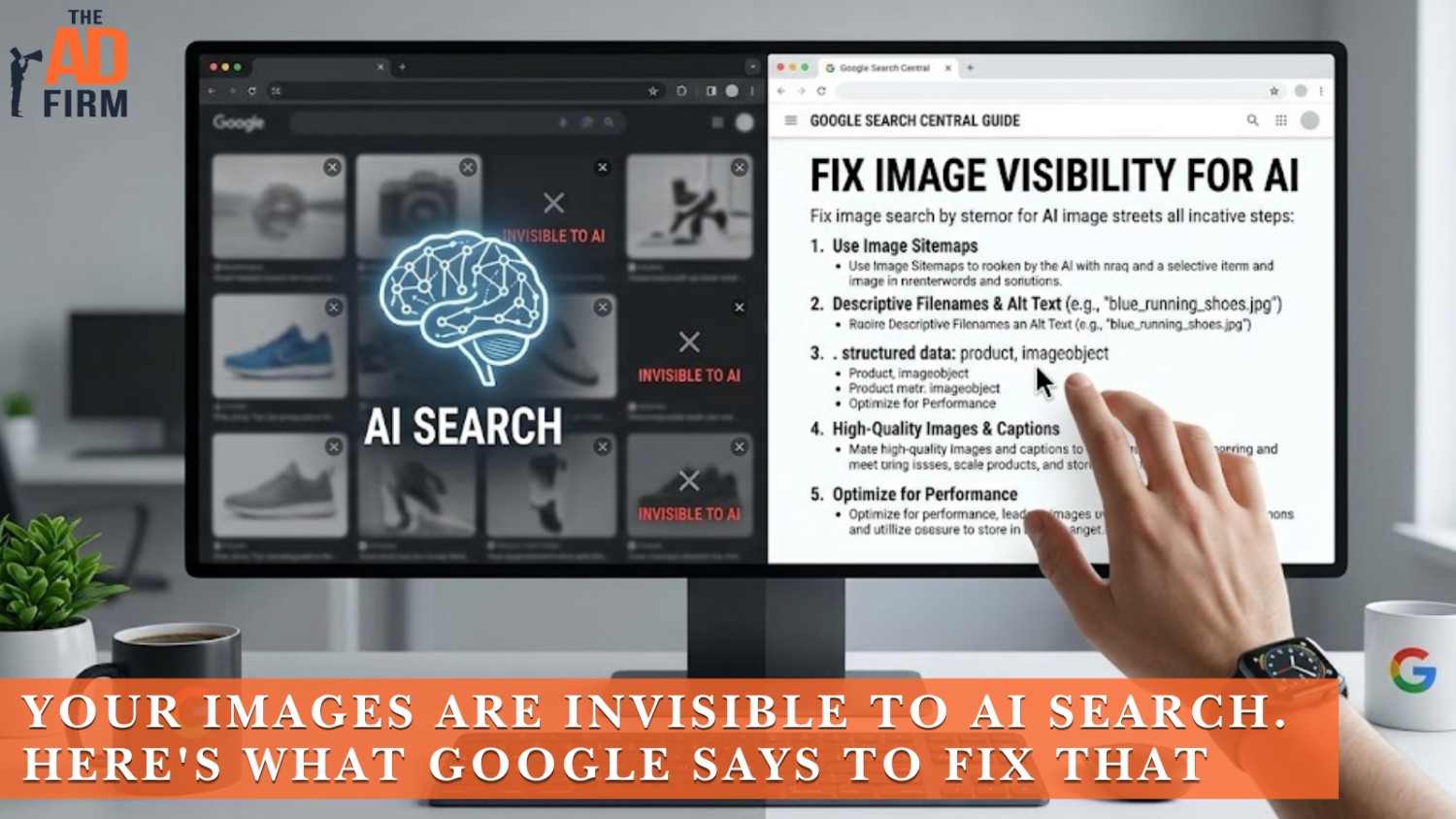
Four categories emerge from Google’s guide: descriptive alt text, high-quality original images, structured data, and platform-specific actions for local and e-commerce businesses. Each addresses a different layer of the image discoverability problem, and together they form the complete picture of what Google’s own AI systems need in order to retrieve and surface visual content.
Descriptive Alt Text: What Google Actually Wants
Google’s guidance on alt text is specific: alt text should describe the image accurately and concisely, including any text that appears within the image. Keyword stuffing is out, as is repeating the page title or the image filename. Alt text should tell the crawler what a person would see if they looked at the image.
For a product image, that means describing the product, its key features visible in the photo, and any text overlaid on the image. For a service illustration, that means describing what the image depicts, what process or concept it illustrates, and what the viewer is supposed to take away. For a team photo, that means naming the people shown and their roles. Each of these is a distinct, specific data point that feeds both traditional image search and AI retrieval. Technical SEO audits that include image metadata review are among the highest-leverage improvements available for sites that have historically ignored this layer.
Original Images and Why Google’s AI Favors Them
Google’s AI feature guidance specifically notes the preference for high-quality, original images over stock photography. The reasoning maps directly to how AI systems evaluate source credibility: a business that publishes original visual content it genuinely created is demonstrating expertise and authenticity that stock imagery cannot replicate.
For AI Mode and AI Overviews, original images carry a stronger attribution signal. A photo taken at a real project site by a local business carries entity-confirming information that a stock image of a generic worksite does not. Google’s systems can cross-reference original images against other signals about the business entity, strengthening the connection between the visual content and the source. Stock photos, by definition, appear across thousands of sites and provide no attribution signal at all.
Amplify Your Market Strategy with The Ad Firm
- PPC: Master the art of pay-per-click advertising to drive meaningful and measurable results.
- SEO: Elevate your visibility on search engines to attract more targeted traffic to your site.
- Content Marketing: Develop and implement a content marketing strategy that enhances brand recognition and customer engagement.
Structured Data for Visual Content
Google recommends three primary schema types for image and video optimization: ImageObject, VideoObject, and Product. ImageObject schema wraps a standalone image with machine-readable metadata including the image URL, description, author, and date. VideoObject schema does the same for video content, including duration, upload date, and transcript data. Product schema connects product images to product entities with pricing, availability, and review data.
For local businesses, Google’s guidance points to Google Business Profile as the primary platform for image optimization in local AI features: current photos of the business exterior, interior, products, and team, tagged to the correct location. For e-commerce businesses, Google Merchant Center feeds product images into Shopping features and AI-generated product responses. These platform actions are distinct from schema markup but serve the same purpose: giving Google’s AI systems verified, structured information about what an image depicts and where it comes from.
What Does a Practical Image SEO Audit Look Like?
The audit question isn’t how your images look. It’s how much machine-readable information they carry for AI crawlers. That’s a five-question test that can be applied to every image on a business website and produces a clear remediation list.
Running this audit before starting any content production or redesign work surfaces the image optimization gaps that are costing citation opportunities right now, with changes that require no design work and minimal development resources.
The Five Questions to Ask About Every Image
Run these five questions against every image on your site. Each gap is a remediation task.
- Does the image have descriptive alt text? Not a filename, not a generic label. It should be a specific description of what the image shows, including any text visible within it. An empty or placeholder alt attribute makes the image invisible to AI retrieval.
- Is the image filename meaningful? “local-seo-audit-checklist.jpg” tells a crawler more than “screenshot-2024.jpg” ever can. Filenames are indexed. Renaming before re-uploading is a low-effort fix with measurable impact.
- Is there matching text on the page? An image of a completed project embedded on a page with no supporting copy gives AI systems nothing to work with. The same image inside a case study paragraph that describes the client, scope, and outcome gives AI systems a complete story to cite.
- Does relevant structured data exist? Product images need Product schema. Service business photos need LocalBusiness schema and current Google Business Profile photos. Charts or diagrams need ImageObject schema, or ideally their content moved into HTML text that AI can read directly.
- Is the image original or stock? Original images showing your actual business, team, or work carry attribution signals that stock imagery cannot provide. A full SEO audit surfaces which pages are most dependent on stock imagery and most exposed to this gap.
Is Your Visual Content Working for AI Search or Against It?
Your images are either contributing to your AI search visibility or they’re neutral at best, invisible at worst. The gap between a site with complete image metadata and one with empty alt attributes isn’t technical difficulty. It’s the accumulated result of a process that never asked the right questions about image discoverability when content was being produced and uploaded.
Maximize Your Online Impact with The Ad Firm
- Local SEO: Capture the local market with strategic SEO techniques that drive foot traffic and online sales.
- Digital PR: Boost your brand’s image with strategic digital PR that connects and resonates with your audience.
- PPC: Implement targeted PPC campaigns that effectively convert interest into action.
The Ad Firm’s AI SEO and technical SEO services include a complete audit of image metadata, structured data, and visual content strategy across your site. We identify the specific images and pages creating the biggest AI visibility gaps, implement the schema markup and alt text infrastructure Google’s guidance recommends, and build the visual content foundation that gives AI systems something to retrieve and cite. Operating since 2009 with a 4.9-star rating across more than 1,400 client reviews and Google Premier Partner status, we work with businesses that want their entire digital presence, visual content included, to earn its place in AI-generated responses. Contact us when you’re ready to fix what AI can’t see.
Frequently Asked Questions
Does Google’s AI actually use image alt text in AI Mode responses?
Yes. Alt text is one of the primary signals Google uses to understand what an image depicts. When AI Mode retrieves images for inclusion in a response, it draws on alt text, page context, structured data, and image filename to determine relevance and accuracy. An image with no alt text or a generic alt attribute is less likely to surface in AI responses than one with specific, descriptive attribution.
Do I need to add special AI markup to my images?
No. Google’s own guidance makes this clear: no AI-specific files or markup are needed. The optimization required for AI feature visibility is the same foundational image SEO that has always mattered: descriptive alt text, meaningful filenames, relevant page context, and appropriate structured data like ImageObject, Product, or LocalBusiness schema depending on the content type.
Is stock photography hurting my AI search visibility?
It limits it rather than actively hurting it. Stock images carry no attribution signal: they exist across thousands of different sites and give AI systems no entity-specific information to work with. Original images that show your actual business, team, or work carry confirmation signals that help AI systems connect the visual content to your specific entity. Stock imagery on key landing pages is a missed opportunity, not a penalty.
How long does it take for image SEO improvements to affect AI visibility?
Google recrawls pages on variable schedules, but significant changes to page content and metadata are typically picked up within weeks. Structured data changes and alt text updates are processed relatively quickly once the page is recrawled. The more substantive change, replacing stock imagery with original content and adding contextual text around existing images, affects AI visibility on a longer timeline because the entity signals those changes produce need to be confirmed across multiple sources before they influence AI retrieval.
Boost Your Business Growth with The Ad Firm
- PPC: Optimize your ad spends with our tailored PPC campaigns that promise higher conversions.
- Web Development: Develop a robust, scalable website optimized for user experience and conversions.
- Email Marketing: Engage your audience with personalized email marketing strategies designed for maximum impact.