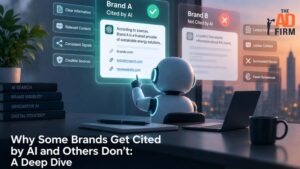
Some brands get cited by AI because their information is clear, relevant, consistent, and supported by credible sources, while others may have a strong online presence but lack the signals AI engines need to confidently use their content. Being visible online does not automatically mean being selected as a source in an AI-generated answer.
AI engines need to understand what a business does, what topics it covers, and how reliable its information appears across the web. They also need to connect that information to the specific question a user is asking.
Several factors can influence that decision, starting with how clearly a brand communicates what it does and the information it wants AI engines to associate with its business.
1. AI Engines Need Clear Information About Your Brand
AI engines cannot cite information they cannot clearly understand. A brand’s website should make it obvious what the business does, which services or products it provides, who it serves, and what topics it has expertise in.
Clear information also needs to be organized across the right pages. A service page should explain the service directly. An About page should provide useful information about the business and its expertise. Supporting content should answer related questions instead of leaving important information scattered across unrelated pages.
Several elements can help establish a clearer picture of your brand:
- Clear service and product descriptions
- Detailed service pages
- Useful About and company information
- Author and expert information where relevant
- Frequently asked questions
- Supporting educational content
- Consistent descriptions of your business and offerings
When these details are easy to find and connected logically, AI systems have more information to work with when determining which sources are relevant to a user’s question.
AI SEO can support this process by examining how your website communicates your expertise and identifying areas where important information may be unclear, incomplete, or difficult to connect.
2. Consistent Brand Signals Build Stronger AI Recognition
A brand does not exist only on its own website. Information about the business can appear across directories, social profiles, review platforms, industry websites, publications, and other third-party sources.
Maximize Your Online Impact with The Ad Firm
- Local SEO: Capture the local market with strategic SEO techniques that drive foot traffic and online sales.
- Digital PR: Boost your brand’s image with strategic digital PR that connects and resonates with your audience.
- PPC: Implement targeted PPC campaigns that effectively convert interest into action.
When these sources consistently describe the same business, they can provide a more coherent picture of the brand.
For example, your website may describe your company as a provider of commercial accounting services, while several important third-party profiles describe it only as a general business consultant. If other sources also contain outdated services, locations, or company descriptions, AI systems may encounter conflicting information.
Important details to keep consistent include:
- Business name
- Services and products
- Locations
- Areas served
- Company descriptions
- Industry or business category
- Key people and expertise
- Contact and website information
This does not mean every mention of your brand needs to use identical wording. The important point is that the underlying facts should remain accurate and consistent.
The Ad Firm’s online reputation management work can help businesses review and manage the information appearing across external sources so important brand details remain accurate and aligned.
3. AI Engines Look for Content That Directly Answers Questions
AI-generated answers are built around questions and information needs. Content that clearly addresses those needs gives AI engines useful material to interpret and potentially reference.
A page does not need to be written specifically for an AI engine. It needs to provide useful information in a way that is clear and easy to understand.
Strong supporting content can include:
- Direct answers to common customer questions
- Definitions of industry terms
- Comparisons between products or services
- Explanations of processes
- Detailed service information
- Examples and practical guidance
- Supporting facts and context
For example, a page that simply says a company provides “high-quality commercial insurance solutions” gives limited information. A stronger resource could explain the types of coverage offered, who typically needs each option, common questions, and factors businesses should consider.
This gives AI engines more substance to work with when generating an answer.
Content marketing can support this by developing useful resources around the topics and questions that matter to your audience. The goal is not to create pages simply to increase content volume. Each piece should provide information that serves a clear purpose.
Transform Your Online Strategy with The Ad Firm
- SEO: Achieve top search rankings and outpace your competitors with our expert SEO techniques.
- Paid Ads: Leverage cutting-edge ad strategies to maximize return on investment and increase conversions.
- Digital PR: Manage your brand’s reputation and enhance public perception with our tailored digital PR services.
4. Your Website Structure Can Affect What AI Engines Understand
Good content can still be difficult to use if important information is buried inside a confusing website structure.
AI systems need to access and interpret the information on your website. Clear organization helps establish the relationship between your main services, supporting topics, and individual pages.
Important areas to review include:
- Clear page titles and headings
- Logical content sections
- Descriptive URLs
- Internal links between related pages
- Crawlable website content
- Structured data where appropriate
- Accessible information
- Consistent navigation
Structured data can also make important information easier for search and AI systems to interpret. Internal linking is particularly useful for showing how related topics connect. A main service page can link to supporting guides, FAQs, case studies, and related services. Those pages can then link back to the primary service when appropriate.
Crawl access is another consideration. Check your robots.txt file and other technical settings to make sure important pages are not unintentionally blocked from relevant AI crawlers. Depending on the platforms you want to monitor, this may include crawlers such as GPTBot, ClaudeBot, PerplexityBot, and Google-Extended.
Web design also plays a role because the way information is organized and presented affects how easily visitors and search systems can access it. A well-structured website provides a stronger foundation for both traditional search and AI-focused optimization.
5. Authority and Third-Party Sources Can Strengthen AI Citations
AI engines do not rely exclusively on a brand’s own website. They can also use information from external sources when generating answers.
These sources may include:
- Industry publications
- Relevant business directories
- News websites
- Review platforms
- Professional organizations
- Expert profiles
- Other authoritative websites
Third-party information can provide additional context around a brand’s expertise and reputation. If several relevant sources independently discuss a company in connection with a particular service or subject, that information can reinforce the relationship between the brand and that topic.
This does not mean collecting as many mentions as possible. Relevance matters. A mention from a credible source that is closely connected to your industry can be more meaningful than a large number of unrelated references.
Elevate Your Market Presence with The Ad Firm
- SEO: Boost your search engine visibility and supercharge your sales figures with strategic SEO.
- PPC: Target and capture your ideal customers through highly optimized PPC campaigns.
- Social Media: Engage effectively with your audience and build brand loyalty through targeted social media strategies.
Traditional SEO also contributes to this broader foundation through work involving content, site structure, authority, and relevant external signals.
6. Being Relevant to the Query Matters More Than Simply Being Visible
A brand can have strong website traffic, rankings, and online recognition and still be absent from an AI-generated answer.
The reason is simple: AI engines are responding to a specific question.
The system needs to determine which available information is relevant to that particular request. A business may be highly visible for one topic but have little useful information connected to another.
For example, a law firm may have strong online visibility for personal injury services but may not be cited when someone asks a highly specific question about business contracts if its website provides little information on that subject.
AI visibility depends on the relationship between:
- The user’s question
- The brand’s expertise
- The information available on the website
- The supporting content around that topic
- Relevant third-party information
- The sources AI engines can access
This is one reason generative engine optimization focuses on more than simply increasing website visibility. The goal is to build stronger connections between a brand and the topics for which it wants to be recognized.
Read More: E-E-A-T for Local Businesses: What It Means and How to Build It
How Can Brands Increase Their Chances of Being Cited by AI?
The first step is finding out where your brand currently stands. Test relevant questions across AI engines and record the brands and sources that appear.
From there, you can compare your website with the sources being cited and identify specific gaps.
- Audit your current AI visibility: Test relevant prompts across major AI platforms and record mentions, citations, and cited pages.
- Identify citation gaps: Find questions where competitors or third-party sources appear while your brand is absent.
- Review the cited sources: Study the pages AI engines are using and identify the information they provide.
- Strengthen relevant pages: Improve service pages and other important resources with clearer, more useful information.
- Build supporting content: Create resources that answer related questions and strengthen your coverage of important topics.
- Improve internal connections: Link related pages so your website establishes clearer relationships between services and supporting topics.
- Review technical structure: Check headings, page organization, structured data, accessibility, and other elements that affect how information can be understood.
- Strengthen external signals: Review relevant third-party mentions and make sure important information about your brand is accurate.
- Keep information current: Update outdated service details, company information, statistics, and other important content.
- Continue monitoring: Test the same questions over time to determine if your brand’s AI visibility and citations change.
The process is ongoing. AI engines can change their results, and competitors can publish new information that changes which sources appear for specific questions.
Boost Your Business Growth with The Ad Firm
- PPC: Optimize your ad spends with our tailored PPC campaigns that promise higher conversions.
- Web Development: Develop a robust, scalable website optimized for user experience and conversions.
- Email Marketing: Engage your audience with personalized email marketing strategies designed for maximum impact.
Build a Stronger Foundation for AI Citations
The Ad Firm can help businesses turn AI citation gaps into a broader optimization strategy. The work starts with understanding how your brand currently appears in AI-generated answers, then identifying the content, technical, authority, and brand signals that may be limiting its visibility.
This can include:
- Reviewing your existing website and content
- Testing how AI engines describe and reference your brand
- Identifying topics where competitors receive citations
- Finding gaps across important service and informational pages
- Improving content so important information is clearer and more useful
- Strengthening the connections between related topics and services
- Reviewing website structure and technical elements
- Assessing third-party brand information and relevant mentions
- Developing supporting content around important topics
- Tracking changes in AI mentions and citations over time
If your competitors are appearing in AI-generated answers while your brand is being overlooked, The Ad Firm can review the signals behind that difference and identify practical areas to strengthen. Talk to our team today!
Frequently Asked Questions About AI Citations
Why does AI cite some brands but not others?
AI engines select sources based on factors such as relevance, available information, source quality, and how well the content addresses the user’s question. A brand can have strong online visibility and still not be selected for a particular query.
Does ranking well on Google guarantee AI citations?
No. Traditional search rankings and AI citations are related but are not the same thing. A high-ranking page is not automatically used as a source in an AI-generated answer.
Does having more content increase AI citations?
More content alone does not guarantee more citations. Useful, relevant, well-structured content that directly addresses important questions can provide more valuable source material than a large volume of repetitive pages.
How important are third-party mentions for AI visibility?
Third-party sources can provide additional information about a brand’s expertise, services, and reputation. Relevant and credible external references can contribute to the broader information AI engines use when generating answers.
Can a small business get cited by AI engines?
Yes. AI citation visibility is not limited to large companies. A smaller business can provide useful, relevant information and build a strong presence around specific topics, services, or areas of expertise.
Strengthen Your Online Authority with The Ad Firm
- SEO: Build a formidable online presence with SEO strategies designed for maximum impact.
- Web Design: Create a website that not only looks great but also performs well across all devices.
- Digital PR: Manage your online reputation and enhance visibility with strategic digital public relations.
How long does it take to improve AI citation visibility?
There is no fixed timeline. Results can depend on the brand’s existing content, website structure, authority, competition, and the AI platforms and queries being monitored. Consistent testing can help show how visibility changes over time.
Can SEO and AI SEO work together?
Yes. Traditional SEO can strengthen the website’s content, structure, and authority, while AI SEO focuses on how information can be understood and referenced in AI-generated answers. The two strategies can support the same broader online presence.