AI engines favor comparison tables and lists since those formats break information into clear, self-contained pieces that are easy to extract, compare, and cite. A table lines up options against the same criteria. A numbered list lays out steps in order. Both give an AI system exactly what it needs to answer a question without guessing at how the facts connect.
That doesn’t mean every page should become a wall of bullet points. Structure works best when it matches the question a reader is asking. For businesses investing in Generative Engine Optimization, knowing when and how to use these formats can make the difference between being quoted in an AI answer and being skipped.
Why Do AI Engines Prefer Structured Content?
The reason comes down to how these systems work: when ChatGPT, Perplexity, or Google’s AI features respond to a question, they pull passages from web pages and need clean, bounded pieces to quote accurately. A list or table gives them exactly that.
Long, winding paragraphs make that harder. If a key fact is buried in the middle of a 200-word block, an AI system has to figure out where the answer starts and stops. A list item or table row removes that problem.
Recent research points the same way. A 2026 analysis by AirOps found that nearly 80% of pages cited by ChatGPT included at least one structured list, compared with fewer than a third of Google’s top-ranking pages. The same research found that most ChatGPT-cited pages followed a logical, sequential heading structure. These findings show a strong correlation, not proof that structure alone causes citations, but the pattern is consistent.
Tables and lists don’t do the same job, though. Tables tend to produce cited comparisons, where an AI answer weighs one option against another. Lists tend to produce cited enumerations, such as a set of steps, options, or factors to consider.
Learn More: How to Write a Direct Answer Paragraph That AI Engines Can Extract
What Types of Structured Content Do AI Engines Cite Most?
The structured formats AI engines cite most are comparison tables, numbered steps, bulleted lists, and question-and-answer sections. Each one fits a different kind of question.
- Comparison tables answer “which is better” and “what’s the difference” questions by showing options side by side.
- Numbered lists answer “how do I” questions with steps in a clear order.
- Bulleted lists answer “what are the options” or “what should I consider” questions with scannable points.
- FAQ sections answer specific questions directly, often in the exact phrasing people search with.
- Pros and cons lists help readers weigh a single option before deciding.
Matching the format to the question matters more than using every format at once. A recipe needs numbered steps. A software comparison needs a table. A guide to choosing a contractor may need a checklist.
When Should You Use a Comparison Table?
You should use a comparison table when you’re comparing two or more options across the same set of features. Tables make differences obvious at a glance, and they give AI engines clearly paired data points to quote.
Here’s a simple example a roofing company might publish:
| Roofing Material | Typical Lifespan | Relative Cost | Best For |
| Asphalt shingles | 15 to 30 years | Low | Budget-friendly replacements |
| Metal roofing | 40 to 70 years | Medium to high | Long-term durability |
| Clay or concrete tile | 50+ years | High | Warm climates and Spanish-style homes |
| Slate | 75+ years | Very high | Historic and premium homes |
A searcher asking “how long does a metal roof last compared to shingles” can get a direct answer from that table, and so can an AI engine.
When you’re evaluating a single option instead of several, a pros and cons list works better than a table. A page about metal roofing, for example, might list durability and energy efficiency as pros and higher upfront cost and noise during heavy rain as cons. That format answers “Is it worth it?” questions directly.
Tables work especially well for:
- Product and service comparisons
- Pricing tiers or package options
- Feature breakdowns
- Specifications, such as sizes, materials, or compatibility
Online stores can put this to work on category and product pages. Comparison tables that line up sizes, materials, and price ranges help shoppers decide faster, and Ecommerce SEO can build those comparisons into pages designed to rank.
How Do You Format Lists and Tables So AI Engines Can Read Them?
You format lists and tables for AI engines by building them in real HTML, labeling them clearly, and keeping each entry consistent. Small formatting choices decide if a crawler sees organized data or a jumble of text.
Use Real HTML, Not Images
A table saved as a screenshot or graphic can’t be read like text. Build tables with standard HTML table tags and lists with proper list tags, so crawlers can see the rows, columns, and items. If you want a visual version for design reasons, publish the image alongside an HTML table that holds the same information, not in place of it.
Introduce Every List and Table
Add a short sentence before each list or table that explains what it shows. That context helps readers and gives AI engines a clear label for the information that follows. A line such as “This table compares four roofing materials by lifespan, cost, and best use” tells everyone what to expect before the first row.
Keep Entries Parallel and Specific
Every item in a list should follow the same grammatical pattern, such as starting each bullet with a verb or a noun. The same logic applies to tables: every row should use the same units and level of detail, and “15 to 30 years” next to “a long time” weakens the comparison.
Use Descriptive Headings
Place lists and tables under headings that state what they cover, ideally as a question. A heading like “How Long Do Different Roofing Materials Last?” tells both readers and AI systems exactly what the section answers. A vague heading like “Our Options” gives no hint about what the list or table compares.
Read More: How to Write Header Tags That Help Both Readers and Search Engines
Match Structured Data to the Page
If you use schema markup for FAQs, products, or how-to content, make sure it reflects what visitors
actually see. Google’s guidance for its AI features states that structured data should match the visible text on the page. Technical SEO reviews can confirm that markup and content line up.
What Does AI-Friendly Structured Content Look Like?
AI-friendly structured content puts each fact in its own defined spot, so readers and AI engines can find an answer without reading the whole page. The examples below show how the same information reads when it’s organized well, what makes a strong comparison table easy to cite, and how different question types call for different formats.
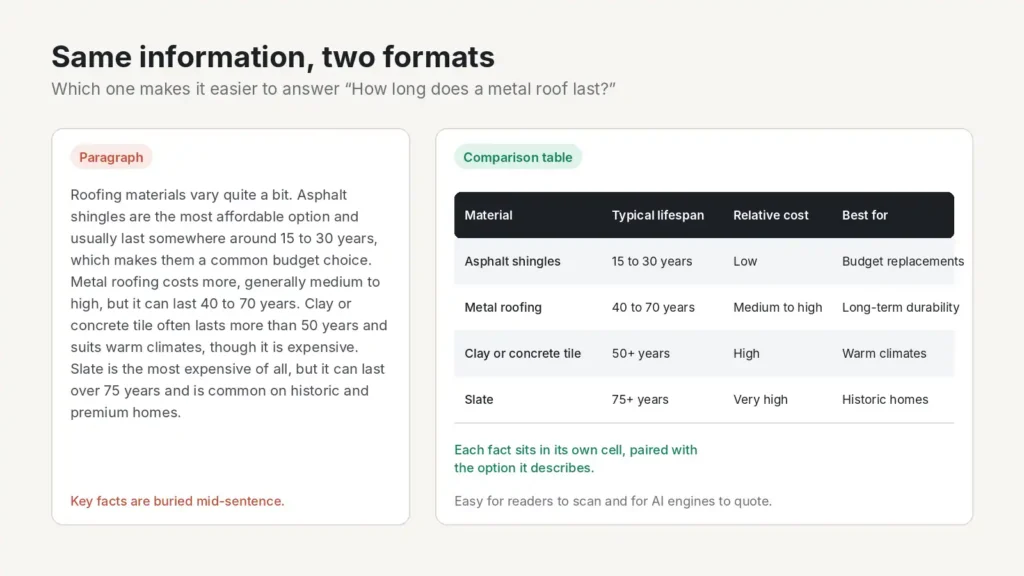
Side-by-side comparison of roofing material information written as a paragraph and organized as a comparison table
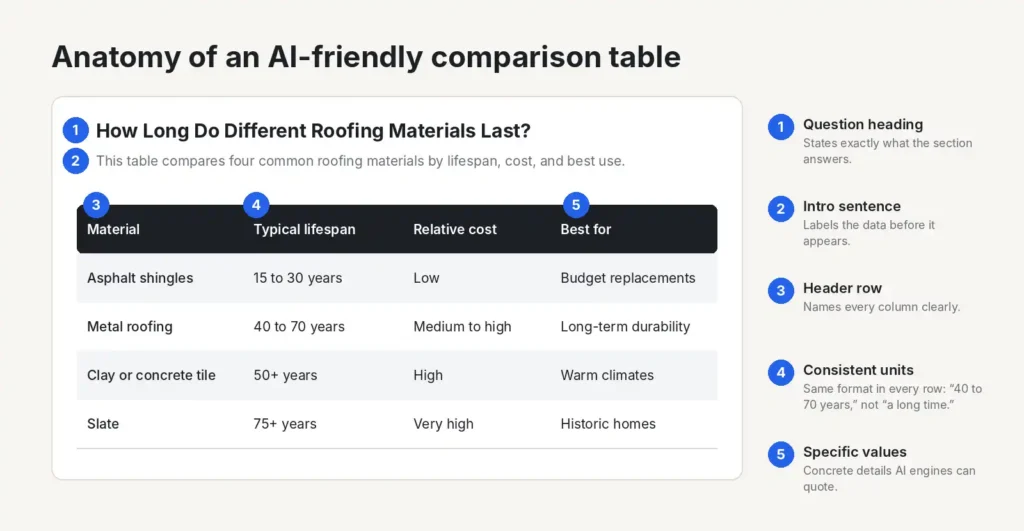
Annotated comparison table of roofing materials labeling the question heading, intro sentence, header row, consistent units, and specific values
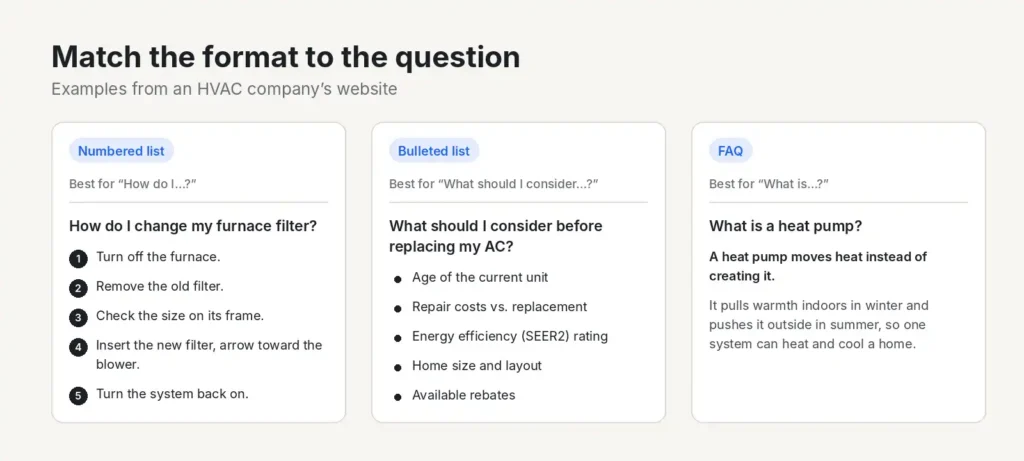
Three examples from an HVAC website showing a numbered list for how-to steps, a bulleted list for considerations, and an FAQ answer for a definition
Same Information, Two Formats
The first image shows roofing details written two ways. In the paragraph, the lifespan of metal roofing sits in the middle of a long sentence, surrounded by details about other materials. In the table, the same fact appears in its own cell, paired with the material it describes. A reader scanning for “How long does a metal roof last?” finds the answer in seconds, and an AI engine can quote it without pulling in unrelated information.
Anatomy of a Comparison Table
The second image breaks down the parts that make a table easy to cite. A question-based heading states what the section answers. A short intro sentence explains what the table compares. A header row names every column, each row uses the same units, and every cell holds a specific value instead of a vague description. Leave out any of these, and the table becomes harder to read and harder to quote accurately.
Format by Question Type: Three Examples
The third image shows how one HVAC company might apply these formats on its site: a numbered list for changing a furnace filter, a bulleted list of factors to weigh before replacing an air conditioner, and a short FAQ answer defining a heat pump.
Common Mistakes With Structured Content
Structured formats help only when they’re used well. These are the issues that most often weaken them:
- Turning everything into a list. Some ideas need explanation. Breaking a nuanced point into fragments can strip out the reasoning readers need.
- Tables loaded by JavaScript. Content that appears only after scripts run may not be visible to every AI crawler.
- Vague list items. Bullets like “Great quality” or “Fast service” give an AI engine nothing specific to quote.
- Oversized tables. A table with 15 columns is hard to read on a phone and hard to summarize in an answer.
- Missing context. A table with no heading or introduction leaves readers and AI systems guessing about what it compares.
Tables need extra care on mobile. A few practical fixes:
- Limit columns. Four or five columns usually fit on a phone screen. Split larger comparisons into two smaller tables.
- Allow horizontal scrolling. Wrapping a table in a scrollable container keeps every column readable without shrinking the text.
- Stack rows on small screens. Some layouts turn each row into a card on mobile, with the column labels repeated beside each value.
A responsive web design keeps tables readable on small screens, using layouts that stack or scroll cleanly instead of breaking apart.
Related Article: Server-Side Rendering vs. JavaScript: Why AI Bots Can’t Read Some Websites
Structure Supports Substance, Not the Other Way Around
Formatting can make good information easier to cite, but it can’t make thin information worth citing. Google states that no special optimization is required to appear in AI Overviews or AI Mode beyond standard SEO best practices, such as helpful content, textual information, and a strong page experience.
The best-performing pages pair clear structure with original detail: real prices, tested steps, firsthand comparisons, and specific examples. Content Marketing planning helps decide which topics need tables, which need step-by-step guides, and which need deeper explanation.
Further Reading: How to Answer “People Also Ask” Questions to Win AI Citations
Make Your Content Easier for AI Engines to Cite
Comparison tables and lists turn your expertise into a format AI engines can extract and reference accurately. The Ad Firm helps businesses restructure existing pages, build comparison content that answers real customer questions, and connect that work to a broader AI SEO strategy.
Contact The Ad Firm to find out which of your pages could earn more AI citations with better structure.
Frequently Asked Questions About Structured Content and AI Search
Do lists and tables help traditional SEO too?
Yes. Structured formats can help pages appear in featured snippets and make content easier to skim, which supports a better reading experience for visitors.
How many lists or tables should a page have?
There’s no ideal number. Use a list or table wherever it makes information clearer, and use paragraphs where an idea needs explanation.
Should I convert my existing blog posts into lists?
Not entirely. Review older posts for sections that compare options, describe steps, or list factors, and restructure those parts. Keep the explanations that give the content depth.
Can AI engines read tables inside PDFs?
Some can, but results are less reliable than with HTML tables on a webpage. Publishing important comparisons directly on the page is the safer choice.
Do I need schema markup for tables?
No specific schema is required for tables. Clean HTML structure and clear headings matter more. Use schema types like Product or FAQ only when they accurately describe the content.