The question every marketing leader needs to ask in 2026 is clear: Is your brand being seen, cited, and chosen by the AI systems your customers now use first? Traditional rank reports and traffic dashboards cannot fully answer that. AI Overviews, ChatGPT, Gemini, Perplexity, and Copilot can deliver complete answers without sending users to your site, which means old search metrics may miss key moments that influence discovery and decision-making.
A stronger AI SEO dashboard shows if AI-driven visibility is helping the right customers find, evaluate, and choose your business. It gives your team a clearer way to confirm that your strategy is building visibility in the places where buyers now research solutions.
Dashboard at a Glance
| Layer | Question Answered | Core Metrics |
| 1. Visibility | Are we present in AI answers? | AI Overview inclusion rate, citation frequency, prompt coverage, share of voice |
| 2. Authority | Do AI systems understand our expertise? | Entity visibility, topical authority by cluster, PAA coverage, E-E-A-T, and freshness |
| 3. Engagement | Are AI-influenced visitors qualified? | Branded search lift, direct traffic trends, on-site engagement, micro-conversions |
| 4. Revenue | What is this worth to the business? | CRM-mapped attribution, cluster-level revenue, assisted impact, executive ROI views |
Each layer answers a different question. Together, they replace what traditional dashboards leave out.
Why Traditional SEO Dashboards Fall Short in 2026
Traditional SEO reporting assumes every search leads to a click. A user searches, reviews the results, visits a website, and then converts. That path still matters, but it no longer reflects how many customers discover and evaluate brands. Today, AI SEO requires a wider view because answer engines can shape your buyer’s opinion before that person ever reaches your site.
Older dashboards often miss these moments because they focus on rankings, sessions, and clicks. Those metrics still have value, but they do not show if your business appears in AI search platforms, earns source visibility, or becomes part of the conversation when prospects research your services. To understand performance in 2026, your dashboard needs to measure more than the final click.
The Rise of Zero-Click and Answer-Engine Discovery
Generative search now changes how buyers move through their research process. A potential customer may see your brand mentioned in a ChatGPT response, find your service cited in a Google AI Overview, and form an opinion about your company before visiting your site.
This makes branded search, direct traffic, and assisted conversions more important to track because they may reflect demand created earlier in the buying cycle.
What Modern Dashboards Need to Measure Instead
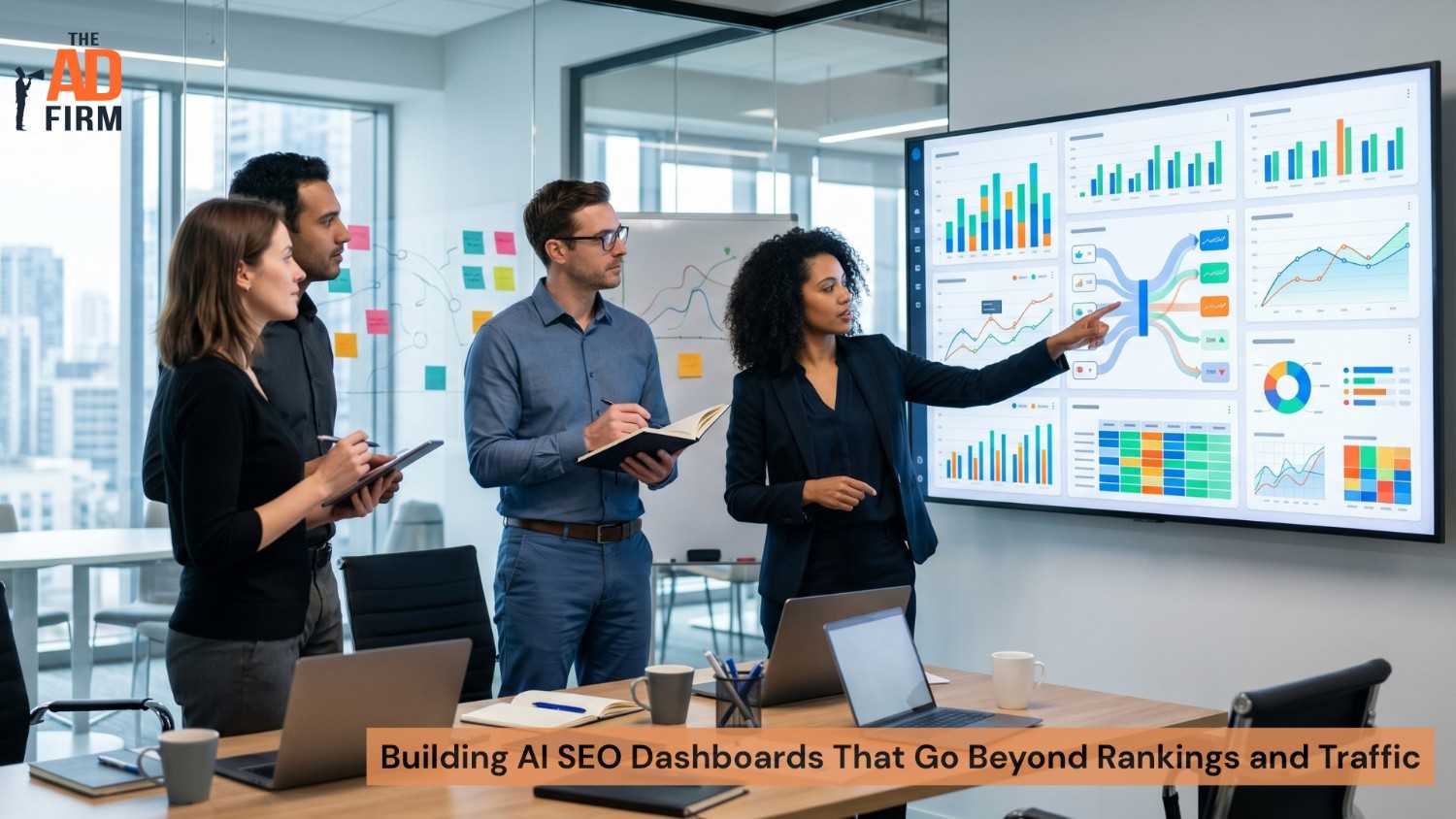
A modern dashboard should connect the signals that show how your business is being discovered, trusted, and chosen. For AI SEO, that means tracking four key layers:
- Visibility: How often your business appears in AI Overviews, answer engines, and citation lists.
- Authority: How well AI systems connect your brand with important topics, services, and expertise.
- Engagement: How AI-driven exposure influences branded searches, session quality, and user behavior.
- Revenue: How visibility and engagement connect to qualified leads, sales, and CRM outcomes.
Each layer answers a different question. Together, they help your team see if your SEO and AI strategy is creating measurable business growth, not just more reports.
RELATED ARTICLE: What 2026 Data Reveals About AI Overviews and Answer Engine Optimization
Layer One: AI Visibility and Citation Metrics
Layer One goes where rank tracking stops. Traditional dashboards confirm a page is on a results page; visibility metrics confirm if your content actually enters the AI-generated answer. The first layer shows if your business appears in the AI search environments your buyers use. If AI systems do not use your brand or content as a source, the rest of your dashboard may be measuring only a shrinking part of the buyer journey. Strong AI SEO measurement starts with visibility inside AI Overviews, citations, and answer-engine responses.
AI Overview Inclusion Rate
AI Overview inclusion rate measures how often your content appears as a source in Google’s AI Overviews for searches that matter to your buyers. To track this clearly, measure:
- The percentage of target searches that generate an AI Overview
- The percentage of those AI Overviews that cite your website
- Your position in the citation list when your website appears
Improvement in this area shows that your content is structured, credible, and relevant enough for Google to use in a synthesized answer. It also helps your team see which pages support visibility and which ones need stronger depth, clarity, or authority.
Citation Frequency Across ChatGPT, Gemini, and Perplexity
Citation frequency helps you compare how each answer engine treats your brand. ChatGPT, Gemini, and Perplexity may rely on different sources, so your visibility can vary by platform.
Treat each platform as a separate visibility channel. Your business may perform well in one answer engine but have little presence in another. Tools such as Profound and Peec.ai track AI citations across multiple assistants. The Bing Webmaster Tools AI Performance Report covers citations and clicks in Copilot. Together, they give your team a clearer view of where your content has authority and where your strategy needs more support.
Prompt Coverage and Share of Voice
Prompt coverage measures how often your brand appears for buyer-focused prompts related to your services, industry, and common customer questions. Share of voice compares your visibility against competitors across the same set of prompts.
Together, these metrics answer a question rankings cannot: When your ideal customer asks an AI assistant about your category, does your brand appear as a recommended source? If competitors show up more often, that gap can guide your content, authority, and citation priorities.
ALSO READ: How to Get Cited in Claude, Gemini, and Other AI Assistants
Layer Two: Entity Authority and Topical Coverage
Layer Two goes where rank reports stop. Traditional SEO dashboards confirm a page is ranking; entity authority metrics confirm if AI systems understand what that page actually represents. Visibility becomes more durable when AI systems clearly understand your brand, your expertise, and the topics your site covers in depth. Topic depth, entity consistency, and source quality help answer engines evaluate where your business fits and when your content should support a response.
Entity Visibility and Brand-Topic Association
Entity visibility measures how clearly AI systems connect your brand with the services and topics you want to be known for. For example, a company that wants visibility for generative engine optimization needs consistent signals across service pages, blog content, schema markup, author profiles, and third-party references.
This does not mean repeating the same phrase across every page. It means building a clear pattern of relevance. AI systems need to understand who you are, what you offer, where your expertise applies, and why your content should be cited.
Topical Authority Coverage by Cluster
Measuring one page at a time can miss the larger authority signals AI systems use. Topic clusters show if your website covers a subject completely or only addresses a few isolated keywords.
A strong dashboard should track how many important subtopics your site covers, how deeply each one is explained, and where content gaps remain. A complete cluster gives AI systems more context to understand your expertise, connect related subtopics, and select the most relevant page for a query. For your team, this makes content planning more strategic and less dependent on guesswork.
PAA Coverage as a Topic-Depth Diagnostic
People Also Ask results can help you understand what customers want to know and where your content may fall short. Use PAA coverage to measure:
- The percentage of relevant PAA questions your pages already answer
- The percentage of follow-up questions your content addresses
This matters because AI-generated answers often rely on the same type of question-based context. If your website does not answer the questions buyers are asking, it becomes harder for AI systems to treat your content as a useful source.
E-E-A-T and Content Freshness Scoring
Content with clear authorship, current information, original insight, and reliable references gives AI systems stronger credibility signals to evaluate. Your dashboard should track signals that support credibility, including author information, original insights, reliable references, and recent updates.
Useful scoring areas include:
- Author trust: Does the page include a credible byline, relevant credentials, or supporting references?
- Freshness: Has the content been reviewed or updated within a reasonable timeframe?
- Originality: Does the content include unique data, examples, insights, or process details?
Pages with clear authorship, useful detail, and current information are stronger candidates for AI citations than generic or outdated content. Tracking these signals helps your team improve content quality in a measurable way.
Layer Three: Engagement and Behavioral Signals

Layer Three goes where session counts stop. Traditional dashboards report how many people visited; engagement metrics report if those visitors behaved like qualified prospects. Visibility and authority can bring more people to your website, but your dashboard should confirm that those visitors take meaningful action. Engagement metrics help you see if AI-influenced discovery is attracting the right audience, not just more traffic.
Branded Search Lift and Direct Traffic Trends
When AI assistants mention your brand more often, you may see branded searches and direct traffic increase as traditional organic clicks decline. Track branded query growth alongside AI citation growth to identify that relationship.
For example, if your direct traffic rises without a new paid campaign, PR push, or offline promotion, AI-driven discovery may be influencing that growth. Plotting those trends together reveals when AI mentions are influencing demand.
On-Site Engagement After AI-Influenced Discovery
Visitors who reach your site after seeing your brand in an AI answer often behave differently from cold organic visitors. They may already understand your value, compare your services, or arrive closer to a decision before they land on the page.
Track signals such as scroll depth, time on page, form starts, calls, demo requests, and other micro-conversions. If AI-influenced visitors engage more deeply or convert faster, that comparison helps your team separate qualified demand from general traffic. This separates surface-level exposure from traffic that shows real buying intent.
Layer Four: Revenue and Conversion-Adjusted Impact
Layer Four goes where traffic graphs stop. Traditional dashboards count sessions; revenue metrics count what those sessions are worth to the business. Visibility and engagement matter, but they need to connect to leads, sales, and revenue. Without that connection, your AI SEO dashboard can look interesting without proving business value. This is the layer that protects the program during budget reviews and earns continued investment.
Mapping Organic and AI-Sourced Traffic to CRM Data
Connect Google Search Console, GA4, and your CRM data into one reporting view. Every lead, demo request, phone call, form submission, or sale should tie back to its source whenever possible.
This gives your team a clearer view of how organic visibility and AI-influenced discovery support pipeline growth. Instead of reporting only on traffic, you can show which channels, pages, prompts, and topic clusters help generate qualified leads.
Conversion-Adjusted Revenue per Topic Cluster
Measuring revenue by individual pages can miss the bigger pattern. Topic clusters show which subject areas support your pipeline and which ones consume resources without producing results.
For example, a single blog post may not convert on its own, but the full cluster around that topic may influence multiple leads over time. Tracking conversion-adjusted revenue by cluster helps your team decide where to update content, where to expand coverage, and where to reduce effort. Use this view to connect content decisions to measurable business outcomes, not just keyword movement.
Assisted Impact and Multi-Touch Attribution
Many AI-influenced conversions do not appear as direct organic sessions. They often appear later as branded search, direct traffic, paid retargeting, or sales-assisted touches.
Include assisted touches so AI visibility receives proper credit in the buyer journey. Without this view, AI SEO can appear less effective than paid channels that receive credit for the final click. Multi-touch attribution gives your team a more accurate view of how early AI visibility contributes to later pipeline activity.
Reporting Cadence and Presenting AI SEO ROI to Leadership
Revenue metrics only protect the program if leadership sees them in context. Build the executive view around three timeframes that match how decisions are made.
- Monthly snapshots: Show citation growth, qualified leads sourced from AI-influenced sessions, and any pages that crossed the freshness threshold.
- Quarterly reviews: Connect cluster-level revenue to content investment, show which topics compounded, and surface where reallocation makes sense.
- Annual ROI views: Translate AI visibility into pipeline contribution, retained revenue, and cost-per-qualified-lead so finance partners see the program in the same language they use for paid channels.
Frame each view around outcomes, not metrics. A leadership audience cares less about prompt coverage than about which buying conversations your brand is now part of, and what that influence is worth in the pipeline.
Building the Dashboard for Decisions, Not Vanity Reporting
A useful dashboard does more than collect metrics. It helps your team see patterns, choose priorities, and take action. If your dashboard only reports what happened, it will not guide your next move. A stronger dashboard shows what needs attention and which improvements are most likely to affect commercial performance.
How to Connect These Layers in Practice
A practical stack does not require a custom build. Most teams can assemble the four-layer view from tools they already use, with two or three additions. A reliable starting point looks like this:
- Visualization: Looker Studio pulls every other source into one shared view that your team can open daily.
- AI citation tracking: Profound or Peec.ai monitors brand mentions and citations across ChatGPT, Gemini, Perplexity, and Copilot.
- Traditional search signals: Google Search Console and GA4 cover rankings, clicks, sessions, and on-site engagement.
- CRM integration: Native HubSpot, Salesforce, or Pipedrive connectors pass lead and revenue data back into Looker Studio. Where a native connector is not available, Zapier or a similar middleware tool fills the gap.
This stack covers all four layers without building infrastructure from scratch. Most stacks of this type can be assembled in 4 to 6 weeks of dedicated build time.
Automating Data Aggregation Across Sources
Pull data from Google Search Console, GA4, your CRM, AI citation tracking tools, crawler logs, and technical SEO platforms into one reporting layer. Manual reporting often creates delays, errors, and conflicting numbers.
Automation gives your team a shared source of truth. It also helps you spot changes faster, compare performance across channels, and reduce the time spent building reports instead of improving results.
Prioritizing Recommendations by Predicted Impact
Not every issue deserves the same level of attention. Sorting tasks only by severity can push your team toward technical fixes that have little effect on revenue.
Use predicted-impact scoring to rank recommendations by expected visibility and pipeline impact. A small update to a high-value page that earns AI citations may matter more than a large rewrite on a page with little visibility. This keeps your SEO work focused on fixes that can influence visibility, qualified traffic, or pipeline.
Alerts for SERP Shifts, Citation Drops, and Freshness Decay
Real-time alerts help your team respond before small problems become larger performance issues. Configure your dashboard to flag:
- Sudden drops in AI citations or AI Overview inclusion
- Competitor gains in share of voice for tracked prompts
- Important pages crossing the six-month freshness threshold
- Crawl, indexation, or schema issues that may reduce visibility
These alerts turn your dashboard into a workflow, not just a report. Your team can see what changed, understand why it matters, and respond before the issue spreads across key pages or prompts.
Turn AI SEO Visibility Into Measurable Growth
A qualified AI SEO agency builds reporting that connects your AI SEO visibility to real business outcomes, not abstract scores. Every engagement starts with an Initial Brand & Content Assessment that reviews your current citation patterns, entity associations, and topical coverage gaps. This gives your team a clearer way to connect AI visibility with content priorities, lead quality, and revenue.
With quarterly reviews, you can see where your AI search visibility is improving, which topic clusters need more investment, and which pages need updates before freshness declines. The Ad Firm’s AI SEO services help your team focus on the metrics that show how your brand earns trust and drives qualified demand.
That is what going beyond rankings and traffic looks like in practice: a four-layer dashboard that measures visibility inside AI answers, the authority behind every citation, the behavior of AI-influenced visitors, and the revenue those visitors produce. SEO and AI reporting belong in one unified view, and that is exactly what this framework delivers. Contact our team to build an AI SEO dashboard that connects all four.
Frequently Asked Questions About AI SEO Dashboards
What is an AI SEO dashboard?
An AI SEO dashboard is a reporting view that tracks how often your brand appears, gets cited, and influences customers across AI Overviews and answer engines such as ChatGPT, Gemini, Perplexity, and Copilot. It connects those signals to engagement and revenue, so your team can see how AI-driven discovery affects the pipeline, not just rankings.
How is AI SEO performance different from traditional SEO metrics?
Traditional SEO measures rankings, organic clicks, and sessions. An artificial intelligence SEO view measures presence inside AI-generated answers, entity authority, citation frequency across answer engines, and revenue tied back to AI-influenced sessions. The shift reflects how more buyers now form opinions during AI conversations that never produce a click. Most modern artificial intelligence SEO programs track all four signals together rather than reporting them in isolation.
Which tools track AI citation and AI Overview inclusion?
Profound and Peec.ai monitor brand citations across ChatGPT, Gemini, Perplexity, and other assistants. The Bing Webmaster Tools AI Performance Report shows citations and clicks inside Microsoft Copilot. SERP monitoring platforms detect AI Overview presence on Google. Most teams combine two or three of these inside Looker Studio for a unified view.
How do I measure branded search lift from AI visibility?
Plot branded search query volume from Google Search Console against AI citation growth from your tracking tool. When citations rise, and branded searches rise alongside direct traffic without a new paid campaign behind them, AI-influenced discovery is most likely the cause. A capable AI SEO agency sets this comparison up as a recurring chart rather than a one-time report.
How often should I review my AI SEO dashboard?
Monthly reviews catch trend shifts, quarterly reviews drive strategy and budget decisions, and real-time alerts handle citation drops or technical regressions. Most teams running AI SEO services at scale work on a monthly-plus-alerts cadence, so leadership sees trend data and the operating team handles incidents in real time.