National gym chains have big ad budgets, recognizable names, and websites with years of authority behind them. When someone searches “gym near me,” it’s easy to assume those brands will always take the top spots. In local results, they often don’t.
Google’s local rankings weigh relevance, distance, and prominence for each location, not the size of the company behind it. A boutique cycling studio or neighborhood strength gym with a complete Business Profile, strong reviews, and a website built around its community can show up right alongside, or above, a big-box club down the street. So how does a smaller gym win those spots, and where should it focus first? It starts with a focused Local SEO strategy built around the way people in your area search for a place to train.
Can a Local Gym Outrank a National Chain on Google?
Yes, a local gym can outrank a national chain on Google, especially in the map results where each location competes on its own. A chain’s brand recognition helps, but it doesn’t guarantee that every individual location has a strong profile, recent reviews, or locally relevant content.
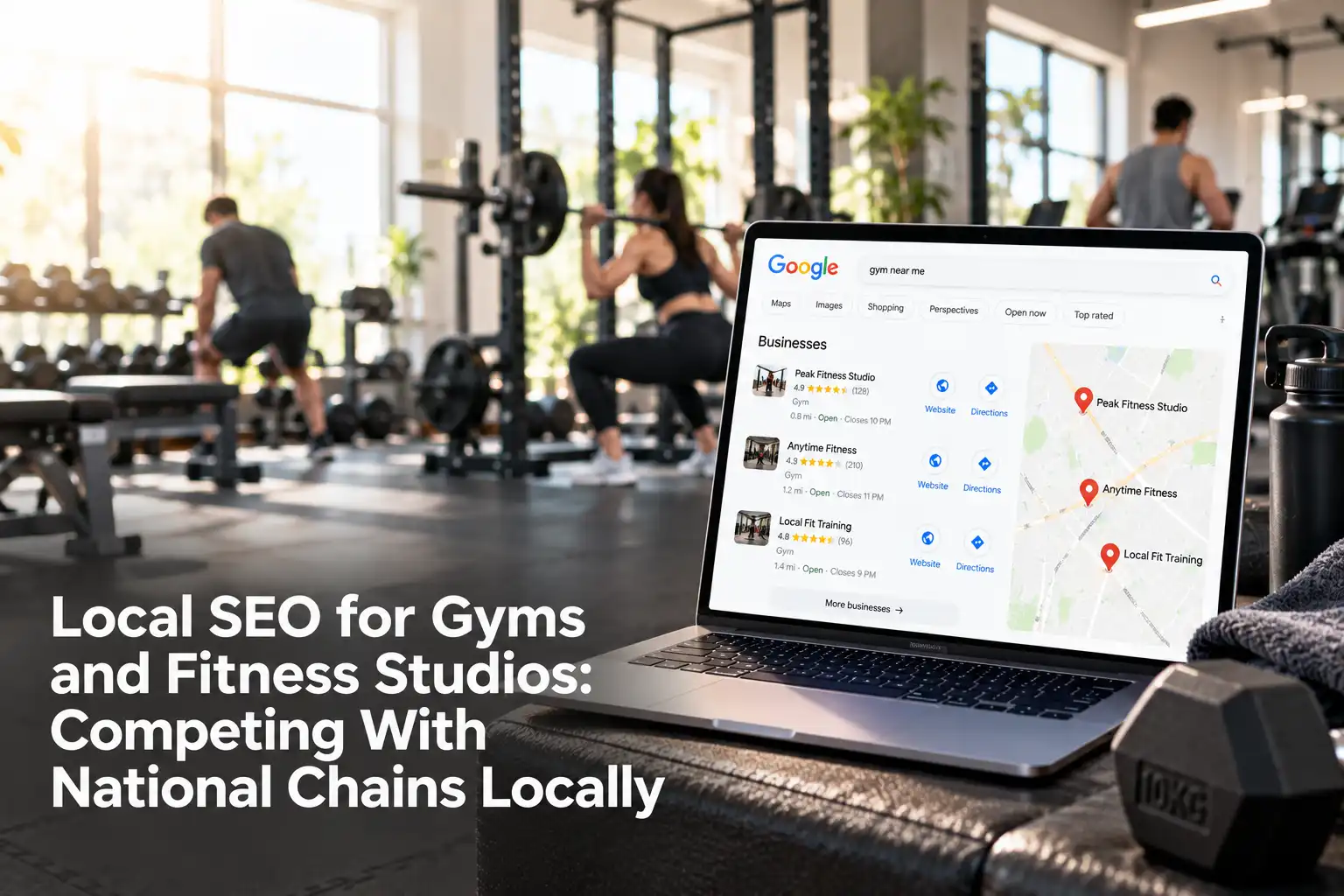
Those map results, known as the Local Pack or Map Pack, show three businesses above the regular organic links. Google ranks each location in the Local Pack on its own signals, such as its Business Profile, reviews, and distance from the searcher, rather than the overall authority of the brand behind it. That’s why a single independent studio can hold one of those three spots ahead of a national name.
That’s where independent gyms have an edge. Corporate-managed locations often rely on a templated page with the same copy as hundreds of other clubs, and their Business Profiles are frequently managed from a corporate office. A local owner can respond to every review, post updates about this week’s classes, and build pages that speak directly to the neighborhood. Those details add up to stronger relevance for the searches that matter most.
What Searches Should Gyms and Fitness Studios Target?
Gyms and fitness studios should target searches that match how people actually look for a place to train, which usually means a specific activity, goal, or convenience factor rather than the word “gym” alone.
Transform Your Online Strategy with The Ad Firm
- SEO: Achieve top search rankings and outpace your competitors with our expert SEO techniques.
- Paid Ads: Leverage cutting-edge ad strategies to maximize return on investment and increase conversions.
- Digital PR: Manage your brand’s reputation and enhance public perception with our tailored digital PR services.
- Activity searches: “spin class near me,” “CrossFit gym,” “hot yoga studio,” “boxing gym”
- Goal searches: “weight loss classes,” “strength training for beginners,” “postnatal fitness classes”
- Convenience searches: “24 hour gym near me,” “gym with childcare,” “gym open early morning”
- Price and commitment searches: “gym with no contract,” “day pass gym,” “first class trial”
Chains tend to compete hardest on broad terms like “gym near me.” Specialized searches, such as “reformer Pilates near me” or “kids martial arts classes,” are often easier for independent studios to win, and the people searching them are usually closer to signing up.
How Do Gyms Improve Their Google Business Profile?
Gyms improve their Google Business Profile by choosing accurate categories, listing every class type as a service, keeping hours current, and adding fresh photos and posts every week. Your profile is often the first place a potential member compares you with a franchise location nearby.
Choose the Right Categories
Pick the primary category that best describes your business, such as gym, yoga studio, Pilates studio, or martial arts school. Add secondary categories only for services you actually offer, like personal trainer or boxing gyms.
List Classes and Programs as Services
Add each class type and program as a service with a short description. A listing for “Small-Group Strength Training” or “Beginner Boxing Fundamentals” gives Google more to match against specific searches and tells visitors exactly what you offer.
Show the Real Experience
Photos of your equipment, class sessions, coaches, locker rooms, and parking help people picture themselves training with you. National brands often rely on stock images, so real photos of your space and community stand out.
Post Updates Every Week
Business Profile posts are a simple way to stay active. Share new class times, member challenges, coach spotlights, and seasonal offers. A post about a January kickoff challenge or a summer outdoor bootcamp keeps your profile timely when interest in fitness spikes.
How Should Gyms Use Reviews to Compete?
Gyms should treat reviews as an ongoing habit, asking members regularly and replying to every review, so the profile stays recent and active. Reviews are one of the clearest places where a local gym can beat a natural brand.
Elevate Your Market Presence with The Ad Firm
- SEO: Boost your search engine visibility and supercharge your sales figures with strategic SEO.
- PPC: Target and capture your ideal customers through highly optimized PPC campaigns.
- Social Media: Engage effectively with your audience and build brand loyalty through targeted social media strategies.
- Catch members right after class. The best time to ask is when energy is high, such as the end of a tough session or the moment someone finishes their first month. A quick reminder from the coach, or a QR code by the exit, turns that good feeling into a review.
- Celebrate milestones. A first pull-up, a 100th class, or a finished six-week challenge are natural moments to ask. Many members are happy to share the story, and those reviews read as real progress to someone deciding where to train.
- Let members call out coaches. Reviews that name a coach or a specific class, like “Coach Dana’s 6 a.m. HIIT,” add relevant detail to your profile and show the personal attention a big-box club rarely offers.
- Reply like the owner you are. In BrightLocal’s 2026 Local Consumer Review Survey, 80% of consumers said they’re likely to use a business that responds to all of its reviews. A short, personal reply that mentions the member’s goal or class feels very different from a corporate template.
- Handle complaints at the front desk level. Thank the reviewer, acknowledge the issue, such as a crowded class or a broken machine, and invite them to talk with you directly.
Reputation Management helps studios request reviews consistently and respond across Google, Yelp, and Facebook without letting anything slip.
Related Article: Do Customer Testimonials Help Local SEO? What the Evidence Shows
Build a Website That Works Like Your Front Desk
Your website should answer the same questions your front desk answers every day: what classes you offer, when they run, how much membership costs, and how to try a first session.
Pricing deserves special attention. Many local gyms hide membership rates and ask visitors to call or come in, but many national brands list their prices openly. When someone can’t find a number, they often move on to a gym that shows one. Listing your rates, or at least a starting price and what’s included, makes it easier for visitors to say yes.
Create a Page for Each Class or Program
Separate pages for each major offering, such as strength training, HIIT, yoga, or personal training, give each one a chance to rank on its own. Describe who the class is for, what a session looks like, the coaches who lead it, and the schedule. Content Marketing can plan these pages around the searches people in your area use and support them with helpful blog posts.
Amplify Your Market Strategy with The Ad Firm
- PPC: Master the art of pay-per-click advertising to drive meaningful and measurable results.
- SEO: Elevate your visibility on search engines to attract more targeted traffic to your site.
- Content Marketing: Develop and implement a content marketing strategy that enhances brand recognition and customer engagement.
Read More: How to Write a Direct Answer Paragraph That AI Engines Can Extract
Make Trial Sign-Ups Simple
Many people decide to try a gym on their phone, often right after searching. A clear “Book Your First Class” button, a visible schedule, and a short sign-up form remove the friction. A fast, mobile-friendly web design keeps that path from search to sign-up quick.
Add Schema Markup
Structured data helps search engines read your gym’s details accurately. LocalBusiness or SportsActivityLocation schema can label your name, address, phone number, hours, and services in a format Google and AI tools understand. When that markup matches your Business Profile, it reinforces the same information everywhere your gym appears. Technical SEO can set up and test this markup for each location.
Show Your Community
Member stories, coach bios, and photos from events give your website a personality no national brand page can copy. These details build trust with people who are nervous about joining a new gym. Feature content your members already create, such as tagged Instagram posts, progress photos shared with permission, or short video testimonials.
Give community events like charity workouts, local 5K teams, or open houses their own pages, since those pages can rank for local searches and earn mentions from neighborhood sites. Each one shows Google, and future members, that your gym is an active part of the area.
Keep Your Listings Consistent Across the Web
Your gym’s name, address, phone number, and hours should match exactly across your website, Business Profile, and directories like Yelp, Apple Maps, ClassPass, and Mindbody. Small mismatches, such as an old phone number or a different suite, can weaken local visibility and confuse potential members.
If you run more than one location, each needs its own Business Profile and its own location page with unique details.
Learn More: The 2026 Local Citation Audit: How to Find and Fix NAP Errors Fast
Grow Faster and Turn Searches Into Members
Local SEO builds lasting visibility, but a few supporting steps help gyms see results sooner and understand which efforts bring in paying members.
Use Social Media to Support Local Search
Fitness is a visual, community-driven business, and social media shows it in action. Class clips, transformation stories, and event recaps give people reasons to look you up on Google. Social Media Marketing keeps that content consistent and tied to the offers on your website.
Advance Your Digital Reach with The Ad Firm
- Local SEO: Dominate your local market and attract more customers with targeted local SEO strategies.
- PPC: Use precise PPC management to draw high-quality traffic and boost your leads effectively.
- Content Marketing: Create and distribute valuable, relevant content that captivates your audience and builds authority.
Run Local Ads Around Peak Sign-Up Seasons
Interest in gyms rises at predictable times, especially in January and the weeks before summer. Paid search targeted to people within a few miles of your location can capture that demand as your organic rankings grow. Local PPC campaigns can promote trial offers during these windows without wasting budget on people too far away to join.
Track Trials, Not Just Traffic
Measure how many people book a trial class, how many show up, and how many turn into trial converts. Business Profile insights show calls, direction requests, and website visits, and your booking software can show which sources lead to sign-ups.
Improve the Pages That Get Visits but Few Sign-Ups
If a class page attracts visitors who don’t book, look at what’s getting in the way. Conversion Rate Optimization can test button placement, pricing presentation, and trial offers to turn more visits into first-time visitors who sign up.
Help Local Members Choose Your Gym
National chains have size, but local gyms have something harder to copy: real coaches, real community, and owners who know their members by name. The Ad Firm helps gyms and fitness studios turn those strengths into stronger Business Profiles, better class pages, more recent reviews, and local campaigns that fill your classes.
Contact The Ad Firm to see which local searches your gym could be winning and where to start.
Frequently Asked Questions
How long does local SEO take for a gym?
Most gyms see early improvements within a few months, with stronger results over six months to a year. Your market’s competition, your current reviews, and the state of your website all affect the timeline.
Should I list my gym on ClassPass or Mindbody?
ClassPass and Mindbody are booking platforms first. Their main value is discoverability, putting your classes in front of people already looking for a place to work out. They can add some supporting NAP signals as a secondary benefit, but they don’t replace traditional citation directories. Make sure your name, address, and class details match your website and Business Profile on each one.
Can I add class schedules to my Google Business Profile?
Google doesn’t offer a full class schedule feature, but you can post weekly schedule updates, link to your booking page, and list each class type as a service.
Maximize Your Online Impact with The Ad Firm
- Local SEO: Capture the local market with strategic SEO techniques that drive foot traffic and online sales.
- Digital PR: Boost your brand’s image with strategic digital PR that connects and resonates with your audience.
- PPC: Implement targeted PPC campaigns that effectively convert interest into action.
Do I need a separate page for every class?
Not for every variation, but each major program should have its own page. A yoga studio might group similar classes on one page and give prenatal yoga or hot yoga their own pages if those draw distinct searches.
Is it worth targeting nearby neighborhoods?
Yes, if members regularly travel from those areas. Mention nearby neighborhoods naturally on your location page, and use local ads to reach people within a reasonable driving distance.