Your SEO vendor keeps pushing another round of backlinks. Your PR contact keeps pitching journalists for a feature. Both bills land on the same desk, and both pitches promise the same outcome: more authority, better rankings, a brand AI models trust. Nobody on either side tells you which one actually moves the needle when the “search result” is a sentence ChatGPT generates instead of a list of blue links.
The two aren’t competing for the same job. A backlink is a vote cast by one page for another, built to influence a ranking algorithm that counts and weighs links. A press mention is a credibility signal built around your name appearing in context, read by a model that cares less about the link itself and more about who’s talking about you and how often. Knowing which one an AI answer engine actually leans on changes where the next marketing dollar should go.
How Does AI Search Authority Actually Get Built?
Google’s ranking algorithm and an AI answer engine are solving different problems, even when they draw on some of the same raw material. Google’s algorithm counts and weighs links at scale. An AI model is instead piecing together a picture of your business, your credibility, and how many trusted sources back up a claim before it repeats that claim as fact. Separating these two jobs is the first step before comparing what press mentions and backlinks each contribute.
What Backlinks Still Do for AI Visibility
Backlinks haven’t become worthless just because the destination changed. They still carry real signal for an AI model, just not the whole signal the way they once did for a ranking algorithm.
Why Links Still Signal Something Real
A backlink placed on a relevant, trafficked site tells both Google and an AI model that another publisher found your content worth referencing. Metrics like domain authority, page relevance, and link placement still show which links carry real weight and which are just noise, and that distinction hasn’t disappeared just because the destination is now a generated answer instead of a search results page.
Where Links Fall Short With Generative Engines
A link passes authority to the page it points at, but it says almost nothing about your brand as an entity. An AI model building a profile of your business cares about your name showing up consistently across sources, and a backlink buried in a footer or a directory listing does little to build that profile even if it technically counts as a link. Ten mediocre links rarely add up to the same lift as one placement where your name, your expertise, and your business are actually discussed in context.
Advance Your Digital Reach with The Ad Firm
- Local SEO: Dominate your local market and attract more customers with targeted local SEO strategies.
- PPC: Use precise PPC management to draw high-quality traffic and boost your leads effectively.
- Content Marketing: Create and distribute valuable, relevant content that captivates your audience and builds authority.
The Volume Trap That Still Catches Businesses
Buying forty low-quality backlinks a month still reads as manipulation to Google’s spam systems, and it reads as nothing at all to an AI model looking for consistent, credible mentions. The businesses still stuck chasing link volume are optimizing for a signal that stopped being the whole picture years ago, the same mistake that shows up in guest posting campaigns still measured by placement count instead of placement quality.
What Press Mentions Add That Backlinks Can’t
A press mention does a job a backlink was never built to do. It tells an AI model who you are and why you’re worth citing, not just that another page pointed at yours.
Earned Coverage as a Trust Signal
A journalist choosing to quote you, feature your data, or cover your launch carries a different kind of weight than a link you or your agency placed yourselves. Press coverage and earned media visibly boost AI search visibility precisely because the editorial judgment of a known publication is doing work a self-placed link can’t replicate.
Context Over Click-Through
An AI model reading a press mention isn’t just registering a URL. It’s reading the surrounding sentence, the expert’s name, the quote, the context of why your business came up at all. That richer context is exactly what makes a brand easier for a model to describe accurately later, which is part of why some brands get cited by AI and others don’t.
A single feature naming your founder as an expert source, paired with a specific, quotable detail about your business, often does more for how a model talks about you than a dozen generic backlinks ever will.
Press Mentions vs. Backlinks: Which Wins for AI Citations?
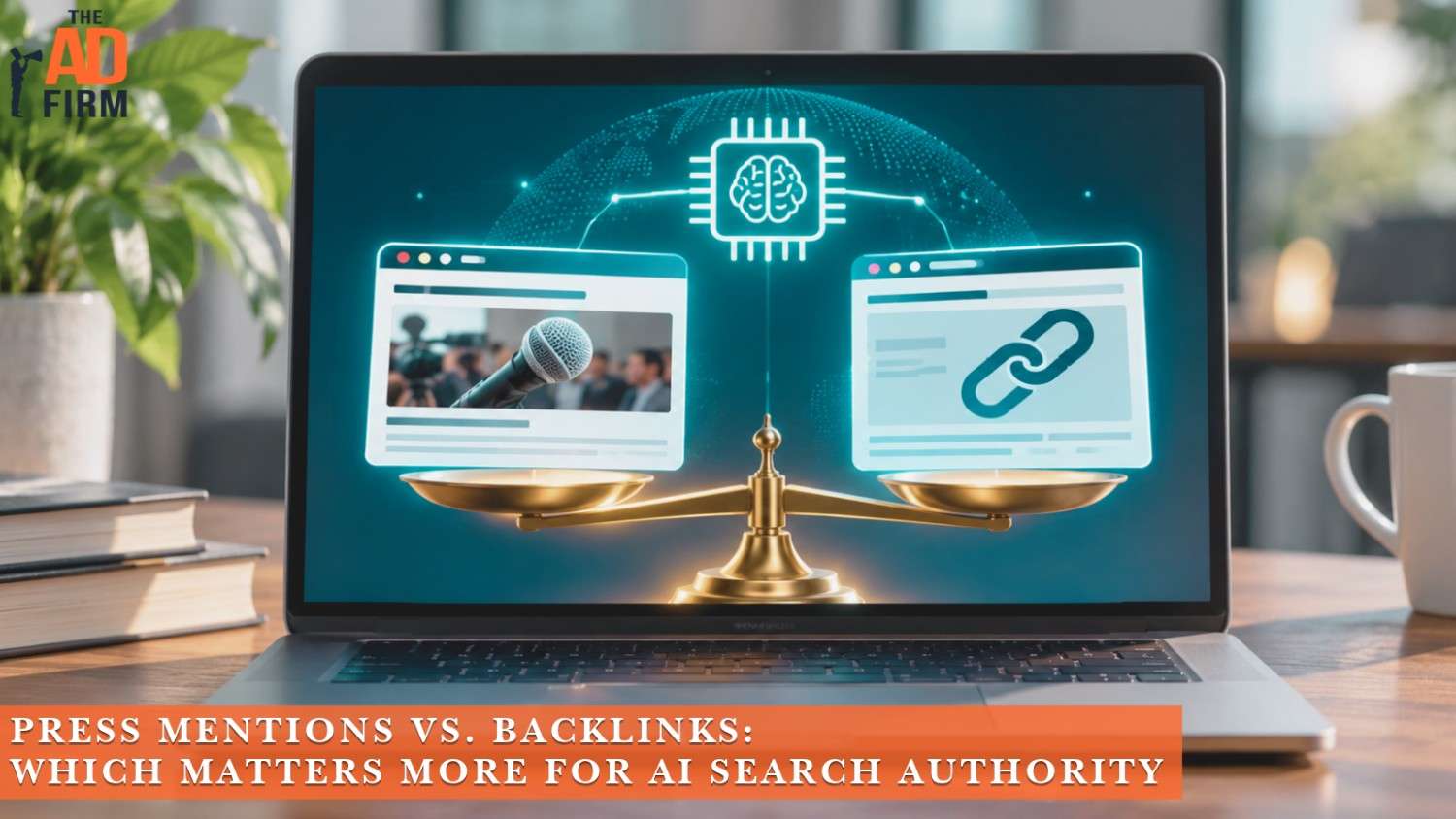
Neither wins outright, because each builds a different half of the same reputation. A backlink profile with no press coverage behind it gives an AI model plenty of links and very little sense of who you actually are. Press coverage with no supporting link profile gives a model a credible mention that’s harder to discover and connect back to your other content in the first place.
The businesses showing up most consistently in AI-generated answers tend to have both: a handful of earned media placements that establish who they are, paired with a link profile clean enough that nothing undercuts the credibility the coverage built. Monitoring if AI engines are actually citing your brand is the only way to confirm which half of that combination is doing the heavier lifting for your specific business.
Boost Your Business Growth with The Ad Firm
- PPC: Optimize your ad spends with our tailored PPC campaigns that promise higher conversions.
- Web Development: Develop a robust, scalable website optimized for user experience and conversions.
- Email Marketing: Engage your audience with personalized email marketing strategies designed for maximum impact.
Building Both Into One Authority Strategy
Treating press mentions and backlinks as a single budget line instead of two separate vendor relationships gets more out of each dollar than running them in isolation.
- Pitch coverage around content you already have. A press mention that cites your own original research or data gives a journalist a reason to feature you and gives an AI model two connected sources instead of one isolated one.
- Let earned coverage justify the links that follow. A feature in a trusted outlet often earns follow-on citations, with smaller sites covering the same story on their own, building a natural link profile instead of a purchased one.
- Keep your entity details consistent everywhere. Your name, your title, and your business description should read the same across press features and backlink anchor text, since inconsistency is what makes a model hesitate to attribute a claim to you specifically. Tracking how AI models already describe your brand’s tone shows you where that inconsistency is doing the most damage before you spend on either tactic.
- Audit link quality before adding volume. A dozen links on relevant, trafficked sites outperform a hundred placed on sites with backlink metrics that don’t hold up under a closer look.
Where This Leaves Your Marketing Budget
Deciding between press mentions and backlinks as an either-or question misses what each one is actually built to do. Backlinks remain a real ranking signal and a real part of how AI models weigh source credibility. Press mentions build the entity authority a model needs before it will attribute a fact to you by name. Businesses that keep funding only one are leaving the other half of their AI-facing reputation unbuilt, and it usually shows up as a model that can name a competitor’s expertise but can only describe yours in generic terms.
The right split isn’t a fixed percentage. A newer business with almost no media history gets more immediate lift by landing one or two credible press placements than by adding another round of links, since it needs an entity profile established before link equity has much to attach to. A business with years of earned coverage already sitting on authoritative sites gets more out of a disciplined link audit instead, since the credibility work is largely done and the ranking signals are what’s lagging.
Strengthen Your Online Authority with The Ad Firm
- SEO: Build a formidable online presence with SEO strategies designed for maximum impact.
- Web Design: Create a website that not only looks great but also performs well across all devices.
- Digital PR: Manage your online reputation and enhance visibility with strategic digital public relations.
Ready to Build AI Search Authority the Right Way?
The Ad Firm runs digital PR and link building as coordinated parts of the same SEO strategy, so neither effort cancels out the other’s value. We can tell you, with a short audit of your current coverage and link profile, which half of your authority is underbuilt and what fixing it would actually look like.
If you want a clear read on which half needs the next dollar, contact us today.
Frequently Asked Questions
Do backlinks still matter for AI search results?
Yes. Backlinks still influence Google’s traditional rankings and contribute to the source credibility signals AI models draw on, particularly when the linking site is relevant and well-trafficked. They matter less on their own than they once did for building the kind of entity authority AI models reward.
Is digital PR better than link building for AI visibility?
Neither replaces the other. Digital PR builds entity authority and earns the kind of editorial context AI models weigh heavily, while link building strengthens the ranking signals that still matter for traditional search. Businesses that fund both tend to show up more consistently in AI-generated answers than those funding either alone.
Can a press mention without a backlink still help AI search visibility?
Yes. Even a press mention that doesn’t include a direct link can reinforce an AI model’s picture of your business if your name, title, and business details are quoted accurately and consistently with how you present them elsewhere.
How many backlinks does a business need to build AI search authority?
There’s no set number. A smaller number of relevant, high-quality links paired with real press coverage typically builds more AI-facing authority than a large volume of low-relevance links with no earned media behind them at all.
What’s the fastest way to build AI search authority right now?
There isn’t a shortcut that replaces consistent work on both fronts. Pairing an active digital PR push with a disciplined, quality-first link building effort builds authority faster than either tactic running alone, since each reinforces the signals the other is sending.