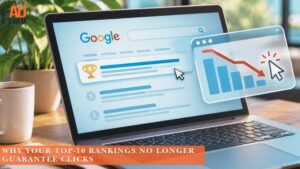
You checked your rankings. Page one, top five, maybe even position one. Then you opened Search Console and the click data told a different story. Impressions are holding. Clicks are falling. Traffic is flat or down.
This isn’t a tracking error. It’s a structural shift in how Google serves results, and it’s happening to sites across every industry. Ranking in the top ten used to mean traffic. Now it means visibility. Those are no longer the same thing.
The Gap Between Rankings and Traffic Is Real
Roughly 68% of searches end without a click to any website, according to recent research. Users get what they need directly on the results page and move on. For sites that worked hard to reach the top ten, that number stings, because ranking well is a necessary condition for traffic but no longer a sufficient one.
The disconnect shows up clearly in Search Console. Impressions trend flat or up while clicks trend down. That pattern is now widespread enough that SEO practitioners across the industry treat it as a baseline expectation rather than an anomaly.
What’s Actually Taking Your Clicks
It’s not one thing. The click gap is the result of several SERP features stacking on top of each other, each one designed to answer a question or fulfill a need without requiring a visit. AI Overviews get most of the attention right now, but they’re part of a longer-running shift that includes featured snippets, People Also Ask boxes, local packs, and paid inventory, all competing for the same screen space your organic listing used to own.
AI Overviews Answer the Question Before the Click
When an AI Overview appears above organic results, users click traditional results roughly 8% of the time, compared to 15% when no AI Overview is present, according to Pew Research data. A composite of multiple studies found CTR reductions ranging from 34% to 61% for top-ranking results when AI Overviews are active, with the drop varying by query type and vertical.
The mechanism is straightforward. AI Overviews synthesize an answer from multiple sources and display it at the top of the page. For informational queries, the user reads the summary and closes the tab. Your page may have contributed to that answer. You still didn’t get the click.
Featured Snippets, PAA Boxes, and Knowledge Panels
AI Overviews get the most attention, but they’re part of a broader SERP ecosystem that’s been absorbing clicks for years. Featured snippets pull a direct answer from your page and display it without requiring a visit. People Also Ask boxes expand inline to answer follow-up questions. Knowledge panels surface structured facts about brands, people, and places.
Enhance Your Brand Visibility with The Ad Firm
- SEO: Enhance your online presence with our advanced SEO tactics designed for long-term success.
- Content Marketing: Tell your brand’s story through compelling content that engages and retains customers.
- Web Design: Design visually appealing and user-friendly websites that stand out in your industry.
Each of these features serves a user who had a quick question. When those features stack above organic links, the users who would have clicked your result have already found what they needed. Successive core and spam updates have pushed Google’s focus toward serving intent faster, which accelerates this trend.
Paid Ads and Local Packs Push Organic Links Down
For commercial and local queries, organic results often don’t appear above the fold at all. Paid ads occupy the top two to four positions, a local pack with map pins and reviews takes another block, and then organic results begin. On mobile, a user may need to scroll past five or six distinct SERP elements before reaching your top-ten listing.
Position one on a query with heavy paid and local competition can sit lower on the visible page than position five on a clean, low-competition SERP. Rank alone doesn’t reflect where your result sits on the visible page.
Does This Mean SEO Is Broken?
No. It means the output you should optimize for has changed. Ranking is still the entry requirement. Without a top-ten position, none of this matters, because you won’t appear in AI Overviews, featured snippets, or local packs at all. Pages that get cited in AI-generated answers consistently come from sites that already rank well organically, a pattern documented in research on technical SEO as an AI signal.
What’s shifted is the downstream value of that ranking. A position-one result on a heavily featured query might generate fewer clicks than a position-three result on a clean SERP with no AI Overview. SEO still builds visibility and authority. The metrics that capture that value have expanded beyond clicks.
What Should You Track Instead of Just Rankings?
Rankings tell you where you appear. They don’t tell you whether that appearance is driving anything. As SERP features absorb more clicks, the gap between ranking position and actual business impact widens, and the metrics that matter most are the ones that measure influence across the full user journey, not just the moment someone clicks.
Impressions and Brand Visibility
If your content is surfaced in AI Overviews or cited by AI tools without generating a click, that exposure still shapes how users perceive your brand. Someone who reads an AI answer pulled from your page may search for your brand directly later. Tracking share of voice in AI-generated answers gives you a fuller picture of how much of the conversation your content is influencing, beyond what Search Console’s click data captures.
Advance Your Digital Reach with The Ad Firm
- Local SEO: Dominate your local market and attract more customers with targeted local SEO strategies.
- PPC: Use precise PPC management to draw high-quality traffic and boost your leads effectively.
- Content Marketing: Create and distribute valuable, relevant content that captivates your audience and builds authority.
Branded Search Volume
One downstream signal of that brand exposure is an increase in branded searches. Users who encountered your content through an AI summary or featured snippet without clicking may return to search for you directly. Tracking branded query volume in Search Console alongside non-branded click data gives you a more complete view of whether your visibility is translating into awareness and intent.
Engagement Metrics for Clicks That Do Come Through
The users who click through from a results page that features AI summaries and snippets tend to be higher-intent visitors. They’ve already seen a quick answer and chosen to click anyway, which typically means they want more depth, want to verify, or are closer to a decision. Tracking engagement metrics for those sessions, specifically time on page, pages per session, and conversion rate, tells you whether your content is worth the click for the users who make it.
How Do You Earn the Click When the SERP Answers the Question?
Knowing what to track is the diagnostic half. The strategic half is building content that earns the click even when Google has already given users a surface-level answer. If the SERP can answer the query in a snippet, the content that drives clicks has to offer something the SERP can’t compress into one.
Original Data and Proprietary Insights
Aggregated, secondhand content is exactly what AI Overviews draw from. What they can’t replicate is research you generated yourself: a client study, an internal analysis, a survey with real respondents, or a tool that produces a personalized output. Content built around original research gives users a concrete reason to visit the source, not just read the summary.
Depth That Rewards Visiting
A page that answers a question in two sentences earns zero clicks when a snippet already answers it. Pages that earn clicks go further: they compare options, address edge cases, include real examples, and answer the follow-up questions a user would naturally have. Understanding how to write content that AI engines can extract as a direct answer is part of this, but the goal is to satisfy what comes after that answer, not just the answer itself.
For pages targeting informational queries, answering People Also Ask questions within your content creates the kind of depth that keeps users on the page and signals to Google that your content goes beyond the surface-level answer.
Streamline Your Digital Assets with The Ad Firm
- Web Development: Build and manage high-performing digital platforms that enhance your business operations.
- SEO: Leverage advanced SEO strategies to significantly improve your search engine rankings.
- PPC: Craft and execute PPC campaigns that ensure high engagement and superior ROI.
Intent-Matched Formatting
A user searching for a comparison wants a table, not five paragraphs. A user searching for a process wants numbered steps. A user searching for a local service wants a phone number and address near the top. When your content format matches what the query intent signals, it earns clicks because it delivers the right experience before the user has to decide whether the page is worth it.
Optimizing your title tags and meta descriptions for AI-first search is another lever here. The snippet Google shows in the results page is often your one chance to communicate that your page offers more than the AI Overview already gave.
Is This Just an Informational Query Problem?
The short answer is mostly, but not entirely. Zero-click behavior hits informational queries hardest, where a snippet or AI Overview can fully satisfy the search without a visit. But the pressures reshaping organic CTR are broader than query type, and understanding where your content sits on that spectrum helps you prioritize what to protect.
Commercial and Transactional Queries Are More Protected
Zero-click behavior is concentrated in informational searches, but commercial queries are not immune. Users looking to buy, compare, book, or contact a business still need to visit a page to complete that action. Queries with purchase or contact intent carry intent that a snippet can’t fulfill, so those clicks are more durable.
That said, even commercial queries are increasingly interrupted by ads, local packs, and shopping carousels. The organic click on a commercial query is competing with more paid inventory than it was a few years ago, which puts pressure on organic CTR even where intent is strong.
Local SEO Is a Partial Buffer
Local businesses with strong Google Business Profiles can capture clicks through the local pack, separate from the ten blue links. A well-optimized profile with current hours, photos, reviews, and accurate categories captures users who would otherwise click an organic result. This doesn’t solve the informational click problem, but it creates a parallel click path for high-intent local queries. For a broader breakdown of how this works in practice, improving organic visibility covers the interplay between local signals and organic performance.
Your Rankings Are Still Worth Protecting
The worst response to declining CTR is to deprioritize rankings. Without them, you lose AI Overview eligibility, featured snippet eligibility, and the baseline authority that earns any traffic at all. The right response is to shift what you optimize alongside rank.
Amplify Your Market Strategy with The Ad Firm
- PPC: Master the art of pay-per-click advertising to drive meaningful and measurable results.
- SEO: Elevate your visibility on search engines to attract more targeted traffic to your site.
- Content Marketing: Develop and implement a content marketing strategy that enhances brand recognition and customer engagement.
Track impressions alongside clicks. Build content with original data or depth that snippets can’t replicate. Align format to query intent. And pay attention to what the SERP actually looks like for your target keywords, because a page-one ranking on a query dominated by AI features is a fundamentally different asset than a page-one ranking on a clean SERP. Our SEO team does exactly this for clients, mapping the actual SERP layouts for their target keywords and adjusting strategy based on what those pages reward.
Ready to Close the Gap Between Rankings and Real Traffic?
Visibility and traffic used to move together. Now they don’t, and most ranking tools won’t show you that gap. Our team audits your actual SERP layouts, identifies where clicks are being absorbed by AI features and paid inventory, and builds the kind of content and technical foundation that earns clicks even on a crowded results page. If your rankings are strong but your traffic isn’t following, let’s take a look.
Frequently Asked Questions
If I rank in the top three, why are my clicks still low?
Top-three rankings on queries with AI Overviews, featured snippets, or heavy paid ad coverage consistently produce lower CTR than top-three rankings on clean SERPs. Your position is measured before SERP features are accounted for. The actual click opportunity depends on what appears above your listing.
Does Google count my page as a source even when it doesn’t send me traffic?
Yes. AI Overviews and featured snippets frequently pull content from pages without sending the user to them. Your content can contribute to an AI-generated answer, appear in a snippet, or populate a knowledge panel, all without generating a session in your analytics. That visibility has brand value, but it doesn’t show up as a click.
Should I stop targeting informational keywords since they generate fewer clicks?
Not necessarily. Informational content builds topical authority, feeds AI citation opportunities, and drives branded search volume from users who encounter your brand through summaries. The case for informational content has shifted from direct traffic to brand exposure and authority building, both of which support commercial page performance over time.
What content types are most protected from zero-click behavior?
Content tied to commercial or transactional intent, original data or research, tools that require interaction, and in-depth comparisons tend to hold CTR better than general informational content. Queries where the user needs to act on something, not just learn something, still require a click to complete.
Strengthen Your Online Authority with The Ad Firm
- SEO: Build a formidable online presence with SEO strategies designed for maximum impact.
- Web Design: Create a website that not only looks great but also performs well across all devices.
- Digital PR: Manage your online reputation and enhance visibility with strategic digital public relations.
How do I know if AI Overviews are appearing for my target keywords?
Search your target keywords in a logged-out Chrome browser or an incognito window and document what SERP features appear above organic results. If an AI Overview is present, note the query. Over time, tracking which keywords trigger AI features versus clean SERPs tells you where your rankings carry different click values. Tracking brand visibility in AI-generated answers is a useful complement to this manual audit.