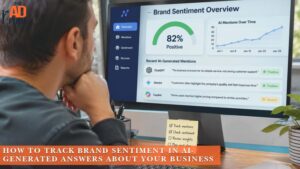
A customer mentions that ChatGPT told them your shop closes at 5pm, and it’s actually 7pm. A prospect says Gemini described your pricing as “on the higher end” without any context on what you include. Neither comment showed up in a review, a social mention, or a star rating. It happened inside a conversation you never saw, on a platform you don’t control, and the only reason you know about it at all is that someone happened to tell you.
That’s the problem with AI-generated answers. A bad review sits on a page you can monitor and respond to. A bad answer given by ChatGPT, Gemini, or Perplexity disappears the moment the conversation ends, leaving no public record and no notification. Businesses that have spent years watching their review profiles closely are now realizing they have a second reputation, one built entirely out of how large language models summarize them, and most have no process for checking it.
Why AI-Generated Answers Need Their Own Sentiment Check
Traditional brand sentiment monitoring tracks reviews, social mentions, and news coverage, the channels your online reputation management strategy already covers. AI-generated answers are a separate surface entirely. A model can summarize your business in a tone or with a detail that never appeared in any review, because it’s drawing on scraped content, outdated listings, and patterns it picked up across similar businesses rather than quoting a single source.
This matters because people increasingly ask ChatGPT or an AI Overview instead of reading five reviews themselves. If the summary they get is inaccurate, outdated, or subtly negative, you lose the sale before your website ever loads.
How Do You Actually Check What AI Says About Your Brand?
Checking this by accident, asking ChatGPT about your business once and feeling reassured, tells you almost nothing. A reliable check needs repetition, structure, and a record you can compare over time.
Running the Same Prompts Across Multiple AI Models
Pick five to ten prompts a real customer might type: “what’s it like working with [your business],” “how much does [your business] charge for [service],” “is [your business] worth it,” and a direct comparison against a named competitor. Run each one in ChatGPT, Gemini, Perplexity, and Copilot, since Copilot draws on Bing’s index and often surfaces different source material than the others. Save the full answer text, not a summary of what you remember reading.
Enhance Your Brand Visibility with The Ad Firm
- SEO: Enhance your online presence with our advanced SEO tactics designed for long-term success.
- Content Marketing: Tell your brand’s story through compelling content that engages and retains customers.
- Web Design: Design visually appealing and user-friendly websites that stand out in your industry.
Tracking Tone, Not Just Presence
Being mentioned isn’t the same as being described well. Score each answer on a simple scale: accurate and positive, accurate but flat, outdated, or wrong. A model that correctly lists your services in neutral language is a different problem than one that calls your pricing “confusing” or your reviews “mixed,” even if both technically mention you. Monitoring if AI engines cite your brand at all answers a different question than this one. Citation tells you if you show up. Sentiment tells you what showing up actually sounds like.
Spotting Outdated or Incorrect Claims
Compare every answer against your current hours, pricing, service area, and ownership details. Models are often working with a snapshot of your site, your Google Business Profile, or a directory listing that’s a year or two stale. A single wrong detail repeated across several AI answers usually traces back to one outdated source feeding all of them.
What a Negative or Inaccurate AI Answer Costs You
An AI answer isn’t neutral background noise. It’s frequently the last thing a prospect reads before deciding if reaching out is even worth it. Unlike a slow month of mediocre reviews, a bad AI summary doesn’t average out over time. It repeats the same framing to every person who asks the same question, so one stale or poorly worded source can shape hundreds of first impressions before anyone notices the pattern.
Lost Trust Before the First Click
A model that frames your business with hedging language, “seems to be,” “reportedly,” “mixed opinions”, plants doubt before a prospect has seen a single page of your site. Unlike a bad review sitting next to dozens of good ones for context, an AI summary often arrives as the only impression someone gets.
Example: A Pricing Claim That Was Two Years Stale
A regional service business discovered that three different AI tools quoted a starting price it had retired two years earlier, one the company had since raised to reflect better materials and faster turnaround. Every prospect asking an AI model about pricing was being quoted a number the company no longer honored, and several mentioned the old figure during calls before learning the real one, souring the conversation before it started.
Fixing What AI Gets Wrong About Your Business
You can’t edit an AI model’s answer directly, so the fix works by changing what it’s drawing on. Correct the source material consistently enough, and the answer catches up. This takes patience more than any single clever trick: models rebuild their picture of a business gradually, as updated pages, fresh reviews, and clearer bios accumulate across the sources they already trust.
Elevate Your Market Presence with The Ad Firm
- SEO: Boost your search engine visibility and supercharge your sales figures with strategic SEO.
- PPC: Target and capture your ideal customers through highly optimized PPC campaigns.
- Social Media: Engage effectively with your audience and build brand loyalty through targeted social media strategies.
- Update the page the error traces back to. If your hours, pricing, or ownership details changed, update your website and Google Business Profile first; most of what models cite starts there.
- Publish a direct, quotable correction. A short, clearly worded paragraph stating the current fact, written the way a direct answer paragraph AI engines can extract is built, gives a model something clean to draw on instead of an old, ambiguous mention.
- Strengthen your author and about pages. Vague or missing bios read as untrustworthy to both readers and models. What an About Us page is actually worth for AI trust signals and well-built author bios both feed the entity profile a model relies on.
- Re-run your prompt set after changes. AI models retrain and re-index on their own schedules, not yours, so a fix can take weeks to surface. Re-check monthly rather than assuming one update solved it.
How Often Should You Check AI-Generated Answers About Your Business?
Monthly is a reasonable baseline for most small and mid-sized businesses, timed to land after any pricing change, major review influx, or site update. Businesses in fast-moving categories, or ones that just launched a correction, do better checking every two weeks until the answers settle into something accurate. Quarterly checks are too slow for catching a stale detail before it costs you several prospects.
Treat the first check as its own category, not just another data point. The initial pass establishes a baseline, the current state of every answer across every model, so later checks can show real movement instead of just a new snapshot with nothing to compare it against. Keep a simple log: date, prompt, model, and a one-line summary of tone is usually enough to spot a pattern within two or three months.
Building AI Sentiment Tracking Into Your Marketing Routine
A single sentiment check is a snapshot. A repeated one, logged against the same prompts every month, becomes a record of how your brand’s AI-facing reputation moves as you publish new content, earn new reviews, and fix old errors. Pair it with the structural work: glossary pages that define your terms clearly and content built for how Google’s AI Overviews actually read a page give models cleaner material to summarize next time around, instead of patching the same misunderstanding every few months.
Boost Your Business Growth with The Ad Firm
- PPC: Optimize your ad spends with our tailored PPC campaigns that promise higher conversions.
- Web Development: Develop a robust, scalable website optimized for user experience and conversions.
- Email Marketing: Engage your audience with personalized email marketing strategies designed for maximum impact.
Ready to See What AI Is Actually Saying About Your Business?
Guessing at your AI-facing reputation costs more than checking it. The Ad Firm’s AI SEO team runs structured sentiment checks across ChatGPT, Gemini, Perplexity, and Copilot, flags the claims that need correcting, and pairs that with generative engine optimization work to fix what’s feeding the bad answers.
Send us your business name and we’ll show you exactly what AI models are telling prospects about you right now. Contact us today.
Frequently Asked Questions
Is AI sentiment monitoring the same as reputation management?
No. Reputation management tracks reviews, social mentions, and news coverage, which is the scope our online reputation management team owns. AI sentiment tracking checks a separate surface: how language models summarize and frame your business in a generated answer, independent of any single review or post.
Can I see what ChatGPT says about my business myself?
Yes, by asking it directly, though a single question answered once tells you little. A useful check runs the same handful of prompts across several AI tools on a schedule, so you can compare answers over time instead of reacting to one conversation a customer happened to mention.
Why does an AI model describe my business inaccurately?
Models draw on scraped web content, directory listings, and patterns picked up across similar businesses rather than a single verified source, so an outdated page or a stale citation can shape the answer long after the real detail changed. Entity consistency across your own site and outside mentions is what eventually overrides the stale version.
How long does it take for an AI model to update an incorrect answer?
There’s no fixed timeline. Some models reflect a correction within weeks of a source update; others lag months behind their last training or indexing cycle. Checking monthly, rather than once after a fix, is the only reliable way to confirm the correction actually landed.
Does this apply to platforms besides ChatGPT and Google?
Yes. Grok’s integration with X search is pulling in real-time social commentary as a source, which means a single bad thread can shape what Grok says about a brand faster than it would show up in ChatGPT or Gemini.