Technical SEO is still key for AI search. AI tools need to crawl, read, and trust your pages before they can cite them, and Google’s John Mueller says that won’t change. In an interview with David Iwanow, reported by Search Engine Journal, Mueller said AI systems build on SEO, and that technical SEO in particular will stay “very relevant.”
That’s a useful reminder at a time when a new AI SEO tactic seems to make the rounds every few months. A certain kind of page gets cited by ChatGPT or Google’s AI features, thousands of sites copy it, and then the results fade. For any business, or any digital marketing company planning for AI search, that’s a clear signal: the foundation still matters more than the shortcut. Technical SEO is what makes your site easy for both search engines and AI tools to find, read, and trust.
Do AI Tools Cite Pages That Rank Well on Google?
Yes, AI tools tend to cite pages that already rank well on Google. In an Ahrefs study of 1.9 million citations from 1 million Google AI Overviews, about 76.1% of cited pages ranked in Google’s top 10 organic results. That correlation is meaningful, though the same study notes that ranking in the top 10 still gives a page only about a coin-flip chance of being cited, so other factors matter too.
That overlap makes sense. Before an AI tool can cite your page, it has to reach it, read it, and decide it’s a reliable source. If your pages load slowly, block crawlers, hide content behind scripts, or send mixed signals about which version is the real one, AI tools face the same problems Google’s crawler does.
The work that helps a site get crawled, indexed, and understood by search engines carries over to AI-generated answers.
That doesn’t mean ranking first guarantees a citation. It means the basics that earn rankings, including technical health, are the same basics that earn AI visibility. Any digital marketing company promising AI results without touching those basics is skipping the step that matters most.
What Did Google’s John Mueller Say About SEO for AI Search?
John Mueller said AI systems build on SEO, technical SEO will remain very relevant, and businesses should focus on a stable foundation rather than short-term tactics. He shared those views in an interview with David Iwanow, available on YouTube.
His comments covered three main points.
AI Systems Build on SEO
When asked if newer labels for AI optimization meant traditional SEO was finished, Mueller said, “I think you’ll see that a lot of the AI systems, they build on SEO. So from that point of view, I think it’s going to continue to be relevant. I think especially technical SEO is going to remain very relevant.”
Short-Term Tactics Expire
Mueller described a familiar pattern. A tactic works, everyone copies it, many people do it badly, and eventually the systems catch up. “If you go all out and say, my whole strategy is listicles, then at some point that’s going to switch off and you’re left with nothing really,” he said.
Businesses Should Question Their Vendors
Mueller warned that low-quality tactics aren’t new. Paid consultants have used keyword stuffing and hidden text in the past, and some now use similar shortcuts for AI search. His advice to small businesses was to “always question what your vendors are doing.”
Is AI SEO Different From Traditional SEO?
AI SEO isn’t a separate discipline from traditional SEO, but it does add a few new layers on top of it. The core work stays the same: a site that’s technically sound, content that answers real questions, and a reputation that earns trust across the web.
Mueller’s point was that AI tools rely on many of the same signals search engines use. A page that’s hard to crawl, thin on detail, or poorly organized won’t suddenly perform well in ChatGPT or Google’s AI Mode. Mueller has said in the past that there’s no need to create special markdown pages just for Google’s AI search.
What does change is the format of the answer. AI tools often pull a short passage, compare several sources, and name a few brands. That rewards content that answers questions directly and clearly, which is where AI SEO builds on the foundation of traditional SEO rather than replacing it.
Related Article: Why Some Brands Get Cited by AI and Others Don’t: A Deep Dive
How Do AI Crawlers Work Differently From Googlebot?
AI crawlers work differently from Googlebot mainly in why they visit your site. Mueller noted that AI systems “have different intents with regards to crawling,” since some crawl to train models and others crawl to find the freshest content for an answer.
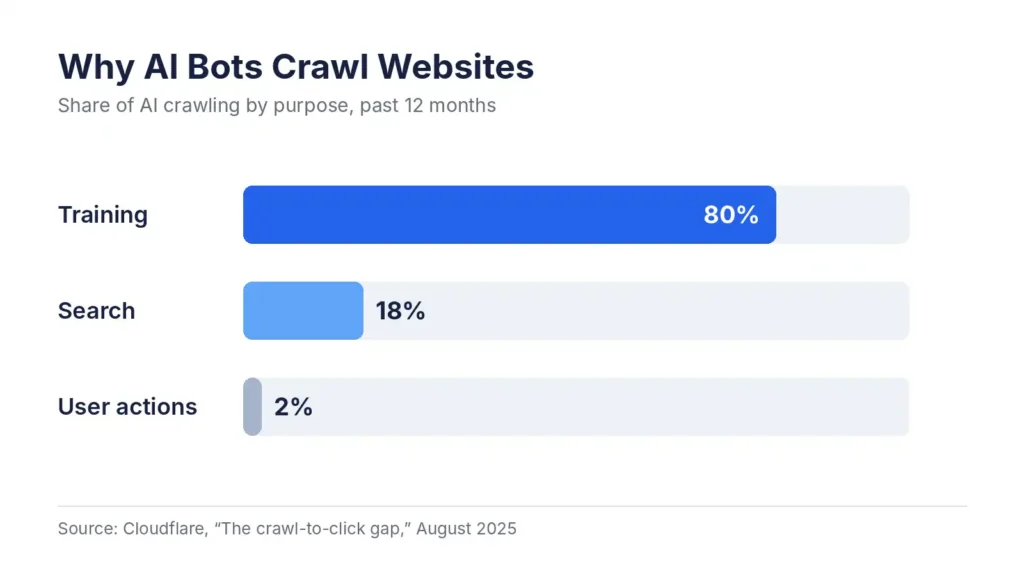
The chart below from Cloudflare shows how AI bot crawling breaks down by purpose.
Source: Cloudflare, “The crawl-to-click gap: Cloudflare data on AI bots, training, and referrals”
Cloudflare’s data backs that up. Over a 12-month period, training drove about 80% of AI bot crawling, search drove about 18%, and user actions, such as a person asking an AI tool to read a specific page, made up about 2%.
Training Crawlers
Bots like GPTBot and ClaudeBot collect content to train AI models. They may visit large parts of your site but send little direct traffic back. Some businesses choose to block them, and others allow them in the hope of being represented in future models.
Search and Answer Crawlers
Bots like OAI-SearchBot fetch pages to answer live questions. Other AI search tools, such as Perplexity, operate their own answer crawlers as well. These are the crawlers most tied to citations and referral traffic, so blocking them can keep your site out of AI answers.
User-Triggered Fetchers
Some visits happen when a person asks an AI tool to open or summarize a page. These fetchers act more like a user’s browser than a traditional crawler.
Mueller called these differences “another flavor of technical SEO.” The same skills apply: knowing which bots visit, what they can reach, and how your server and pages respond.
Read More: AI Bots Are Already Crawling Your Website. Is Your Technical Setup Ready for What They Find?
What Technical SEO Factors Matter Most for AI Search?
The technical SEO factors that matter most for AI search are crawlability, indexability, page speed, clean site structure, structured data, and content that loads without relying on heavy scripts. These are the same factors that help search engines, applied with AI crawlers in mind.
Crawl Access and robots.txt
Check which bots your robots.txt file allows and blocks. Many sites block AI crawlers by accident through broad rules, firewall settings, or security tools. Decide on purpose which training and search bots you want to allow.
Some site owners add an llms.txt file, a plain-text summary that tells AI tools what a site covers and which pages are most useful. It’s not a standard that all crawlers follow yet, but it’s worth watching as AI search develops.
Content That Renders Without JavaScript
Many AI crawlers don’t run JavaScript the way a modern browser does. If your key content, prices, or product details only appear after scripts load, some AI tools may never see them. Serving important content in the initial HTML makes it readable for every crawler.
Page Speed and Server Health
Slow pages and server errors waste crawl time and can cause bots to give up. Fast hosting, compressed images, and clean code help both users and crawlers. A fast, well-built web design supports technical SEO from the ground up.
Site Structure and Internal Links
A clear hierarchy and strong internal links help crawlers understand how your pages relate to each other. Orphaned pages with no links pointing to them are harder for any bot to find.
Structured Data
Schema markup labels your business details, products, reviews, FAQs, and articles in a format machines can read. It doesn’t guarantee an AI citation, but it reduces the guesswork when a system tries to understand your page.
Canonicals and Duplicate Content
Duplicate pages and conflicting canonical tags confuse search engines and AI tools alike. Clear canonicals tell every crawler which version of a page is the one to trust.
Are Listicles Bad for SEO?
No, listicles aren’t bad for SEO on their own, but listicles built only to manipulate AI rankings are a risky strategy. Mueller said he “wouldn’t necessarily say anything that is a listicle is spam,” as long as it adds value.
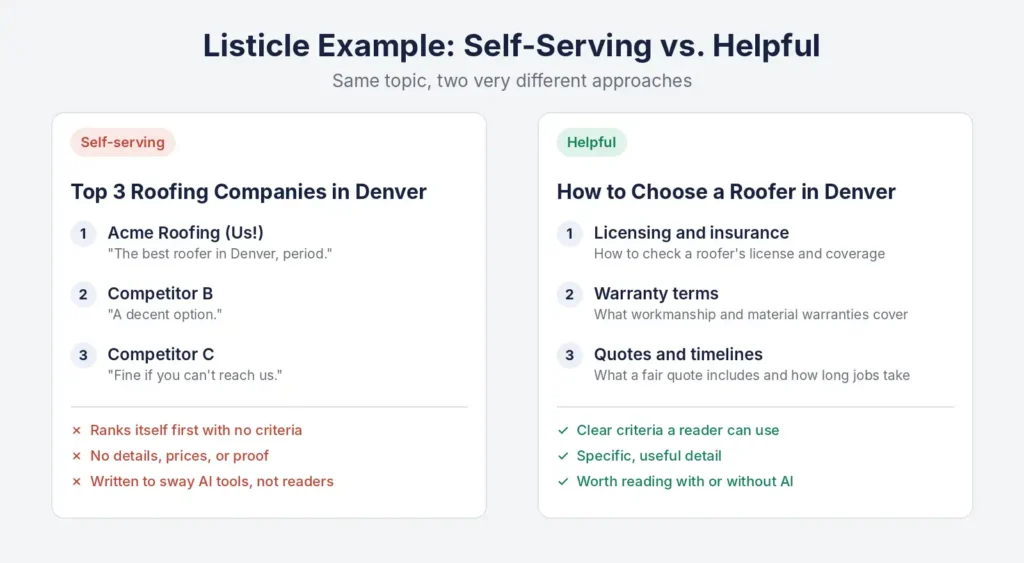
The problem is how some companies use them. A business publishes a “top companies in our industry” list, ranks itself first, and hopes AI tools repeat the claim. When enough sites do this badly, Mueller expects the systems to catch up, and the tactic loses its value.
A useful list works differently. It compares options honestly, explains the criteria, and helps a reader make a decision. If you publish comparison content, ask a simple question: would this page still be worth reading if AI tools didn’t exist? If the answer is yes, it’s likely adding value. Honest comparisons, clear criteria, and real usefulness are what The Ad Firm’s Content Marketing work is built around, since pages that hold up over time keep working long after any single tactic has faded.
The example below shows the difference between a self-serving listicle and a helpful one.
How Do You Know If Your SEO Company Is Using Bad Tactics?
You can tell if your SEO company is using bad tactics by asking what work they’re doing, checking it yourself, and watching for shortcuts that promise fast results with little explanation. Mueller’s advice was clear: don’t take a vendor’s word for it.
Warning signs include:
- Vague monthly reports that show rankings but never explain what work was done
- Promises of guaranteed AI citations or “ranking #1 in ChatGPT”
- Mass-produced listicles that rank your business first without real comparison
- Bought links or link schemes that appear suddenly in your backlink profile
- Hidden or cloaked content that shows one thing to crawlers and another to visitors
- No technical work on speed, crawl access, or site structure
A trustworthy digital marketing company will explain what it’s changing on your site, why it matters, and how it will measure results. If your current provider can’t answer those questions, that’s a reason to look closer. SEO done well should leave your site stronger every month, not dependent on a tactic that could stop working overnight.
How Can a Digital Marketing Company Help You Prepare for AI Search?
A digital marketing company can help you prepare for AI search by strengthening your site’s technical foundation, improving your content, and tracking how AI tools describe your business. The goal is long-term visibility in both traditional search and AI answers, not a quick spike that fades.
The right digital marketing company usually starts with a technical audit. That means checking crawl access for search and AI bots, page speed, rendering issues, structured data, and duplicate content. From there, it builds content that answers your customers’ questions directly and earns mentions on trusted sites.
Tracking matters too. A digital marketing company with AI search experience can monitor which AI tools mention your brand, which pages they cite, and how that visibility changes over time.
Further Reading: How to Monitor If AI Engines Are Citing Your Brand
Questions to Ask Before Hiring a Digital Marketing Company
Before you hire a digital marketing company for AI search work, ask:
- What technical changes will you make to my site first, and why?
- How do you decide which AI crawlers to allow or block?
- How do you measure AI visibility and its effect on leads or sales?
- What tactics do you avoid, and why?
Clear answers show a digital marketing company that builds for the long term. Vague answers or big promises are a sign to keep looking.
How Long Does It Take for Technical SEO Fixes to Affect AI Visibility?
Technical SEO fixes can start to affect AI visibility within a few weeks, but the full effect usually builds over a few months. The timeline depends on how often search engines and AI crawlers revisit your site and how large the fixes are.
Some changes show up quickly. Unblocking an AI search crawler in robots.txt, fixing a server error, or moving key content into the initial HTML can make pages readable on the next crawl. Bigger projects, such as restructuring internal links, cleaning up duplicate pages, or rebuilding a slow site, take longer to show results since crawlers need time to work through the changes.
Track progress in steps. Watch crawl stats and indexing reports in Google Search Console, check server logs for visits from AI bots, and test key questions in AI tools each month. Search Console’s generative AI performance report, which Google began rolling out in June 2026, shows impressions for your pages in AI Overviews and AI Mode. It doesn’t show clicks or cover tools like ChatGPT, but it gives you a direct view of Google’s own AI features. A digital marketing company that reports on these steps can show progress before rankings and citations fully catch up. Clear expectations from the start, not promises of overnight results, are what separate strong work from shortcuts.
Build an SEO Foundation That Lasts
AI search is changing fast, but the fundamentals that make a website easy to find, read, and trust aren’t going away. Google’s own advice is to focus on a stable foundation and question any tactic that seems too good to last. The Ad Firm is a full-service digital marketing company that helps businesses strengthen technical SEO, build helpful content, and track their visibility across search engines and AI tools.
Contact The Ad Firm to get a clear picture of your site’s technical health and how AI tools see your business today.
Frequently Asked Questions About Technical SEO and AI Search
Do I need special pages or files for AI search?
Not for Google’s AI features. Mueller has said there’s no reason to create special markdown pages for Google’s AI search. A well-built, crawlable website is the better investment.
Should I block AI crawlers?
It depends on your goals. Blocking training crawlers may protect your content from model training, but blocking search crawlers like OAI-SearchBot or PerplexityBot can keep your site out of AI answers. Review each bot on its own.
Does page speed affect AI visibility?
Page speed affects how easily crawlers can access your content, and slow or error-prone pages can be skipped. Fast pages help both users and bots.
Is SEO dead with the rise of AI?
No. Google’s John Mueller says AI systems build on SEO, and data from Ahrefs shows most AI Overview citations come from pages that already rank well in Google.
How often should I run a technical SEO audit?
Most businesses benefit from a full audit once or twice a year, with monthly checks on crawl errors, speed, and indexing. Run one after any site redesign or platform change as well.