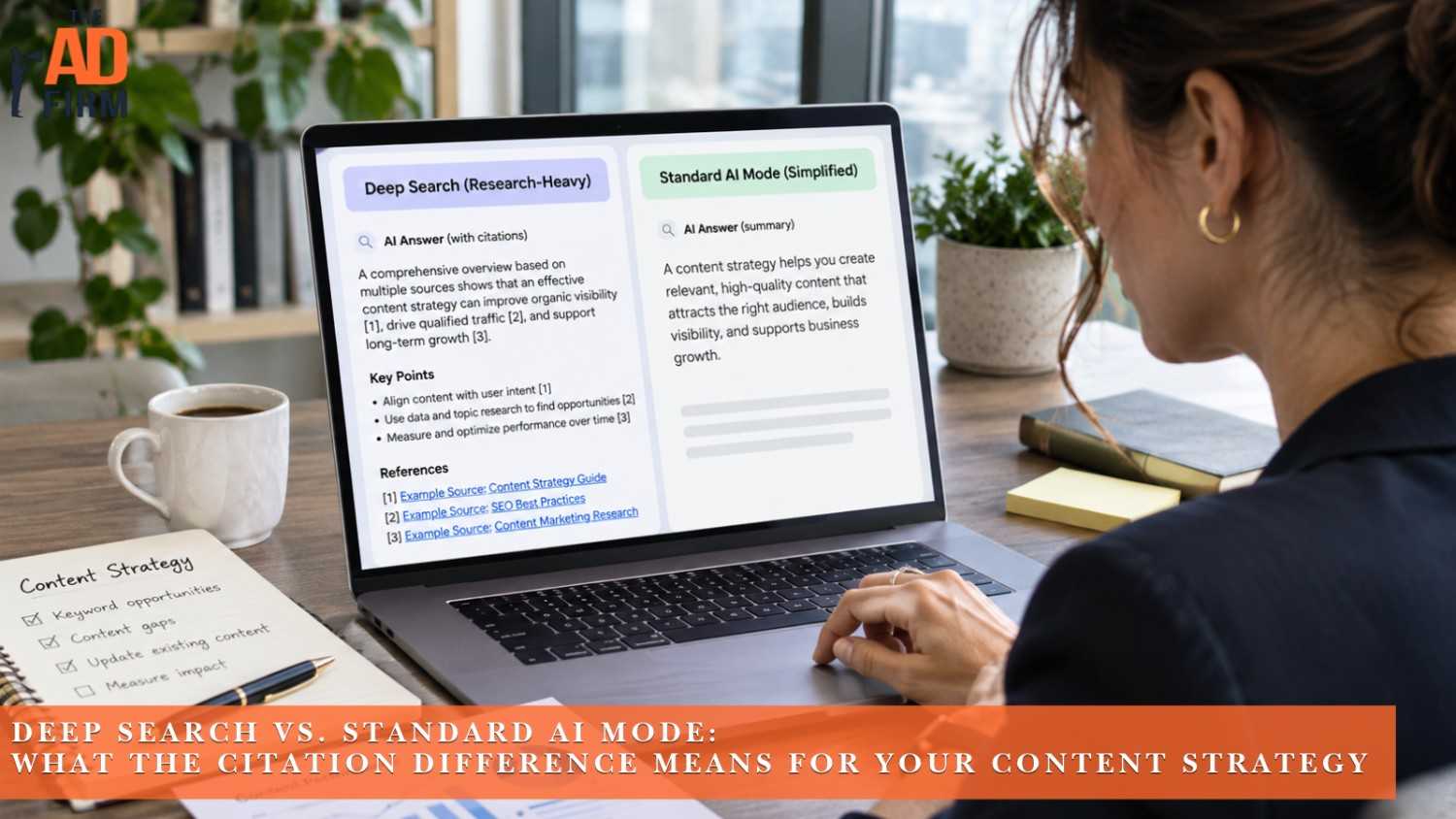
Deep Search runs the same query fan-out as standard AI Mode at far greater scale, so citations go to pages that answer narrow sub-questions. AI Mode and AI Overviews rarely cite the same URLs, so cover each sub-question and track each surface separately.
Your page ranks on page one, yet Google’s AI Mode cites a forum thread and a competitor instead. Rankings reports can’t explain that, and an AI SEO agency has to start from how each mode chooses its sources. Deep Search pushes that selection further, and what the studies show about it changes how a page should be built.
What is the difference between Deep Search and standard AI Mode?
Deep Search runs the same query fan-out as standard AI Mode at a much larger scale. Google describes it as the same technique taken further, able to issue hundreds of searches and return a fully cited report in minutes, according to Google’s announcement.
Search Engine Journal reported that Google’s Robby Stein said Deep Search can run dozens or even hundreds of background queries and may take several minutes to finish.
- Standard AI Mode splits a question into related searches across subtopics and data sources, then writes a conversational answer with links.
- Deep Search runs that split across dozens to hundreds of searches, takes minutes, and returns a fully cited report.
The citation studies below compare AI Mode with AI Overviews, and none of the studies cited here separates out Deep Search. Treat the gap as one of degree: more sub-searches mean more narrow questions your pages can be pulled in to answer. For what AI Mode already does to clicks and measurement, AI Mode’s effect on the SERP and rankings is the place to start.
How do Google’s AI surfaces choose which pages to cite?
Google’s AI surfaces choose pages by retrieving them through many related searches rather than by taking the top results for the typed query, which is why one question can earn different citations on each surface. The deeper selection logic is laid out in how AI search engines decide what content to cite, and the five signals that decide who gets cited add the trust layer.
Query fan-out turns one prompt into many sub-searches
Google’s documentation describes query fan-out as the technique AI Mode uses to handle a single prompt. Instead of running one search, it splits the question into several related searches across subtopics and data sources.
Streamline Your Digital Assets with The Ad Firm
- Web Development: Build and manage high-performing digital platforms that enhance your business operations.
- SEO: Leverage advanced SEO strategies to significantly improve your search engine rankings.
- PPC: Craft and execute PPC campaigns that ensure high engagement and superior ROI.
Each of those sub-searches returns its own set of candidate pages. That’s how the final answer can cite a source that never ranked for the phrase the person typed. Deep Search repeats the process many times over, which widens the net even further.
A page that settles one narrow question well has more chances to be picked up.
AI Mode and AI Overviews rarely cite the same URLs
AI Mode and AI Overviews rarely cite the same URLs, and both published overlap figures land well under half.
- Ahrefs studied 540,000 pairs of AI Mode and AI Overviews responses from September 2025 data and found the two cited the same URLs only 13.7% of the time.
- SE Ranking’s study of 10,000 keywords, with data collected in June 2025, found a 10.7% URL overlap and a 16% domain overlap between AI Mode and AI Overviews.
The figures differ because the studies used different queries, dates and methods, yet none finds a majority. Low citation overlap means a page cited in an AI Overview has no guarantee of showing up in AI Mode.
Cited pages often sit outside the top 10
AI Mode cites many pages that do not rank in Google’s top 10 for the query. Semrush’s July 2025 study of 5,000 keywords found that across all AI Mode results about 35% of cited URLs also appeared in Google’s top 10 organic results, which leaves most citations coming from elsewhere. The same study found AI Mode’s sidebar averaged seven unique domains compared with three for AI Overviews, so AI Mode casts the wider net.
The source mix shifts too. In the same Ahrefs data, AI Mode cited Quora 3.5 times more often than AI Overviews did, Reddit appeared at a similar rate in both, and YouTube held the top spot in AI Overviews. Community answers and video compete for the same slots as brand pages, and a top 10 ranking is a good sign but not the gate.
What does the citation gap mean for your content results?
The citation gap means a page’s AI visibility can’t be read off its rankings, so content results need their own measurement and their own planning unit. Why ranking and citation split apart is covered in the difference between content that ranks and content that gets cited by AI.
Track citations by surface, not as one blended number
Citation tracking needs one column per surface, because a URL cited in an AI Overview may never appear in AI Mode. For each priority query, record whether your page is cited, which URL, which competitors appear and the date, then run the same list on a fixed schedule.
Advance Your Digital Reach with The Ad Firm
- Local SEO: Dominate your local market and attract more customers with targeted local SEO strategies.
- PPC: Use precise PPC management to draw high-quality traffic and boost your leads effectively.
- Content Marketing: Create and distribute valuable, relevant content that captivates your audience and builds authority.
The share of tracked queries where your pages are cited, the AI citation rate, gives the team a number to move that rankings reports don’t show. Results shift between runs, so judge the rate across many queries and never from one screenshot.
Turn one topic into a map of sub-questions
A topic map starts from the sub-questions a fan-out would raise, and each one gets its own heading and its own direct answer. Take a bookkeeping firm’s page on outsourced bookkeeping. A fan-out around that phrase would plausibly probe:
- What outsourced bookkeeping costs and what moves the price
- How onboarding works and what the firm needs from you
- How it compares with hiring in-house
- Which accounting software it supports
- How client financial data is protected
Each item becomes an H2 or H3 whose first sentence answers it outright. Pull more candidates from People Also Ask, related searches and the questions sales calls keep surfacing. Deep Search runs far more sub-searches, so a page that already covers the edge cases, such as migrating from another tool or what happens at tax time, gives it more ways to retrieve that page.
How do you write pages that get cited in both modes?
Pages get cited in both modes when each section opens with a direct answer, states facts in a form a model can lift out, and gives a reason to trust them. What content performs best in AI search results and how to make content AI readable cover formats in more detail.
- Open each section with one sentence that names the subject and answers the heading, then add caveats and background afterward, so a system that grabs only that passage still gets a complete answer.
- Put facts where they can be lifted out: clean headings, numbered steps, comparison tables and concrete figures placed in the section where the question is asked.
- Show where a claim comes from with original data, a stated method, published pricing, case studies and mentions on other sites that repeat the same facts.
Where should your content team start this quarter?
Start with the pages that already bring in leads and rewrite each one around the sub-questions a buyer would raise. If a lead page ranks but never gets cited, restructure it around those sub-questions. If it neither ranks nor gets cited, fix indexing and the basics first.
GEO in 2026 lays out a quarter-by-quarter roadmap for the wider program. Want help deciding which pages to restructure first? Contact The Ad Firm.
Maximize Your Online Impact with The Ad Firm
- Local SEO: Capture the local market with strategic SEO techniques that drive foot traffic and online sales.
- Digital PR: Boost your brand’s image with strategic digital PR that connects and resonates with your audience.
- PPC: Implement targeted PPC campaigns that effectively convert interest into action.
Frequently asked questions
Do you need special markup or files to be cited in Google AI Mode?
No, Google says AI Mode needs no special optimizations beyond the basics. A page must be indexed and eligible to appear in Google Search with a snippet to show up as a supporting link, according to Google’s AI features guidance. That puts the effort on content structure and indexing.
Why do AI Mode citations change when you repeat the same search?
AI Mode citations change between runs of the same search, and the instability is large. SE Ranking ran the same 10,000 keywords through AI Mode three times on one day and only 9.2% of URLs matched across the runs. A single screenshot of a citation proves little, and a rate across many tracked queries gives a steadier read.
How long does Deep Search take to build an answer?
Deep Search takes minutes to build an answer. Google describes a fully cited report in minutes, and Search Engine Journal reported that it may take several minutes to finish.
Is Google’s Deep Search the same as ChatGPT deep research?
No. Deep Search is a feature of Google’s AI Mode, while ChatGPT’s deep research is a separate OpenAI product with its own sources and methods, so citation data from one doesn’t carry over to the other.