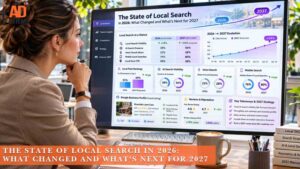
Local search had a rough and revealing year. The May 2026 core update sent ranking volatility to levels most businesses hadn’t seen before. AI Overviews started appearing directly next to the map pack, compressing the visible results even further. The GBP, once treated as a secondary listing, became the primary thing AI models pulled from when deciding which businesses to recommend. Rankings started fluctuating based on the user’s exact location and context.
Conversational queries replaced keyword strings. That shift favored businesses with a clear, consistent web presence across directories, reviews, and citations, the ones AI engines could confidently verify as real and relevant.
How Did AI Change the Way People Find Local Businesses in 2026?
The relationship between local businesses and search engines shifted in a fundamental way this year. AI systems stopped acting as pure index-and-retrieve tools and started acting as recommendation engines, pulling from multiple data sources to generate answers rather than just pointing users to a list of links.
For local businesses, that change means visibility is no longer just about ranking. It’s about being recognized as a credible, complete entity across every platform where AI models gather data.
Google AI Overviews and Local Pack Compression
AI Overviews are now appearing directly next to the map pack, and that placement is eating into the click share that local businesses once relied on. Users increasingly bypass the traditional search bar entirely and ask ChatGPT, Google AI Overviews, or voice assistants for a direct recommendation. The result is fewer organic clicks even when rankings hold steady.
The local pack itself shrank in many verticals. Queries that once returned a full 3-pack now surface a single AI-generated recommendation in some categories, with the map pack pushed further down the page.
Conversational Queries and Keyword String Decline
Search behavior shifted noticeably toward natural language. Users are typing full questions and describing situations rather than typing two or three keywords.
That shift rewards businesses that have content, reviews, and GBP attributes answering those specific questions, not just businesses that have optimized for head keywords. How retrieval-based AI systems interpret local SEO signals is now a practical concern, not a theoretical one.
Transform Your Online Strategy with The Ad Firm
- SEO: Achieve top search rankings and outpace your competitors with our expert SEO techniques.
- Paid Ads: Leverage cutting-edge ad strategies to maximize return on investment and increase conversions.
- Digital PR: Manage your brand’s reputation and enhance public perception with our tailored digital PR services.
Platform Fragmentation: Local Discovery Beyond Google
Younger audiences now search for local businesses on Instagram and TikTok at rates that rival or exceed traditional Google search. This isn’t a future trend anymore. It’s happening now, and it means local SEO can’t be a single-channel task.
Tools like ChatGPT are beginning to surface local recommendations based on web data they’ve indexed. Yelp, Apple Maps, and niche directories are feeding into AI recommendation layers. A business that appears strong on Google but is absent or inconsistent everywhere else is becoming increasingly invisible to a meaningful segment of potential customers.
What Did Google’s May 2026 Core Update Actually Do to Local Rankings?
The May 2026 core update hit local results harder than most anticipated. Diagnosing local SEO ranking drops after algorithm updates became one of the most searched topics in the SEO community for weeks after the rollout.
Volatility, Micro-Location, and the End of Fixed Rankings
Organic search volatility jumped significantly during and after the update. What made this update different from prior core updates was the degree to which micro-location started influencing results. Two searchers a mile apart in the same city started seeing different local pack rankings for the same query.
That means a business that appeared to be holding steady in rank-tracking tools might have been losing ground in the specific blocks or neighborhoods where their customers were actually searching. The 2025 SEO review and core update lessons laid the groundwork for understanding why this direction was coming, and 2026 confirmed it.
What the Update Rewarded and What It Penalized
Businesses with strong entity signals, complete GBP profiles, consistent NAP data across directories, and genuine review activity held or improved their positions. Businesses with thin content, inconsistent citations, or inactive GBPs lost ground disproportionately.
The update also penalized over-optimized local landing pages that were thin on actual business information. Pages stuffed with keyword variants but lacking service specifics, staff details, or operational information saw the biggest drops.
The Google Business Profile Is Now a Primary Ranking Asset
One of the clearest outcomes of this year’s algorithm and AI shifts is how dramatically the GBP’s role changed. What was once a supplementary directory listing is now the primary data source AI engines use to identify, verify, and recommend a local business. The investment it deserves has changed accordingly.
Elevate Your Market Presence with The Ad Firm
- SEO: Boost your search engine visibility and supercharge your sales figures with strategic SEO.
- PPC: Target and capture your ideal customers through highly optimized PPC campaigns.
- Social Media: Engage effectively with your audience and build brand loyalty through targeted social media strategies.
What GBP Signals AI Models Are Actually Reading
GBP data is not just feeding traditional local pack rankings anymore. AI retrieval systems are pulling from it to populate recommendation answers across multiple platforms. The signals that matter most have expanded beyond just name, address, and phone. Service categories carry significant weight. Business descriptions are being parsed for entity clarity. Photo activity and post frequency signal that a business is active and operating.
Seven overlooked GBP settings that can boost your ranking covers several of these in detail, including attribute fields that most businesses leave blank.
Review content is also being read semantically. A business with 50 reviews that repeatedly mention “fast response” or “same-day availability” is more likely to surface for those specific service attributes than a competitor with 200 reviews that say nothing specific.
GBP Categories and the Review Velocity Requirement
Category selection became more consequential in 2026. A business in the wrong primary category might have excellent content and reviews and still not appear for relevant queries. The algorithm is reading category assignment as an intent signal, not just a classification label.
Google Business Profile categories and local rankings shows how category mapping connects to the specific searches a business needs to show up for.
Review velocity, meaning the pace at which new reviews arrive, is now weighted differently than raw review count. A business with 50 reviews and consistent monthly activity can outperform a competitor sitting on 300 reviews with no recent additions. Fresh social proof signals relevance and trustworthiness to both the algorithm and the customer.
Local Service Ads and the Blurring of Paid and Organic Local Results
The 2026 LSA redesign moved Local Service Ads closer to the top of the SERP and gave them visual treatment that makes them harder to distinguish from organic local results at a glance. For businesses in eligible categories, LSAs are no longer optional if maintaining top-of-page visibility matters. The practical effect is that paid and organic local strategies are converging. A business managing both GBP optimization and LSA presence is competing at a different level than one treating them separately.
Streamline Your Digital Assets with The Ad Firm
- Web Development: Build and manage high-performing digital platforms that enhance your business operations.
- SEO: Leverage advanced SEO strategies to significantly improve your search engine rankings.
- PPC: Craft and execute PPC campaigns that ensure high engagement and superior ROI.
What Is GEO, and Why Does It Matter for Local Businesses Now?
Generative Engine Optimization is the practice of optimizing a business’s digital presence specifically to appear in AI-generated answers, not just traditional search results. For local businesses, it means building the kind of off-page credibility and entity clarity that AI systems trust when deciding what to recommend.
Trust factors that influence GEO performance in AI search breaks down what that actually looks like in practice, and connecting local rankings to revenue with GEO and AI search covers how to measure it.
Entity Signals, Digital PR, and the Off-Page Footprint
Being recommended by an AI engine requires more than a good website. AI retrieval systems cross-reference multiple sources before surfacing a recommendation. Editorial mentions, citations in relevant publications, and consistent brand presence across authoritative directories all function as trust signals.
Digital PR and local sponsorships for link building and 25 citation sites for local businesses are both directly relevant here. The off-page footprint a business builds today is feeding the AI recommendation layer it’s trying to appear in tomorrow.
Why Consistent NAP Across Every Platform Now Feeds AI Accuracy
Name, Address, and Phone consistency has always been a local SEO best practice. In 2026, it became something more than that. When AI systems cross-reference a business across multiple data sources, inconsistent NAP creates conflicting entity records. A business showing one phone number on its website, a different address in an old directory, and a third variation on a data aggregator creates an entity profile that AI engines can’t confidently resolve.
Businesses with clean, consistent NAP data across their full citation footprint are more likely to appear in AI recommendations with accurate information. A fractured entity record doesn’t just hurt traditional rankings; it undermines AI recommendation accuracy at a foundational level. How retrieval-based AI interprets local SEO signals goes deeper on this if you want to understand the mechanics.
What Should Local Businesses Prioritize Going Into 2027?
The businesses that held their ground through 2026’s volatility shared a common profile: strong entity signals, complete and active GBPs, genuine off-page credibility, and they had stopped measuring success by rank position alone.
Strengthen Your Online Authority with The Ad Firm
- SEO: Build a formidable online presence with SEO strategies designed for maximum impact.
- Web Design: Create a website that not only looks great but also performs well across all devices.
- Digital PR: Manage your online reputation and enhance visibility with strategic digital public relations.
2026 SEO forecasts for AI agents and search everywhere optimization and 10 ways to increase brand visibility in AI search results give additional context here.
Authentic Media Assets Over Generic Stock
AI systems and human visitors are both getting better at identifying generic visual content. Original photos of your team, your location, your work, and your process outperform stock imagery on every platform now. Google’s image indexing gives preference to unique visuals, and customers convert at higher rates when they can see what they’re actually getting.
Businesses that invest in authentic visual assets are differentiating themselves at exactly the layer AI engines are now weighing most.
Moving From Rank Tracking to Revenue Metrics
A business that ranks #2 in a micro-location grid for half its service area and doesn’t appear at all in the other half needs to know that. A traditional rank tracker showing an average position of #3 tells you almost nothing useful.
The measurement shift that matters going into 2027 is from rank position to business outcomes: calls, form fills, direction requests, and conversion-tracked revenue. Connecting local rankings to revenue with GEO and AI search is a good starting point for setting up that framework.
Cross-Platform Brand Signals and LLM Integration
ChatGPT, Perplexity, and Gemini are increasingly capable of providing local business recommendations. The businesses showing up in those answers have one thing in common: a consistent, well-documented brand presence across multiple authoritative sources.
That means citation records, editorial mentions, review profiles, and GBP data all need to be treated as a unified brand signal layer, not separate SEO tasks. The local business that gets recommended by an LLM in 2027 is the one that built the right off-page foundation in 2026.
Frequently Asked Questions
What is the biggest change to local SEO in 2026?
The biggest shift is that visibility now requires being recognized as a credible entity across multiple platforms, not just ranking in Google’s local pack. AI Overviews, conversational search, and cross-platform discovery all contribute to whether a business gets recommended or gets skipped.
How did the May 2026 core update affect local rankings?
The update increased micro-location ranking variability significantly, meaning rankings can differ block by block within the same city. It also penalized thin local landing pages and businesses with inactive or incomplete GBP profiles.
Boost Your Business Growth with The Ad Firm
- PPC: Optimize your ad spends with our tailored PPC campaigns that promise higher conversions.
- Web Development: Develop a robust, scalable website optimized for user experience and conversions.
- Email Marketing: Engage your audience with personalized email marketing strategies designed for maximum impact.
What is GEO and how is it different from traditional local SEO?
GEO (Generative Engine Optimization) focuses on optimizing for AI-generated recommendations rather than traditional search rankings. It emphasizes entity clarity, off-page credibility, and consistent data across platforms. Traditional local SEO remains important but is now one part of a broader visibility strategy.
How important are Google Business Profile reviews in 2026?
Review velocity matters more than it used to. Regular incoming reviews signal relevance and activity to the algorithm. The content of reviews is also being parsed semantically, so specific service mentions in review text influence which queries a business surfaces for.
Should local businesses worry about platforms beyond Google?
Yes. Younger demographics are using Instagram, TikTok, and AI tools like ChatGPT to find local businesses at rates that rival Google. A local SEO strategy built entirely around Google is leaving meaningful visibility on the table in 2026 and beyond.
2027 Is Already Being Decided Now
The local search landscape in 2027 will be shaped by decisions businesses make right now. AI recommendation systems are building their entity understanding of your business today, pulling from your GBP, your citations, your reviews, and your off-page presence. What they find, or don’t find, is what determines whether you get recommended next year.
If your local visibility strategy still looks the same as it did in 2024, it’s time for a full audit. The Ad Firm’s local SEO team works with businesses across every growth stage to build the kind of multi-channel presence that holds up in an AI-first search environment.
Contact us to get started.