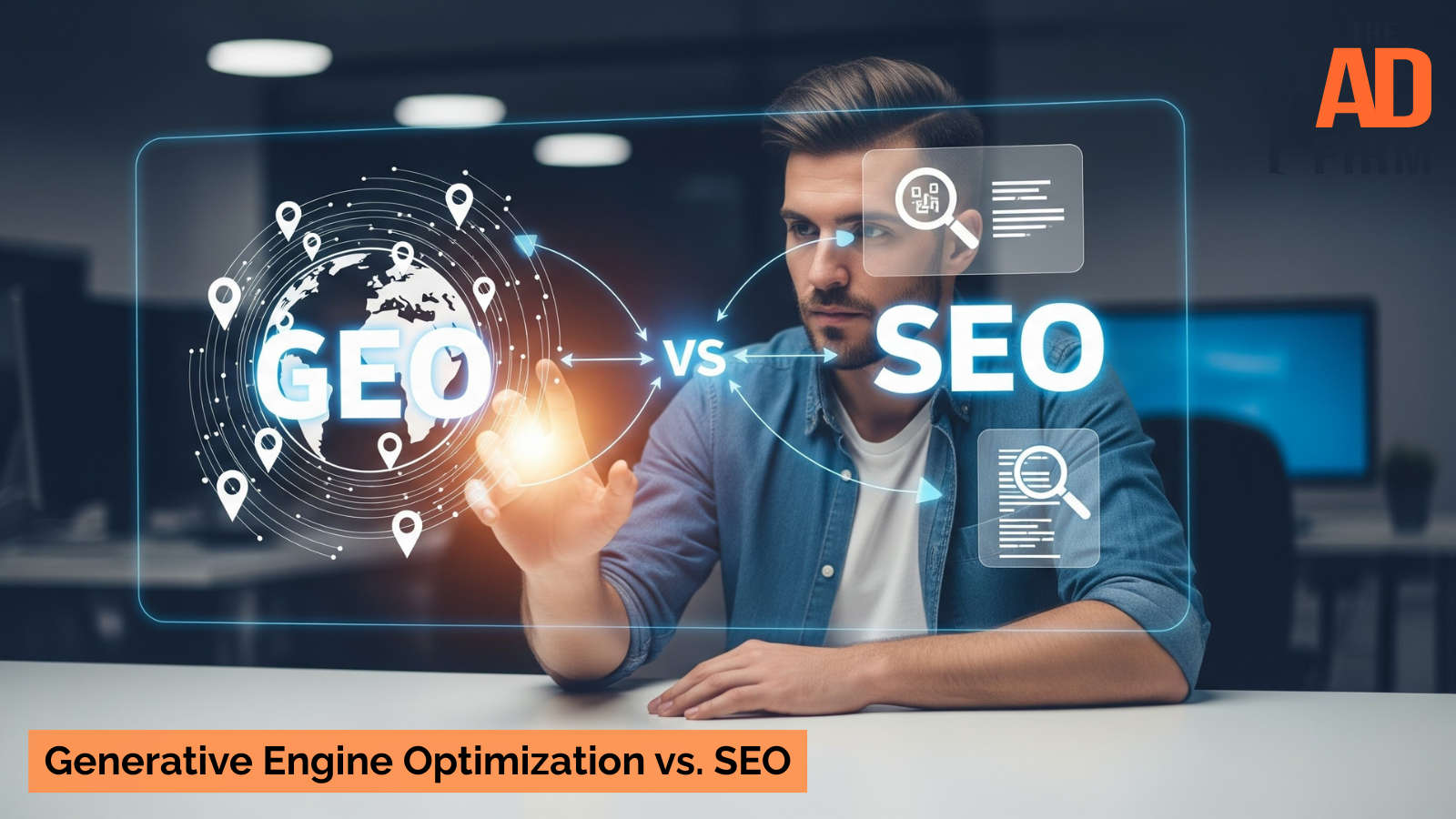
As search evolves with artificial intelligence, businesses must learn to adapt to new visibility models. One emerging concept is generative engine optimization, a forward-thinking approach designed to help content appear in AI-generated answers rather than just in traditional search results.
GEO doesn’t replace SEO; it complements it. Together, they help brands stay visible in both Google’s organic search results and AI-driven summaries.
In this blog, you’ll learn what sets GEO apart from SEO, how the two intersect, and how businesses can prepare to thrive in this new dual-search environment.
SEO and GEO: The Two Paths to Online Visibility
SEO and GEO share the same end goal: getting your business seen by the right people. However, the way they achieve that visibility differs significantly, especially as AI-driven platforms begin shaping the future of search.
- SEO focuses on traditional search rankings: Search Engine Optimization (SEO) involves refining your website so it ranks higher on platforms like Google or Bing. This process includes improving page speed, keyword placement, and overall site quality so that search engines view your site as trustworthy and relevant. The goal is to drive clicks from search results to your actual website.
- GEO targets AI-driven summaries: Generative Engine Optimization (GEO) is about shaping your content so it appears directly in AI-generated responses, such as Google AI Overviews, ChatGPT’s search results, or Bing Copilot. Instead of waiting for users to click a link, your content is integrated into AI’s direct answers, placing your brand directly in the conversation.
- The difference lies in the user journey: SEO brings visitors to your website to find answers, while GEO brings your answers to users within AI results. This means visibility now extends beyond clicks; it’s about brand presence in intelligent search interfaces that instantly summarize information.
- Why this shift matters: As AI search tools gain popularity, being cited or referenced within these systems becomes critical for authority. Businesses that adapt early will benefit from increased visibility, even when users don’t visit their websites directly.
- Preparing for dual visibility: SEO and GEO don’t compete; they address different moments in the user journey. Businesses that recognize this distinction early can start aligning their teams, content, and analytics to serve both kinds of search experiences effectively.
Read Also: Using AI to Identify and Build Topical Authority for Your Website
Similarities Between GEO and SEO
Though SEO and GEO operate on different platforms, they share the same foundation: helping people find trustworthy, useful information online. Both rely on a deep understanding of users and on presenting information in ways that search systems, whether traditional or AI-powered, can easily interpret.
- Shared goal of discoverability: Both GEO and SEO exist to make sure your content gets noticed by the right audience. They do this by improving how clearly information is presented so that algorithms and users can quickly identify its relevance. Whether it’s a link in Google or a snippet in an AI-generated summary, both strategies aim to get your message seen first.
- Understanding user intent: Both methods depend on recognizing what users are genuinely looking for when they search. Instead of focusing only on keywords, successful strategies anticipate questions and provide answers that satisfy curiosity or solve problems. This alignment with user intent increases engagement and ensures content matches real-world needs.
- Quality as the foundation of visibility: Search engines and AI tools alike prioritize content that demonstrates clarity, accuracy, and trustworthiness. High-quality pages that explain concepts clearly tend to perform better because they’re easier for both humans and algorithms to understand. Good writing and verified information remain central to success, regardless of how search evolves.
- Dependence on measurable performance: SEO tracks metrics like organic traffic and click-through rates, while GEO evaluates visibility within AI responses or brand mentions inside summaries. In both cases, data drives decision-making. Regularly reviewing these insights allows businesses to refine strategies, identify what resonates, and sustain visibility across platforms.
- Adaptation as a constant necessity: Both SEO and GEO demand continuous updates because search systems evolve rapidly. Algorithms change, new features appear, and user behavior shifts with every new technology. Staying adaptable ensures that your content remains relevant in a landscape where visibility depends on both human understanding and machine interpretation.
Key Differences Between GEO and SEO
While both GEO and SEO aim to make your business more visible online, they operate under entirely different mechanics. Understanding these differences is essential to adjusting your strategy for both traditional and AI-driven search environments without losing opportunities on either side.
1. Target Platforms and Purpose
SEO and GEO serve different ecosystems. SEO helps your site rank in traditional search results, while GEO ensures your information appears inside AI-generated summaries or conversational answers.
- Different visibility goals: SEO is all about ranking your website higher so users can click through and explore your pages. GEO focuses on being featured in AI-generated answers, so users get key information without leaving the AI interface. This means businesses must now think beyond clicks and consider visibility where users find answers instantly.
- Where users find you: In SEO, a searcher types a query, scans results, and decides which website to visit. GEO works differently; AI tools scan trusted sources, summarize key insights, and display your content alongside the answer. This makes brand exposure faster and more passive, but still valuable for credibility and recognition.
- Practical impact for brands: By tailoring content to both ecosystems, businesses stay present wherever users search or interact. Instead of relying on one platform, this balanced approach ensures consistent exposure as people shift between browsing and conversational search.
2. User Experience
The way users interact with SEO and GEO results is another significant difference. SEO focuses on directing traffic to your website, while GEO centers on delivering answers directly to users within AI interfaces.
- Depth vs. immediacy: In SEO, users click your site to explore complete information, images, and calls to action. GEO offers immediate responses by summarizing information directly in the AI output, giving users quick insights without needing to browse multiple sites. This difference changes how people consume your content and perceive your expertise.
- Control over experience: SEO allows you complete control of your website design, message flow, and conversion paths. In GEO, the AI system decides what part of your content to highlight or reference, so accuracy and clarity are critical. Structuring content clearly increases the likelihood that AI will accurately represent your brand in its summaries.
- Implications for engagement: SEO encourages deeper engagement, as visitors spend more time reading and interacting with your site. GEO builds brand awareness in a faster, more indirect way—people recognize your brand from AI answers even if they don’t click through. Together, they create a balance between quick recognition and long-term trust.
3. Optimization Focus
Because search engines and AI systems process information differently, SEO and GEO require distinct optimization approaches. The key lies in understanding how each system interprets and prioritizes your content.
- SEO’s foundation: Traditional SEO improves rankings through technical precision, clean URLs, internal links, keyword placement, and authoritative backlinks. These elements help search engines index your site effectively and determine its credibility. Maintaining this foundation ensures your website stays competitive in standard search environments.
- GEO’s foundation: Generative Engine Optimization depends on clarity, structure, and context rather than just keywords. AI systems analyze meaning and relationships between topics, so adding schema markup and well-labeled sections helps them interpret your content accurately. This makes your business more likely to be cited or summarized in AI-generated answers.
- Bridging both sides: The most successful strategies combine both worlds, strong SEO for technical visibility and GEO for interpretive clarity. For instance, an AI SEO approach may focus on writing content that’s readable for both humans and AI systems. By integrating both, businesses prepare for today’s search habits and tomorrow’s AI-driven discovery.
4. Metrics That Matter
The success of SEO and GEO is measured differently because each reaches users in unique ways. SEO tracks site performance, while GEO examines how your information appears and performs within AI-generated environments.
- Traditional SEO metrics: These include keyword rankings, organic traffic, and conversion rates. They reveal how effectively your website attracts visitors and converts them into customers. Regularly reviewing these metrics ensures that your traditional search presence remains strong.
- GEO-specific metrics: GEO focuses on AI visibility indicators, such as how often your content is cited, summarized, or linked in AI-generated results. This helps businesses measure presence even when users don’t click through to their site. Tracking this data shows how your content contributes to brand exposure within AI-driven tools.
- Complementary measurement: Using both sets of metrics gives a complete picture of visibility. SEO shows tangible engagement through visits and conversions, while GEO shows emerging visibility trends within AI-driven answers. A digital marketing agency that understands both can help balance the data and design a strategy for lasting growth across all search types.
How GEO and SEO Work Together

GEO and SEO aren’t competing strategies; they’re complementary. GEO depends on the groundwork SEO lays, and SEO gains new power when it is adapted to AI-driven systems. Understanding how they connect helps businesses prepare for a future where both traditional clicks and AI-generated visibility matter.
- GEO relies on SEO-built foundations: AI systems gather and summarize information from well-optimized websites. Without strong SEO, precise metadata, organized site structures, and crawlable pages, AI tools wouldn’t know your content exists. GEO therefore enhances, rather than replaces, SEO by amplifying well-optimized pages in AI search results.
- SEO fuels GEO’s accuracy and reach: When your website is optimized for humans and search engines, AI has reliable data to reference. Structured content, factual accuracy, and consistent updates make it easier for generative systems to interpret and include your insights. The stronger your SEO signals, the more likely your brand is to appear naturally in AI answers.
- They complement each other’s visibility goals: SEO brings traffic to your website, while GEO makes your content part of the broader conversation in AI-generated summaries. Together, they cover both discovery paths, traditional search results and instant answers. This combined approach ensures your business stays relevant in all search contexts.
- Balancing both creates lasting stability: Businesses that optimize for both GEO and SEO future-proof their visibility as search evolves. By maintaining technical SEO while adopting GEO-friendly structures such as schema markup, brands stay present on emerging platforms without losing ground in traditional search results.
- Practical integration example: A company investing in both might use SEO to boost rankings for key service pages while refining those same pages for GEO-friendly structure. With guidance from an experienced SEO company, this approach seamlessly bridges traditional traffic growth with new AI-driven opportunities.
The Future of Search Is Dual Visibility
Search behavior is rapidly changing, but one truth remains: visibility depends on being present where people look for answers. SEO helps businesses earn clicks through traditional rankings, while GEO ensures they stay visible inside AI-generated conversations.
Both strategies aim to make your content helpful, accessible, and trustworthy, just in different ways. GEO doesn’t replace SEO; it expands your reach into the growing world of AI-driven search experiences.
At The Ad Firm, we help businesses adapt to this evolving landscape with strategies that combine strong technical SEO and GEO-ready content. From optimizing your website for organic visibility to preparing it for AI Overviews and emerging search tools, we ensure your brand thrives in both search ecosystems.
If your goal is to stay visible wherever your customers search or ask questions, reach out to The Ad Firm today. Let’s future-proof your digital strategy and keep your business ahead in both clicks and conversations.