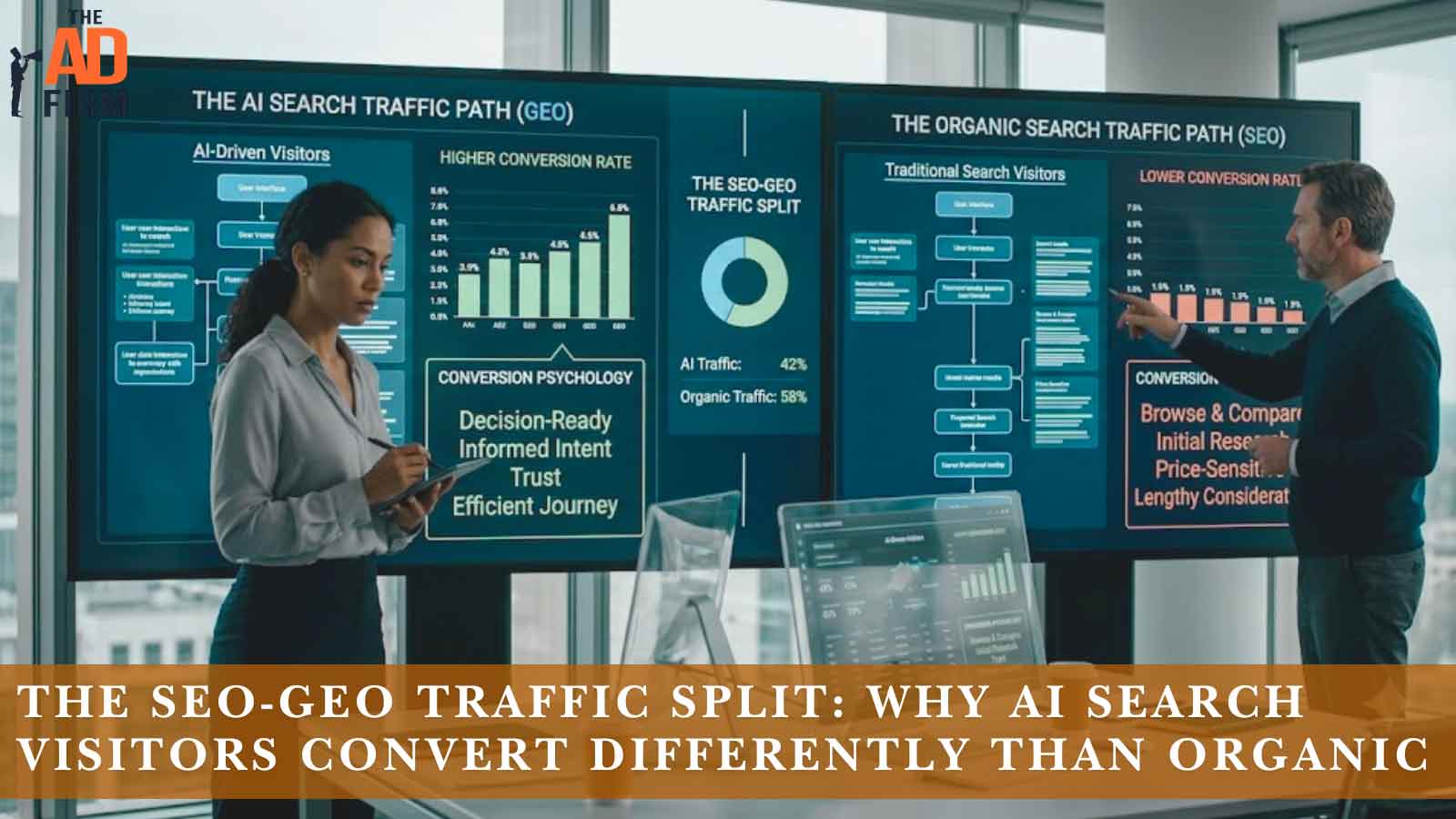
Two visitor groups now arrive on your website from search, and they convert at very different rates. Classic organic visitors arrive in research mode and need multiple touches to make a decision. AI search visitors arrive pre-briefed by an AI answer that already compared the options for them, so they land closer to a decision and convert faster on the first session. Same business, same site, two conversion patterns built on opposite starting points. Planning for one and ignoring the other leaves money on the table.
What the SEO-GEO Traffic Split Actually Means
The split refers to the gap between traffic from traditional Google search (organic) and traffic from generative AI engines like Google’s AI Overviews, AI Mode, ChatGPT, Perplexity, and Gemini. Both still count as search. They behave like two different channels.
Search Engine Land’s recent analysis of LLM referral traffic across 10 websites and 150,000 indexed pages shows that visitors arriving from AI engines do not browse the same way. They land on a page after an AI has already answered most of their question. The session is short by design.
Organic search still drives the bulk of traffic for most businesses. But the smaller AI-driven segment sends different signals: higher intent on arrival, faster decision-making, and less tolerance for long content paths. Treating them as one bucket makes the data look worse than it is.
For local service businesses, this matters more than for ecommerce. When someone asks ChatGPT for the best web design company in Carlsbad, the AI returns a short list. The click that follows comes from a user who has already narrowed the field.
The two visitor types you’re now serving
- The classic organic visitor: typing keywords, comparing options, reading multiple pages, and slower to convert
- The AI-referred visitor: arriving with context, fewer questions, faster decision, often closer to contacting you
Why is this gap widening
AI search adoption is fragmented. Search Engine Journal reporting confirms that most users still prefer traditional search methods. Yet the share asking AI tools first is growing in B2B and service-heavy categories, which are exactly the categories most agency clients compete in. The trend line points up even when day-to-day volume looks small.
Streamline Your Digital Assets with The Ad Firm
- Web Development: Build and manage high-performing digital platforms that enhance your business operations.
- SEO: Leverage advanced SEO strategies to significantly improve your search engine rankings.
- PPC: Craft and execute PPC campaigns that ensure high engagement and superior ROI.
How AI Search Visitors Behave Differently From Organic Search Visitors
The behaviour gap shows up in three places: how deep they go on your site, how long they stay, and how they convert.
Intent depth on arrival
Organic visitors usually arrive in research mode. They want to compare, read, and understand options before deciding. They click multiple links, open new tabs, and treat your site as one stop in a longer process.
AI-referred visitors arrive after the AI has done the comparing. They land closer to a decision point. Their first question is usually narrow: “Do you serve my area?” “What does this cost?” “Can I book a call?” Pages that bury those answers below long introductions lose them fast.
Session length depends entirely on page type
Average engagement time across all pages tells you almost nothing. The Search Engine Land study found organic and LLM sessions averaged within a fraction of a second of each other (46.9 versus 47.1 seconds). The interesting pattern shows up when you split by page type. On 71% of LLM-receiving pages, sessions were shorter than organic. For the remaining 27%, they ran 3 to 10 times longer.
LLM users spend less time on long blog articles (they extract the specific answer and leave) and more time on tools, homepages, and service or product pages (where they evaluate the actual offer). A 90-second visit to your service page that ends in a phone call is not a bounce; it’s a high-intent conversion that looks like one in your analytics. Blended session metrics hide this pattern, which is why reporting frequently misreads the AI segment.
Conversion path length
Organic traffic typically needs multiple touchpoints before converting. AI-referred traffic can convert in the first session. The AI did the upper-funnel work; your job is to confirm the answer the visitor already received.
The two channels reach different pages. Search Engine Land’s study found that of the top 100 organic pages across the analyzed sites, 49 had zero LLM traffic. Your best organic page and your best AI-cited page are usually not the same page, which has direct implications for how you prioritize updates.
ALSO READ: How Page Experience Influences Local SEO Engagement Metrics
Why AI Search Traffic Converts at a Different Rate
Same site, same offer, two conversion rates. The reasons trace back to how each engine ranks and presents you.
Advance Your Digital Reach with The Ad Firm
- Local SEO: Dominate your local market and attract more customers with targeted local SEO strategies.
- PPC: Use precise PPC management to draw high-quality traffic and boost your leads effectively.
- Content Marketing: Create and distribute valuable, relevant content that captivates your audience and builds authority.
Pre-qualified by the AI’s answer
When an AI tool recommends your business, that recommendation acts as a referral. The user has read the AI’s comments about you before clicking. Trust is already built. Skepticism is lower. The contact form fills out faster.
This pre-qualification effect is the reason AI-referred sessions often outperform standard organic conversion rates, even at much lower volume. Industry observations across service categories tend to show this pattern, though the size of the gap varies widely by vertical and offer.
Classic SERPs show the user 10 blue links and let them open 10 tabs to compare. AI tools do the comparing first and surface a tight shortlist of two or three options. Landing on that shortlist functions as a trusted, scalable endorsement, which is why click intent looks so different on arrival.
Lower volume, higher intent
GEO traffic is rarely a volume play. Even strong AI visibility produces a fraction of the clicks that ranking for the same keyword in classic search would deliver. The clicks that arrive carry weight.
For service businesses, this trade is often favourable. A web design lead from ChatGPT who already knows your portfolio is worth far more than a cold organic click that lands on the same page.
When AI traffic underperforms
GEO traffic stops converting when the AI’s summary contradicts what the visitor finds on the page. If ChatGPT describes you as full-service but the landing page reads narrow and technical, the visitor leaves disappointed. Brand-to-page consistency matters more for AI-referred visits than for organic ones.
The same effect shows up around pricing, service-area claims, and team size. An AI tool that calls a business “boutique” sends visitors who expect a small, hands-on team. A page that opens with enterprise client logos and corporate language breaks that expectation in the first scroll. The visit ends before it starts. Aligning the page with the most common AI descriptions of your brand closes that gap.
ALSO READ: Combining CRM Data and GEO Metrics for Smarter AI SEO Forecasting
What This Means for Your Reporting
If your dashboard treats every search visitor the same, it hides the most important shift happening to your channel mix.
h3 Why blended metrics hide the truth
The average bounce rate, session duration, and pages-per-session combine two channels with opposite profiles into a single number. AI traffic looks worse than it is. Organic traffic looks better than it is. Decisions made on the blended view tend to underinvest in GEO at exactly the wrong time.
Elevate Your Market Presence with The Ad Firm
- SEO: Boost your search engine visibility and supercharge your sales figures with strategic SEO.
- PPC: Target and capture your ideal customers through highly optimized PPC campaigns.
- Social Media: Engage effectively with your audience and build brand loyalty through targeted social media strategies.
Picture a typical month: 2,000 organic visitors with a 2.1% conversion rate and 80 AI-referred visitors converting at 11%. Blended, the AI segment vanishes inside a flat 2.5% report. Pulled apart, it’s the strongest-converting channel on the site: same data, two very different decisions.
KPIs to add to your dashboard
- AI Overview, impressions, and click data from Google Search Console’s new AI Search reports
- Referrals from ChatGPT, Perplexity, Claude, Gemini, and other AI engines, segmented in GA4
- Conversion rate by source category, with AI engines isolated from generic organic
- Brand mentions in AI answers, tracked through tools like Otterly.AI or BrightLocal’s AI Citations
Attribution gaps to expect
AI engines pass referrer data inconsistently. Some sessions show up as direct traffic. Some show up as referrals from chatgpt.com or perplexity.ai. Some never show at all. The honest move is to acknowledge the gap in client reports and triangulate with branded search lift, direct traffic shifts, and form-fill source questions.
Branded search lift is often the most defensible AI-ROI signal in the stack. When an AI tool recommends you, many users open Google later and search your brand directly. A clean spike in branded queries that lines up with AI mention growth is worth tracking as a leading indicator, even if your last-click attribution still credits “direct” or “organic.”
How to Plan for Both Channels Without Splitting Your Budget in Half
The fastest mistake is to build two separate strategies. The smarter move is to have one foundation feed both.
One content strategy, two visitor types
Strong topical depth, clear entity associations, and answer-ready content work for both engines. Pages that answer specific questions in the first paragraph rank for organic queries and get cited in AI answers. Building for the AI-referred visitor also improves the page for the classic organic visitor. Most of the gains come from sharpening pages you already have, not from publishing new ones.
Local SEO signals that feed both
For multi-location and service-area businesses, local SEO inputs feed both engines. Google Business Profile completeness, review depth, citation consistency, and locally relevant content all appear in AI summaries of local services. The Ad Firm’s local SEO work covers the inputs that both classic and AI search pull from, which is why the two services share so much of the same playbook.
Enhance Your Brand Visibility with The Ad Firm
- SEO: Enhance your online presence with our advanced SEO tactics designed for long-term success.
- Content Marketing: Tell your brand’s story through compelling content that engages and retains customers.
- Web Design: Design visually appealing and user-friendly websites that stand out in your industry.
Which pages get cited by AI engines
Across categories, the pages that earn AI citations share a few traits. They open with a direct answer to a specific question. They name sources clearly. They cover one entity deeply rather than ten entities shallowly. They use simple structure (clear headings, scannable paragraphs, defined terms).
What gets ignored: thin pages, pages stuffed with synonyms, pages that bury the answer below sales copy, and pages with no clear author or organization signal. The fix is structural, not stylistic. Strong content already on the site often needs only a rewrite of the first paragraph and a tightened heading hierarchy to start showing up in AI answers.
When direct GEO investment makes sense
Direct GEO investment earns its place when your category sees high AI search adoption, such as B2B services, agencies, professional services, and complex local services. The Search Engine Land study found service and product pages outperform every other page type for LLM traffic, capturing 29.4 LLM sessions per 1,000 organic sessions. That ratio sat highest among page categories tested, ahead of articles, FAQs, tools, and homepages. The Ad Firm’s generative engine optimization service handles the entity, schema, and citation work that gets brands cited in AI answers, layered on top of the SEO foundation.
For categories with lower AI adoption (transactional retail, impulse purchases, hyper-local emergency services), the SEO foundation alone usually carries the load. The right call depends on a simple question: do your buyers ask AI tools before they Google? Most service buyers do. Most coupon-driven shoppers don’t.
Working With The Ad Firm on a Combined SEO and GEO Strategy
The Ad Firm has been operating since 2009. As a Google Premier Partner with a 4.9-star rating across 1,400+ reviews on Clutch, Google, UpCity, and DesignRush, our SEO, AI SEO, local SEO, and GEO teams work as one unit. That matters here. The traffic split is real, but the foundation feeding both channels is shared.
If you’re seeing flat clicks paired with stronger leads, or rising AI mentions without traffic to match, our team can audit the gap and rebuild the reporting view so the numbers tell the right story. Reach out to start a conversation about your SEO and GEO strategy.
Amplify Your Market Strategy with The Ad Firm
- PPC: Master the art of pay-per-click advertising to drive meaningful and measurable results.
- SEO: Elevate your visibility on search engines to attract more targeted traffic to your site.
- Content Marketing: Develop and implement a content marketing strategy that enhances brand recognition and customer engagement.
Frequently Asked Questions
Is GEO traffic counted in Google Analytics like organic?
Partly. GA4 captures referrals from named AI engines like chatgpt.com and perplexity.ai, but many AI visits are counted as direct traffic with no referrer. Adding source/medium segmentation for known AI domains closes part of the gap. The rest needs triangulation through branded search trends and form-fill source questions.
Should I optimize differently for AI Overviews and traditional search?
The foundation overlaps. Both reward topical depth, clear entity signals, and answer-first content. The differences lie in structure: AI engines favour pages that answer specific questions within the first 100 words and back claims with cited sources. Pages built that way perform in both.
How long before GEO traffic starts converting?
GEO citation timelines tend to move faster than classic ranking timelines. Brand mentions can appear in AI answers within weeks once entity signals and authoritative coverage are in place. Conversion patterns follow the citation, not the keyword, so the lift shows up in lead quality first.
Can a small business compete in AI search?
Yes, often more easily than in classic search. AI engines weigh brand depth, review patterns, and local signals heavily. A small business with strong reviews, consistent citations, and clear service-area content can outrank larger competitors in AI answers for local queries.