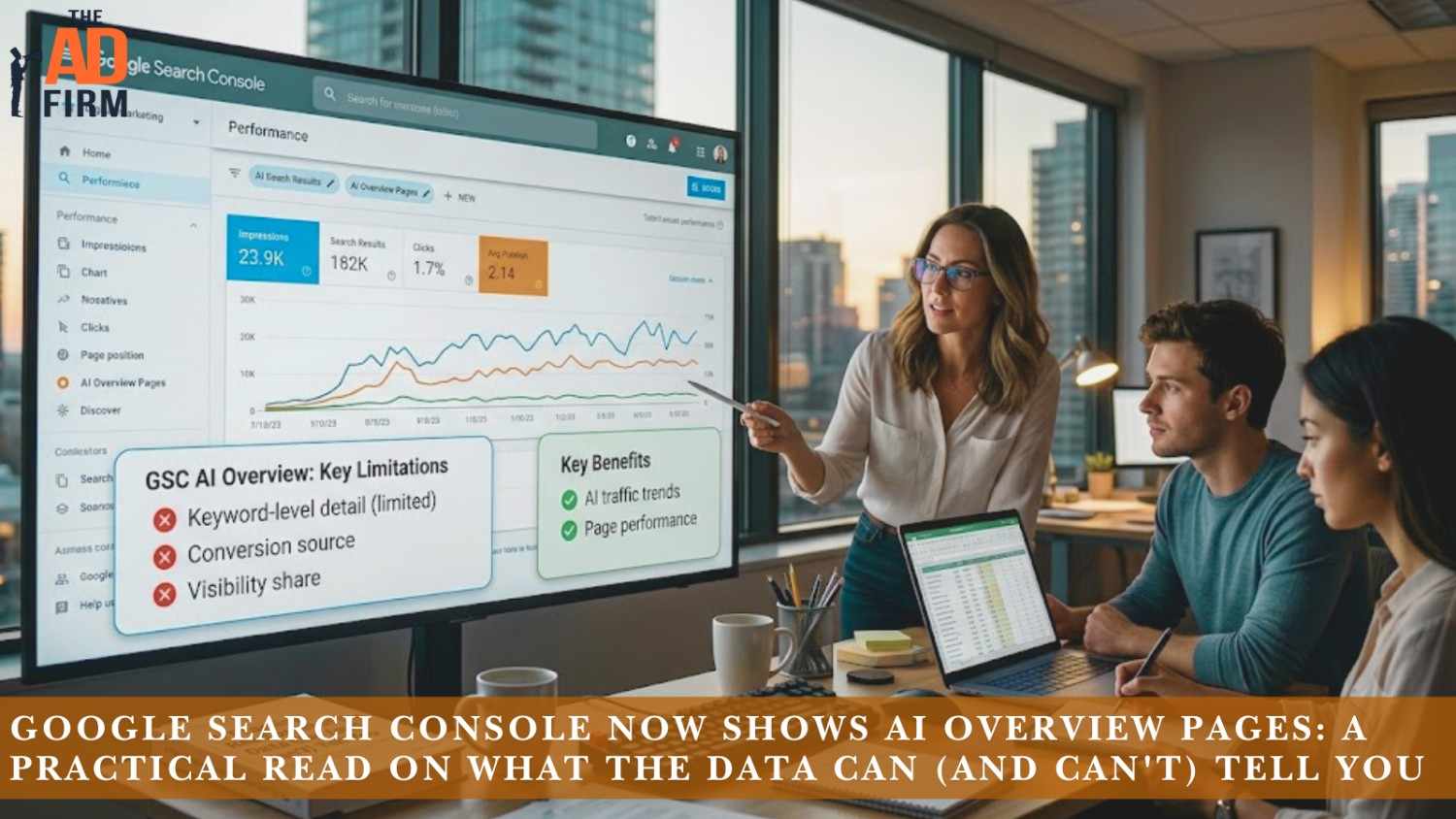
Google Search Console now features dedicated Search Generative AI performance reports, giving site owners a clean, isolated view of organic impressions in AI Overviews, AI Mode, and generative AI features in Discover. On June 3, 2026, Google launched these reports as a standalone section inside the Performance tab, separating AI-driven visibility from standard Search data for the first time.
The new metrics represent visibility on AI-driven platforms, but understanding what this data tells you, where the blind spots remain, and how to measure actual traffic impact is the critical piece most coverage skips. Here is what the report covers, what it leaves out, and how to read it without drawing the wrong conclusions.
What Google Actually Launched
The new report sits inside the Performance section of Search Console as a standalone view. Google’s data was always counted in your aggregate Performance numbers. The June 3, 2026 launch, announced by Hillel Maoz (Search Ecosystem Engineering Manager) and Moshe Samet (Product Manager Lead), isolated that data so site owners can now see AI-driven visibility on its own.
Two surfaces are covered under the report. Generative AI features within Search include both AI Overviews and AI Mode. Generative AI features within Discover are reported separately. Google confirmed the rollout is phased, with UK site owners among the first wave, tied in part to pressure from the Competition and Markets Authority. Access expands automatically inside the Performance section once your property is included. There is no opt-in process.
ALSO READ: Attribution Modeling in an Era Where AI Answers Reduce Click-Through
What the New Report Can Tell You
Four areas of visibility are now accessible directly in Search Console.
AI Visibility Trends Over Time
You can track how often your pages appear inside Google’s AI features and monitor that figure over time. The report supports hourly, daily, weekly, and monthly intervals. The hourly view catches publication-day spikes. The monthly view supports trend analysis once enough data accumulates. This is the clearest signal you have that your content is being recognized by Google’s AI systems, and it is measurable across campaigns.
Which Pages Are Getting AI Impressions
The Pages dimension shows exactly which URLs on your site appeared inside AI features. This is the single most actionable breakdown in the report. Pages appearing consistently across multiple AI surfaces carry strong topical authority signals in Google’s eyes. Pages absent from the report represent gaps in your AI visibility footprint. Sort by impressions to identify your heaviest-lifting pages and prioritize them for E-E-A-T improvements and GEO optimization.
Maximize Your Online Impact with The Ad Firm
- Local SEO: Capture the local market with strategic SEO techniques that drive foot traffic and online sales.
- Digital PR: Boost your brand’s image with strategic digital PR that connects and resonates with your audience.
- PPC: Implement targeted PPC campaigns that effectively convert interest into action.
Where Your AI Traffic Is Coming From
Country data shows where your AI impressions originate. Device data, available for Search results, shows the device type in use when your content surfaced. For brands serving multiple markets, country data confirms your AI visibility aligns with your geographic targets or flags unexpected skews. Mobile-heavy patterns suggest your content is surfacing in mobile AI Overviews, which carry different engagement dynamics than desktop.
The Opt-Out Toggle
Google introduced a publisher-level toggle that lets you remove your content from AI Overviews, AI Mode, and generative Discover features without affecting standard Search rankings. The toggle operates at the property level in Search Console and is distinct from Google-Extended, which governs training data, and from the nosnippet directive, which affects standard snippets only. For most businesses, opting out trades real visibility for no offsetting gain. More on that in the FAQ.
What the Report Can’t Tell You
Knowing the report’s limits is as important as knowing what it tracks. Four critical dimensions are missing from the current view.
No Clicks, No CTR, and No Query Data
The reports show impressions only. There is no click data, no click-through rate, and no query-level breakdown. You cannot see which searches triggered the AI Overview that cited your page, which means identifying your top AI pages is possible but mapping them to the conversational queries driving those impressions is not.
Why this matters: research from Seer Interactive found that organic CTR for queries with AI Overviews dropped from 1.76% to 0.61%, a 65% decline against comparable impression counts. A growing AI impression count can coexist with a meaningful traffic loss. Pairing Search Console’s impression view with GA4 is essential to understand what that visibility is actually worth. Google has rolled out an AI Assistant traffic source in GA4 that captures clicks from AI features, and combining both tools gives you the closest approximation of a complete picture inside Google’s own ecosystem.
You Can’t Separate AI Overviews from AI Mode
The reports group all generative AI features into a single view. There is no way to isolate performance in AI Overviews specifically versus AI Mode specifically. If you want to understand which surface is driving your impressions, Search Console cannot tell you that yet. For query-level or surface-level breakdowns, third-party tools remain the only option.
Streamline Your Digital Assets with The Ad Firm
- Web Development: Build and manage high-performing digital platforms that enhance your business operations.
- SEO: Leverage advanced SEO strategies to significantly improve your search engine rankings.
- PPC: Craft and execute PPC campaigns that ensure high engagement and superior ROI.
Impressions Don’t Confirm You Were Cited
The report shows impressions on an AI-generated page, but it does not confirm whether your site was explicitly cited as a visible web link inside the AI snapshot. Your content may have informed the AI’s response without your domain appearing as a clickable source. This distinction matters for measuring brand authority versus direct traffic contribution, and the current report does not distinguish between the two.
No Visibility Into Third-Party AI
Search Console only measures Google Search. It tells you nothing about how your site is referenced by ChatGPT, Perplexity, or other AI platforms. For most businesses operating in competitive markets today, a complete AI visibility picture requires tracking across multiple engines, not just one. This is the core premise behind generative engine optimization, and it requires data sources that go beyond what any single platform’s native analytics can provide.
ALSO READ: Consent Mode Made Simple: How Google’s Update Affects Your Analytics and Ad Data
How to Fill the Reporting Gaps
Because Google’s native AI reporting focuses on impressions rather than traffic acquisition, three supplementary strategies close the most important gaps.
- Analyze traditional GSC data alongside the new AI report. Look for search terms where your site’s overall impressions are high but clicks are flat or declining. A widening gap between the two correlates with AI Overviews capturing zero-click searches. This is a pattern you can detect in your standard Performance report right now, even without the new AI-specific view. Our SEO services include this type of cross-channel analysis as part of ongoing performance audits.
- Monitor GA4 referral traffic. Use Google Analytics to check for actual click-throughs from AI platforms and other third-party search tools. The AI Assistant channel in GA4 captures clicks from Google’s AI features and is the click-side complement to the impression-side data in Search Console.
- Review Google’s official documentation. The AI Features and Your Website guidelines explain how to analyze traffic changes and combine Search Console with Analytics for a fuller picture. The Search Generative AI Performance Reports documentation covers the phased rollout and what to expect as access expands.
How to Read the Data Without Drawing the Wrong Conclusions
Three reading errors are common with this report.
Strengthen Your Online Authority with The Ad Firm
- SEO: Build a formidable online presence with SEO strategies designed for maximum impact.
- Web Design: Create a website that not only looks great but also performs well across all devices.
- Digital PR: Manage your online reputation and enhance visibility with strategic digital public relations.
The first is treating AI impressions as a direct proxy for traffic. A page can carry 50,000 AI impressions per month and generate close to zero clicks if the AI Overview answers the user’s question entirely. Compare AI impression trends against GA4 organic traffic over the same period. A growing divergence between the two is the signal worth acting on.
The second is confusing presence with authority. Appearing in an AI Overview once does not establish topical authority. The pages worth flagging are those appearing consistently across multiple surfaces, multiple countries, and multiple devices. A page surfacing in one geography only suggests narrow signal strength, not broad recognition.
The third is reading this report in isolation. GSC tells you what Google’s AI is doing with your content. It tells you nothing about what ChatGPT, Perplexity, or other platforms are doing. If your visibility strategy depends entirely on Google’s native data, you are measuring one window of a multi-window building. A broader GEO strategy accounts for the full surface area.
ALSO READ: Why Your Brand Should Care About Gemini (Not Just Google Search)
What to Do This Week If You Have Access
Five actions matter in the first week of access.
- Capture a baseline. Export the report on day one and save impression totals, top pages, country breakdown, and device split. There is no historical view in the report itself, so this export is your only benchmark.
- Identify your top AI pages. Sort the Pages dimension by impressions and document the top 20. These are the pages carrying the most weight in Google’s AI features and the logical starting point for E-E-A-T improvements.
- Compare AI impressions to total Search impressions. If AI impressions represent 15% or more of your total Search impressions, AI visibility is a meaningful share of your discovery surface and warrants dedicated resourcing. Below 3%, your topical coverage likely needs work before AI features will consistently surface your pages.
- Audit your top AI pages for citation signals. Pages cited by AI features tend to have strong author attribution, original research or data, clear structured headers, and direct answers to the user query in the first paragraph. Pages absent from the report often lack one or more of these signals.
- Cross-reference with GA4’s AI Assistant channel. Combining GSC impression data with GA4 click data is the closest you can get to a complete picture inside Google’s own tooling. Do not report on one without the other.
What This Means for Your SEO and GEO Strategy
The new report does not change what earns AI citations. Strong topical depth, clear structured answers, current data, and verified authorship still drive citation frequency. What it changes is your ability to measure progress and report on it with specificity.
Enhance Your Brand Visibility with The Ad Firm
- SEO: Enhance your online presence with our advanced SEO tactics designed for long-term success.
- Content Marketing: Tell your brand’s story through compelling content that engages and retains customers.
- Web Design: Design visually appealing and user-friendly websites that stand out in your industry.
Sites with rising AI impressions and stable or growing click totals are converting AI exposure into qualified traffic. Sites with rising AI impressions and falling clicks are losing the click battle even when Google’s AI cites them. Both patterns are diagnostic, and neither tells the full story without GA4 context.
Document AI visibility separately in client and stakeholder reporting. Folding AI impressions into a generic Search visibility metric obscures the most significant shift happening in organic right now. Pull the AI report monthly, track the trend, and connect it back to the specific pages driving results. Teams building this reporting discipline today will have a much cleaner data story as AI features continue to expand across Google’s surfaces. For a broader view of how to position your content for AI-driven discovery, our Search Generative Experience explainer covers the foundational context.
If your AI impressions are growing but clicks are not following, the issue is usually content structure, not content volume. The Ad Firm’s Generative Engine Optimization services are built specifically for this: auditing which pages earn citations, identifying the structural gaps keeping users from clicking through, and building the kind of content that performs across Google’s AI surfaces and beyond. Contact us to get a clear picture of where your AI visibility stands and what it would take to turn impressions into measurable traffic.
Frequently Asked Questions
Is the AI Overview data new, or was Google already tracking it?
The data is not new. Google confirmed AI impressions were always counted inside the aggregate Search Console Performance report. The June 3, 2026 launch separated it into a dedicated view. Your total numbers in the main report did not change.
Does the new report show clicks from AI Overviews?
No. The report shows impressions, pages, countries, devices, and date-range breakdowns. Click data, CTR, and query-level information are not part of the report. GA4’s AI Assistant channel covers the click side separately, and combining both gives you the most complete picture available.
How do I get access if my property is not in the rollout?
Access is phased, and Google has not published an eligibility list or timeline. The reports surface automatically inside the Performance section of Search Console once your property is included. There is no application or opt-in process.
Elevate Your Market Presence with The Ad Firm
- SEO: Boost your search engine visibility and supercharge your sales figures with strategic SEO.
- PPC: Target and capture your ideal customers through highly optimized PPC campaigns.
- Social Media: Engage effectively with your audience and build brand loyalty through targeted social media strategies.
Should I opt my site out of AI features using the new toggle?
For most businesses, no. Opting out forfeits AI impressions and any clicks they generate, with no offsetting benefit to standard Search rankings. Publishers with subscription-driven revenue, where AI answering replaces a click to a gated article, may evaluate this trade differently. Service-based businesses, local businesses, and ecommerce brands almost always benefit from staying visible inside AI features.