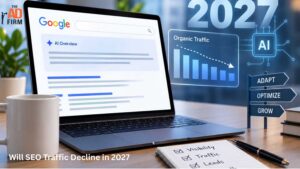
Your rankings are still holding, but your clicks are dropping. That is often the AI Overview effect, especially when your site relies on informational search traffic. To recover, you need more than stronger rankings. You need content that AI systems can cite and traffic channels that do not depend on every user clicking a traditional blue link. Generative engine optimization (GEO) helps you sharpen your content, protect your brand presence, and keep your audience connected to your business as search results change.
Why AI Overviews Are Pulling Clicks Away From Your Pages
AI Overviews give users direct answers on the results page, which means they may get what they need before clicking through to your site. For businesses that rely on informational search traffic, this changes how organic search presence turns into measurable visits, leads, and revenue.
It also helps to separate the two surfaces Google now runs. AI Overviews are the AI-generated summaries that appear inside standard search results. AI Mode is a more conversational experience built for deeper exploration and follow-up questions, and Google expanded it to more than 35 new languages and over 40 additional countries on October 7, 2025. Both pull from the open web, so your visibility strategy has to account for each.
The CTR Drop the Data Confirms
The decline is measurable, not anecdotal. Ahrefs first measured a 34.5% drop in click-through rate for the top-ranking page when an AI Overview was present, based on 300,000 keywords in April 2025. The firm then re-ran the same study with December 2025 data and found the effect had nearly doubled.
That updated number tells the real 2026 story. Ahrefs found that the presence of an AI Overview now correlates with a 58% lower average click-through rate for the top-ranking page. Put plainly, for every 100 clicks a position-one page used to earn, Google now keeps 58 of them.
Seer Interactive tracked the same trend across a longer window. Its data showed organic click-through rate (CTR) fell from 1.76% to 0.61%, while a separate measure put CTR down 68%. The pattern is clear: when the results page answers the question first, your link has to work harder to earn the click.
It Is Not Only Informational Queries
This shift does not stop with pages that trigger an AI Overview. Seer’s tracking showed queries down roughly 41% year-over-year, even outside Overview results, which points to a broader change in how people use search. Users are clicking less across the board.
That matters for your planning. If you treat this as a problem limited to a few “what is” pages, you may underestimate how much it can affect your content strategy, lead generation, and organic traffic forecasts.
Early Signs the Decline Is Leveling Off
The trend is not a straight drop to zero. Seer’s April 2026 update documented organic CTR for AI Overview queries climbing from 1.3% in December 2025 to 2.4% in February 2026, which the firm describes as stabilization rather than a full rebound.
Two points matter here. First, organic search still sends clicks worth competing for. Second, the sites that recover are the ones adapting their content for AI extraction, not the ones waiting for old CTR numbers to return.
What the May 2026 Update Changed
Google reshaped how citations appear, and it works in your favor if you publish focused content. On May 6, 2026, Google rolled out structural changes to AI Overviews and AI Mode: inline citations now sit next to the specific text they support, hover previews show site names on desktop, and a new “Expert Advice” block pulls firsthand perspectives from forums, social media, and review sites.
Two of those changes affect what you publish. Citations placed next to the specific claim they support reward self-contained, passage-level writing, and firsthand-source surfacing rewards lived experience and attributable community presence. The hover preview adds another reason to sharpen your title tag and meta description, since the user now sees which site they are heading to before clicking.
The New Goal: Be the Brand AI Cites
Ranking first still helps, but it no longer secures the click. The goal has shifted. You want your brand to appear inside the AI-generated answer as a trusted source, not only below it as a standard organic result. This is the core idea behind GEO: making your content useful enough for AI engines to identify and reference.
Why Citations Hold Clicks Steady
When AI Overviews cite your brand, your traffic can hold even as CTR slips. Citation now carries real click value: Seer Interactive’s data shows brands cited in AI Overviews get 35% more organic clicks than uncited ones. Placement inside the answer offsets fewer clicks per impression.
Citations also build trust. When users see your brand named as a source, they reach your site with more context and clearer intent than someone who scrolls past a list of standard links.
What AI Models Reward in a Source
AI-generated answers tend to pull from sources that provide direct explanations, original evidence, trusted signals, and organized information. Rankings alone no longer decide this. Top-10 ranked pages accounted for 76% of AI Overview citations in mid-2025 but only about 38% by early 2026, so the work now centers on being quotable, not just being ranked. The next step is to make those signals easy to find on your own pages.
LEARN MORE: How to Get Cited in Claude, Gemini, and Other AI Assistants
How to Optimize Content for AI Citation
Answer engine optimization starts with how you structure your page. If your content gives AI systems useful answers, clean formatting, and reliable evidence, you increase your chances of being cited instead of ignored. Generative SEO begins with making every section easy for both people and AI models to evaluate, and it extends to the authority signals AI weighs across the wider web.
Lead Every Section With a Direct Answer
Start each H2 and H3 with a clear sentence that answers the question right away. Skip long introductions, rhetorical hooks, and vague setup lines. Give your reader the answer first, then add context, examples, and proof.
This approach helps your audience understand the point quickly. It also gives AI tools a clean sentence to quote and attribute to your page, which matters more now that inline citations sit beside the exact claim they support.
Format Data as Tables and Lists
AI Overviews favor content that organizes information clearly. If your page compares options, explains steps, or breaks down features, use a table or list instead of hiding important details in long paragraphs.
| Content format | Why AI favors it |
| Short definition sentences | Easy to pull and attribute |
| Bulleted lists | Scannable, maps to summary points |
| Comparison tables | Directly answers “vs” and “best” queries |
| FAQ blocks | Matches question-shaped prompts |
Clear formatting also improves the reading experience. When people find answers faster, they are more likely to stay on your page and take the next step.
Publish Original Data and Research
Original data gives AI systems a stronger reason to cite your content. Publish surveys, benchmarks, tests, case studies, or internal findings that add something new to the topic. A short study with real numbers often carries more authority than a long article that repeats information found on other sites.
Use your data to support specific claims. Show what you measured, explain what it means, and connect the insight to a practical business decision your reader can make.
Support Content With Structured Data
Schema markup gives search engines and AI tools a clearer context about your page, its purpose, and its key sections. Match your structured data to the type of content you publish.
- FAQ schema: Use it for question-and-answer sections that address common user concerns.
- LocalBusiness schema: Use it for location pages that support local search presence.
- Product or Service schema: Use it for pages that explain your offerings clearly.
- HowTo and Article schema: Use it for guides, tutorials, and educational blog content.
Keep your Knowledge Graph details, FAQs, schema markup, and business information accurate. Fast, mobile-friendly pages with a clear menu structure also matter because AI systems favor content that works well for real users.
Build the Off-Page Authority AI Trusts
AI systems look beyond your page when deciding which sources deserve to be cited, so on-page quality needs off-page credibility behind it. Strengthen Experience, Expertise, Authority, and Trust with named author credentials, expert review, clear sourcing, quality backlinks, and transparent claims. When you cite data, link to reliable sources; when you make a claim, support it with evidence or results.
Earned visibility carries real weight now. The May 2026 “Expert Advice” block pulls firsthand perspectives from forums, social media, and review sites, so a presence on Reddit, Quora, industry forums, and review platforms feeds the same signals AI uses to judge relevance. Digital PR, thought leadership, and genuine community participation put your brand where AI systems already look.
RELATED ARTICLE: AI Local Search Citations for Local Business Visibility
Win the Click Below the AI Summary

When your link appears below an AI Overview, your page needs to offer something the summary cannot. Your title, angle, and search intent all influence whether users choose your result after reading the AI-generated answer.
Rewrite Titles to Promise What AI Cannot
Your title should make a clear case for why the user should click beyond the summary. AI Overviews usually provide broad answers, so your title needs to promise depth, proof, or practical application.
Use titles that highlight value, such as “Expert Analysis,” “Step-by-Step Guide,” “Real-World Case Study,” or “What the Data Shows.” You can also create a sharper reason to click with titles like “Why the AI Answer Misses the Mark on [Topic],” which signals that your page offers context the summary left out. With desktop hover previews now showing your site name before the click, a clear, specific title earns more than a clever but vague one.
Move Toward High-Intent, Bottom-of-Funnel Pages
AI Overviews often absorb basic informational searches, so your strategy should focus more on queries tied to decisions, comparisons, and action. These searches still earn clicks because users need details before they act. They also play to a real advantage: branded keywords are less likely to trigger an AI Overview, and when they do, Amsive measured an 18.68% CTR boost, likely due to greater user intent and brand familiarity.
- Product comparisons: Create pages for searches like “Brand A vs. Brand B” or “alternatives to [software],” where users need details before making a decision.
- Local intent queries: Target searches that require a provider in a specific area, especially terms tied to map results, service areas, and location-specific decisions.
- Pricing and cost guides: Build pages around searches like “how much does X cost in 2026,” since users need current details, context, and practical next steps.
These pages connect search presence to stronger intent. Instead of only attracting readers who want to learn, you reach people who are closer to choosing a solution.
Diversify Traffic So Zero-Click Stops Hurting
Build direct channels so your lead flow does not depend on a single search result. The goal is to create steadier relationships with your audience across email, social platforms, branded search, direct traffic, and community touchpoints.
Own Your Audience Through Email
An email list gives you a direct way to reach prospects and customers after they leave your site. Prioritize newsletter sign-ups, lead magnets, and useful follow-up campaigns so your business can keep communicating with buyers after the first visit.
Strong email campaigns turn one-time visitors into a repeat audience through timely follow-ups, helpful resources, and messages tied to where each prospect sits in the buying process.
Grow Where Your Buyers Spend Time
Build presence on the platforms your audience already uses. For many B2B companies, that means LinkedIn. For many B2C brands, that may mean Instagram, TikTok, YouTube, or other platforms where buyers discover and compare solutions.
A real following creates demand before a search ever happens. When people already know your brand, they are more likely to search for you directly, click your result, and choose your business with confidence.
How to Measure Success in an AI Overview World
Traditional SEO metrics no longer tell the full story. Rankings and CTR still matter, but they can miss a bigger shift: your brand may gain exposure in AI-generated answers even when standard organic clicks decline. Generative AI search engine optimization depends on measuring the right signals.
Track Citations and Impressions, Not Just Position
Watch AI Overview citations, impression growth, branded search demand, total clicks, and how strongly your business appears for important topics. Google has begun rolling out generative AI visibility reports in Search Console, though initially only to a subset of properties, so check your account for an AI Mode view under Search Appearance and compare recent impressions and clicks against the prior quarter.
Review which keywords trigger AI Overviews and if your content appears as a cited source. A weekly check helps you see where your reach is growing, where competitors earn citations, and where your content needs a cleaner structure, better proof, or more authority.
Find Citation Gaps With the Right Tools
Citation-tracking tools show which domains AI answers already cite in your space. Platforms such as Ahrefs Brand Radar, Profound, Otterly.ai, and Peec.ai surface the listicles, comparison pages, guides, and source types your brand has not yet covered across Google AI Overviews and assistants like ChatGPT, Perplexity, and Gemini.
Once you spot the gaps, build content that answers those queries more clearly and credibly than the sources currently cited. This gives your business a stronger path into AI-generated answers and helps protect qualified discovery as search behavior keeps changing.
Start Recovering Your Search Visibility Today
If your rankings hold while clicks fall, your strategy needs to evolve with how people now use search. The Ad Firm maps where AI Overviews affect your traffic, then builds a recovery plan around three layers: passage-level content structured for citation, off-page authority through digital PR and community presence, and owned channels that protect your lead flow.
Through GEO and full-funnel SEO services built around measurable growth, The Ad Firm helps businesses turn AI search into a source of qualified discovery. Reach out today to map your recovery plan and turn AI search into a stronger visibility channel for your business.
Frequently Asked Questions
Do AI Overviews always reduce my clicks?
No. AI Overviews usually affect basic informational searches the most. Searches with commercial, branded, or local intent can still drive clicks because users often need to compare providers, request pricing, or take action. Branded queries can even see a click-through lift when an Overview appears.
How do I get my content cited in an AI Overview?
Answer the query directly at the start of each section, organize supporting details in clear lists or tables, and back important claims with credible evidence and original data. Strong author credentials, schema markup, and earned mentions on trusted platforms round out the signals AI weighs.
Is SEO still worth it with AI Overviews?
Yes. Search still influences traffic, leads, and brand trust, but the strategy has changed. Your content now needs to earn citations inside AI-generated answers while also targeting commercial and local searches that bring qualified users to your site.
What is the difference between AI Overviews and AI Mode?
AI Overviews are AI-generated summaries that appear within standard Google search results. AI Mode is a separate, conversational search experience built for follow-up questions and deeper research. Both draw on web sources and can cite your content, so a complete strategy accounts for each.
How often does Google update the sources it cites?
Citations change frequently and do not track tightly with traditional rankings, so a page cited this month may drop next month. Plan for a recurring citation audit rather than a one-time fix, and keep your highest-value pages fresh, well-structured, and backed by current data.