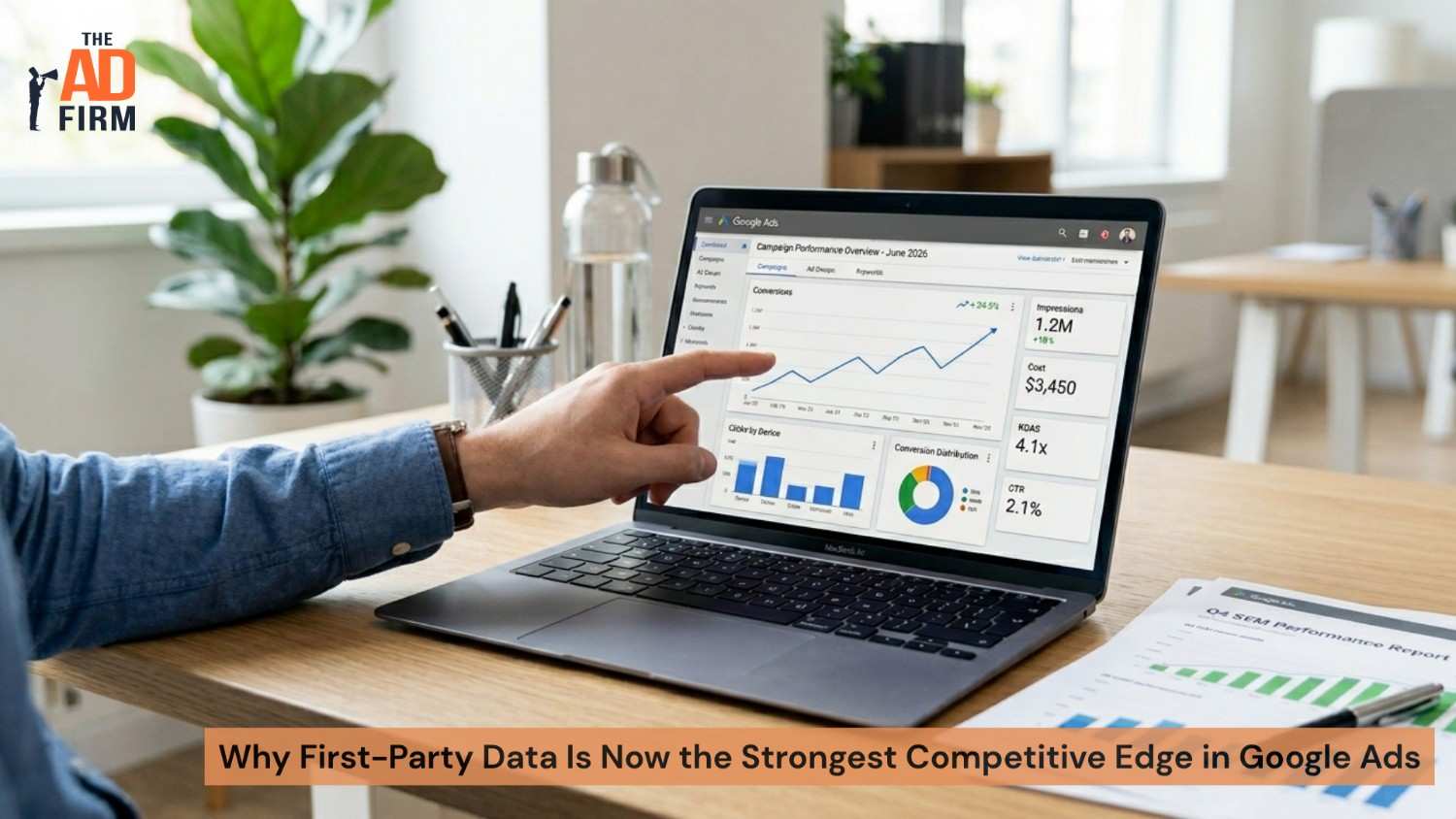
First-party data gives your Google Ads campaigns a stronger competitive edge because it helps the algorithm learn from real customer actions, not broad platform assumptions. When your competitors rely on the same default bidding strategies and audience segments, the quality of your data can be the difference between wasted spend and measurable growth.
The businesses pulling ahead in paid search are not necessarily spending more. They are working with a PPC agency that feeds Google’s AI more accurate, business-specific information, and the algorithm responds accordingly.
Google’s AI Runs on Data, and Not All Data Is Equal
Google Ads no longer depends on manual bid adjustments the way it once did. Smart Bidding, Performance Max, and AI-driven automation now make thousands of decisions across the auctions your ads enter. The quality of those decisions depends entirely on the quality of the data you provide.
If you only track basic conversions, Google has limited context for separating profitable customers from low-value leads. First-party data gives Google more useful context because it reflects real customer behavior, actual revenue, and the specific actions that matter most to your business.
Your CRM Data Trains the Algorithm for Profit, Not Just Clicks
When you upload value-based conversion data from your customer relationship management (CRM), such as revenue, purchase history, or qualified lead values, Google can learn which customers bring the most value to your business. To illustrate how this works in practice: a lead who purchases a $1,500 service plan is worth far more to your business than a lead who downloads a free resource. When you assign those different values inside Google Ads, Smart Bidding learns to pursue the higher-value conversion type, not just the higher-volume one.
Smart Bidding and Performance Max can optimize toward outcomes like revenue and customer lifetime value, but only when you provide accurate, business-specific data. Without it, Google may treat a $50 form fill the same as a $500 closed deal, which means the algorithm optimizes for volume rather than value.
Value-based bidding requires the right technical connection beyond the initial setup. A PPC company must map your revenue data to the correct conversion actions, so Google Ads understands which results are worth more to your business and adjusts bids accordingly.
First-Party Signals Drive Quality. Default Signals Drive Volume
Default campaign settings often push Google toward the easiest conversions. Those conversions may look strong in a dashboard, but they are not always the leads or customers that generate revenue.
Quality-based optimization matters most when lead volume looks healthy, but your sales data tells a different story. If your campaigns generate many form fills but few qualified opportunities, Google needs stronger conversion values, lead-stage data, or offline imports to course-correct. That disconnect between reported performance and actual revenue is one of the clearest signs that your campaign data needs to be stronger.
Why Third-Party Data Can No Longer Carry Your Campaigns
Privacy regulations, iOS updates, and browser changes have reduced the reliability of third-party tracking. You may not notice the impact in a single month, but over time, weaker tracking data affects attribution accuracy, audience targeting, and overall campaign stability.
If your Google Ads strategy still depends heavily on third-party data, you are building campaigns on information that becomes less complete each year. That makes it harder to understand which users convert, which audiences perform, and which campaigns deserve more budget.
Cookie Restrictions and iOS Changes Have Reduced Signal Depth
Cross-site tracking restrictions have made default audience data less reliable across the industry. Campaigns that depend too heavily on third-party tracking may see wider performance swings, less accurate attribution, and rising acquisition costs with no obvious cause.
Adapting means building stronger owned data sources rather than waiting for platform signals to recover. A pay-per-click agency still relying mostly on third-party data is working with inputs that become less dependable as privacy standards tighten, and that dependency creates compounding measurement problems over time.
Why Consent-Based Customer Data Is More Durable
Consent-based customer data gives you more control over what enters Google Ads and how it gets used. Because this data comes from direct customer relationships, your business can manage quality, permissions, and updates more consistently than it can with outside tracking sources.
Regulations like the General Data Protection Regulation (GDPR) and California Consumer Privacy Act (CCPA) have changed how businesses collect and use customer data. A privacy-aware first-party data strategy reduces your reliance on cross-site tracking while giving Google Ads a more stable and compliant measurement source for campaign decisions.
How Google Ads Features Put Your First-Party Data to Work
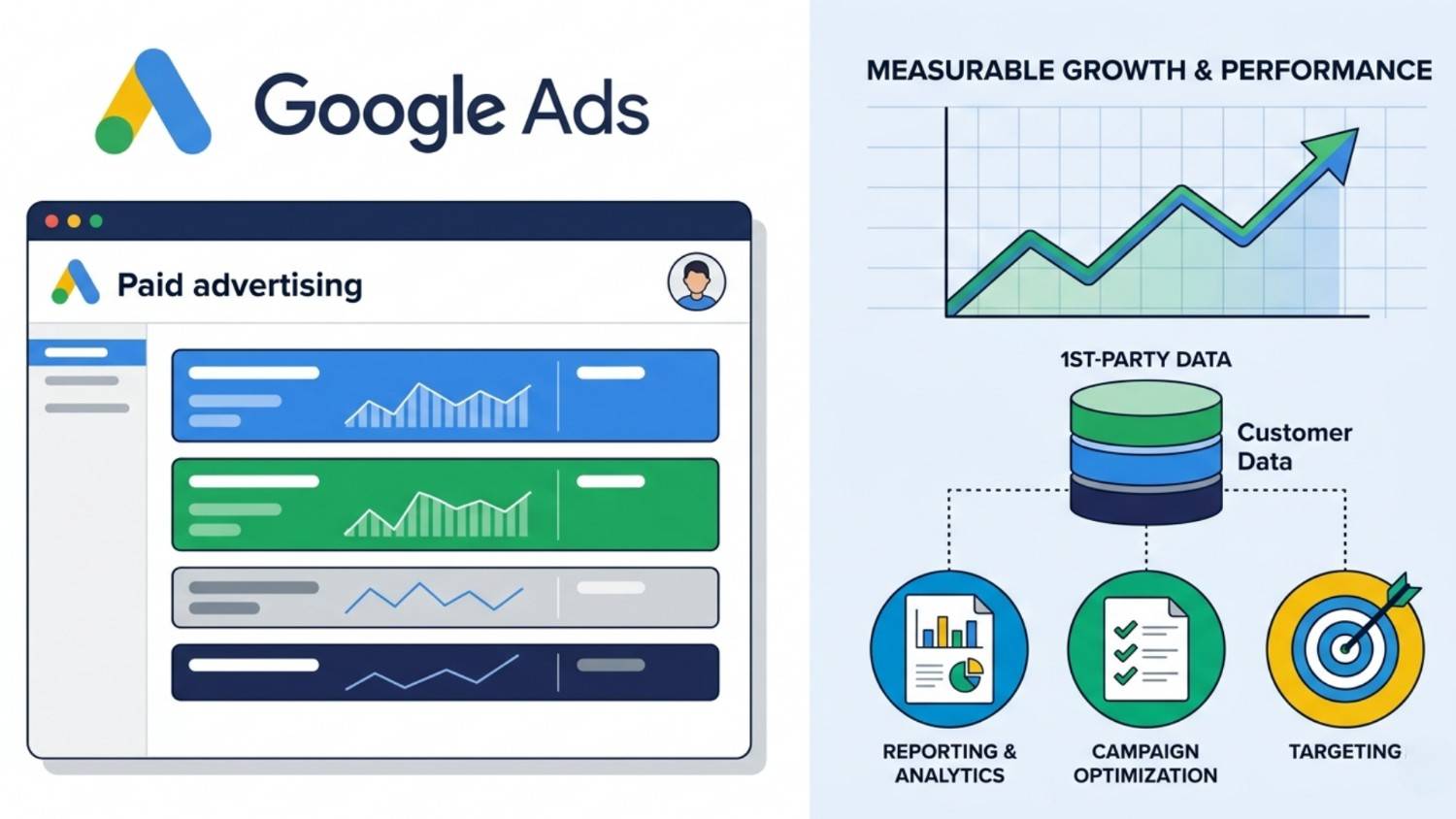
First-party data sitting in your CRM will not improve campaign performance on its own. You need the right setup to connect that data to Google Ads, guide the algorithm, and translate customer insights into better bidding and targeting decisions.
These three Google Ads features form the foundation of that connection.
Customer Match: Re-Engage Past Buyers and Build Accurate Lookalikes
Customer Match lets you upload hashed customer information, such as email addresses and phone numbers, into Google Ads. Google then matches those records to signed-in users so you can reach known customers across Search, YouTube, Display, and Gmail.
The real value comes from segmentation. When you upload a list of your highest-value customers, Google gets a more precise audience input for reaching people more likely to match your ideal buyer profile. Where eligible, customer lists can support audience expansion by helping Google identify users who share traits with your existing customers.
Effective pay-per-click services treat Customer Match as a core campaign input, not an optional add-on. List quality, audience segments, and update schedule all affect how well the system performs.
Enhanced Conversions: Give Google the Feedback It Actually Needs
Standard conversion tracking captures basic actions such as button clicks, form fills, or purchases. Enhanced Conversions improves that accuracy by securely hashing and sending first-party user data, such as an email address, when someone completes a lead form or transaction.
This improved data helps Google connect more conversions back to the ads that influenced them, giving the bidding system more accurate inputs during auction-time decisions. Enhanced Conversions supports data-driven attribution (DDA) as well, distributing conversion credit more accurately across the campaign path rather than assigning it all to the final click.
For PPC services built around measurable performance, Enhanced Conversions should be part of the standard setup. It moves your campaigns beyond basic click and form-fill tracking and gives the algorithm stronger, more complete feedback to learn from.
Offline Conversion Imports: Close the Loop Between Ads and Revenue
Many campaigns stop measuring success at the form fill or phone call. Offline Conversion Imports (OCI) close that gap by sending backend outcomes, such as qualified leads, closed deals, returned orders, or revenue values, back into Google Ads as conversion signals.
This matters because Google can only optimize for what it can measure. OCI data directly influences how Google’s automated bidding sets Cost Per Acquisition (CPA) and Return on Ad Spend (ROAS) targets, meaning the system calibrates its spend efficiency against your actual revenue, not just front-end actions. A PPC agency with the right process can help you map those offline outcomes correctly, so your campaigns optimize for revenue quality instead of raw lead volume.
Connecting CRM data to Google Ads often requires an integration layer. Tools like Salesforce, HubSpot’s native Google Ads integration, or platforms like Supermetrics can help automate the data transfer between your CRM and your Google Ads account, reducing manual work and improving data freshness.
ALSO READ: Google Local Service Ads Supporting Local SEO Growth
Why First-Party Data Becomes More Valuable With Every Campaign Cycle
First-party data grows more useful over time because every closed sale, qualified lead, repeat purchase, and CRM update gives Google Ads a clearer pattern to optimize against. A single data upload can support one campaign, but a consistent feedback loop lets your account keep learning from real business outcomes rather than resetting each time.
When your CRM and Google Ads account stay connected, your campaigns can use customer behavior, sales quality, and revenue outcomes as continuous inputs, making the system sharper with each meaningful customer interaction.
How Closed-Won Data Improves the Next Campaign Cycle
Closed-won data shows which leads became actual customers, not just which users clicked an ad or completed a form. When you feed that outcome back into Google Ads, your account gains a clearer picture of the searches, audiences, and campaign paths that produced real revenue.
This distinction matters because two leads can look identical at the form-fill stage but produce very different outcomes after sales follow-up. Closed-won data helps your campaigns learn from that difference, shifting budget toward the traffic patterns that actually close.
Your Data Cannot Be Copied or Shared with Competitors
Your competitors can bid on the same keywords, use similar ad formats, and target overlapping audiences. They cannot copy your customer data, your CRM history, or the conversion insights built inside your Google Ads account.
Google does not share your uploaded customer lists, CRM data, or conversion signals with other advertisers. What your account learns from your customers stays tied to your business. As your first-party data grows, your campaigns develop an account-specific advantage that competitors cannot close by simply increasing their ad spend.
LEARN MORE: PPC Ad Copy That Stands Out in Crowded Search Results
Ready to Turn Your Customer Data Into a Campaign Advantage?
Your CRM already holds valuable customer insights. The problem is that most Google Ads accounts do not connect that data to the bidding systems that can act on it. First-party data works best when your campaign structure supports it through Customer Match, value-based bidding, Enhanced Conversions, and Offline Conversion Imports.
If your current pay-per-click services are not using your customer data to improve targeting, bidding, and reporting, you may be leaving your strongest competitive signal unused. Schedule a free strategy session with The Ad Firm today and see how your data can start driving better results in your next campaign cycle.
Frequently Asked Questions
What is first-party data in Google Ads?
First-party data in Google Ads is information your business collects directly from customers and leads. This can include email addresses, phone numbers, purchase history, form submissions, and CRM records. You can use this data to build stronger audiences, improve conversion tracking, and help Google Ads optimize toward higher-value results.
How does Customer Match work in Google Ads?
Customer Match lets you upload customer contact information, such as emails and phone numbers, into Google Ads. Google matches that data to signed-in users so you can reach and re-engage your customers across eligible Google channels, including Search, YouTube, Gmail, Shopping, and Display.
What is Enhanced Conversions and why does it matter?
Enhanced Conversions improves conversion tracking by sending securely hashed first-party customer data to Google when someone converts. This helps Google Ads match more conversions to ad interactions, which supports better bidding decisions and more accurate budget allocation.
Is first-party data GDPR and CCPA compliant?
Yes, first-party data can support GDPR and CCPA compliance when your business collects it with proper consent and manages it correctly. Because this data comes from direct customer relationships, it gives you more control than third-party data from brokers or cross-site tracking networks.
How is first-party data different from third-party data?
First-party data comes from your own customers and business systems, while third-party data comes from outside sources your business does not control. First-party data is more reliable because it reflects your actual audience, sales activity, and customer relationships. A strong pay-per-click agency uses this data as a campaign foundation, not a backup input.
What should I look for in the best PPC agency for first-party data campaigns?
The best PPC agency for data-driven campaigns should know how to connect customer data directly to campaign performance. Look for hands-on setup experience with Customer Match, Enhanced Conversions, Offline Conversion Imports, and value-based bidding. These PPC services help your campaigns focus on the customer actions and revenue outcomes that matter most to your business.